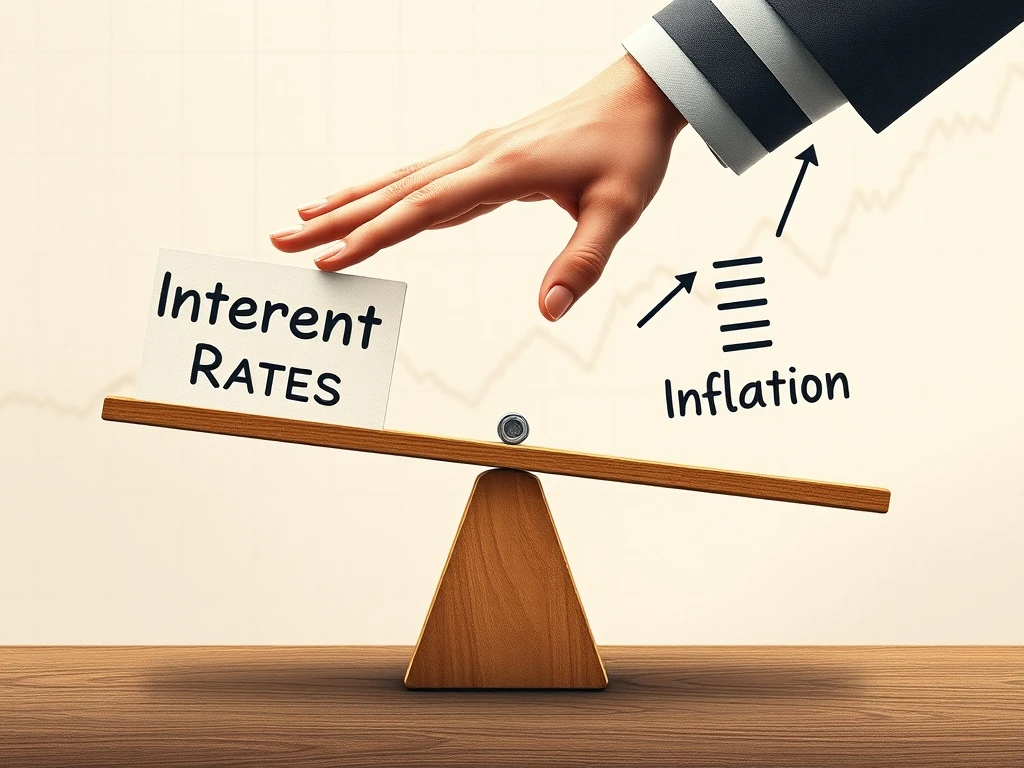
The world of cryptocurrency often reacts sharply to macroeconomic shifts. Therefore, understanding central bank policy is crucial for every investor. Recently, Chicago Federal Reserve President Austan Goolsbee delivered a significant warning. His insights shed light on the intricate relationship between interest rates, inflation, and global monetary policy. These factors profoundly impact the digital asset landscape.
Austan Goolsbee’s Critical Assessment of Interest Rates and Inflation
Austan Goolsbee, a prominent voice within the Federal Reserve, recently articulated a crucial perspective. He stated that holding interest rates steady amidst rising inflation effectively acts as an interest rate cut. This statement carries significant weight for economic observers and market participants alike. It implies that the central bank’s inaction can unintentionally loosen monetary conditions. Consequently, this could further fuel inflationary pressures rather than curb them. Goolsbee’s comments highlight a critical challenge facing policymakers today. They must navigate a complex economic landscape. Moreover, their decisions directly impact financial markets globally, including the volatile cryptocurrency sector. His assessment urges a proactive approach. It underscores the potential for passive policy to have active, unintended consequences on price stability.
Unpacking the Federal Reserve’s Monetary Policy Dilemma
The Federal Reserve typically employs monetary policy tools to manage economic stability. Specifically, it uses interest rate adjustments to control inflation. When inflation rises above its target, the Fed usually increases rates. This action aims to cool down the economy. It makes borrowing more expensive for consumers and businesses. Therefore, spending and investment often decrease. This helps to reduce aggregate demand and bring prices down. However, Goolsbee’s observation points to a different, more subtle scenario. If inflation accelerates while nominal interest rates remain unchanged, the ‘real’ interest rate actually falls. This real rate considers the impact of inflation on purchasing power. A lower real rate makes money effectively cheaper. Thus, it can inadvertently stimulate demand, counteracting anti-inflationary efforts. This situation significantly complicates the Fed’s efforts to achieve its dual mandate of maximum employment and price stability. It forces a re-evaluation of what ‘holding steady’ truly means in a dynamic economic environment.
The Far-Reaching Impact of Monetary Policy on Global Markets
Changes in monetary policy ripple through all financial markets, both traditional and nascent. Traditional assets like stocks and bonds react swiftly to Fed announcements and expectations. For instance, higher interest rates can make fixed-income assets, such as government bonds, more attractive. They offer better risk-free returns. Conversely, rising rates often pressure stock valuations. This happens as future corporate earnings become less valuable when discounted at higher rates. The cryptocurrency market also feels these effects profoundly. Bitcoin and other digital assets have shown sensitivity to macro indicators. When the Federal Reserve signals a hawkish stance, implying tighter monetary policy, crypto prices often experience declines. Conversely, expectations of looser policy, or a perceived ‘rate cut’ as Goolsbee describes, can sometimes boost crypto valuations. This correlation stems from crypto’s status as a risk asset. It also reflects its growing integration into the broader financial system. Therefore, Goolsbee’s warning has direct implications for crypto investors, influencing their risk assessments and investment strategies.
Real Interest Rates: A Key Indicator for Investors
The concept of real interest rates is vital for understanding economic incentives. It represents the nominal interest rate minus the rate of inflation. Goolsbee’s point is clear: if nominal rates stay flat while inflation climbs, real rates decline. A falling real interest rate environment can make holding cash less appealing. The purchasing power of money diminishes more rapidly. Consequently, investors often seek assets that might offer better inflation-adjusted returns. These often include riskier assets like growth stocks, commodities, or cryptocurrencies. This search for yield can drive capital flows. However, unchecked inflation also erodes overall purchasing power. It creates economic uncertainty and instability. This uncertainty can dampen overall market sentiment and consumer confidence. Therefore, the Fed must carefully manage real rates to maintain economic stability and foster sustainable growth. Austan Goolsbee emphasizes this delicate balance. He warns against complacency in the face of persistent inflationary pressures.
Historical Precedents and Strategic Considerations for the Federal Reserve
History offers valuable lessons regarding inflation and central bank responses. Periods of high inflation in the past, such as the 1970s, often required aggressive rate hikes to bring prices under control. Failure to act decisively can entrench inflationary expectations among consumers and businesses. This makes future control much harder and more painful. Goolsbee’s remarks serve as a proactive caution. They suggest the Fed must remain vigilant and responsive. Otherwise, it risks falling behind the curve, allowing inflation to become more persistent. Future monetary policy decisions will critically depend on incoming economic data. These include consumer price index (CPI) reports, producer price index (PPI) figures, and employment statistics. Investors should monitor these indicators closely. They provide crucial clues about the Federal Reserve’s next moves. Ultimately, achieving and sustaining price stability benefits all market participants. This includes those operating in the burgeoning and dynamic crypto space. The Fed’s credibility also hinges on its ability to manage inflation effectively.
Chicago Federal Reserve President Austan Goolsbee has articulated a significant concern. He argues that holding interest rates steady while inflation rises is akin to an implicit rate cut. This perspective highlights the ongoing challenge for the Federal Reserve. They must navigate complex economic dynamics with precision. Their monetary policy choices profoundly influence traditional and cryptocurrency markets alike. Consequently, investors must understand these nuanced relationships. Vigilance regarding inflation trends and central bank communications remains paramount for navigating future market volatility and making informed investment decisions. The stakes are high for global economic stability.
Frequently Asked Questions (FAQs)
Q1: What does Austan Goolsbee mean by “holding rates steady amid rising inflation is like a rate cut”?
A1: Austan Goolsbee, the Chicago Federal Reserve President, means that if the nominal interest rate remains unchanged while the rate of inflation increases, the “real” interest rate effectively decreases. A lower real interest rate makes borrowing cheaper and can stimulate economic activity, which is similar to the effect of an actual interest rate cut.
Q2: How does the Federal Reserve typically combat inflation?
A2: The Federal Reserve primarily combats inflation by increasing its benchmark interest rate, the federal funds rate. This action makes borrowing more expensive, which slows down economic activity, reduces demand, and ultimately helps to bring prices down.
Q3: Why are real interest rates important for investors?
A3: Real interest rates reflect the true return on an investment after accounting for inflation. When real rates are low or negative, the purchasing power of cash diminishes. This often encourages investors to seek higher returns in riskier assets, such as stocks, commodities, or cryptocurrencies, to protect their capital from inflation’s erosive effects.
Q4: How does the Fed’s monetary policy affect cryptocurrency markets?
A4: The Federal Reserve’s monetary policy significantly impacts cryptocurrency markets. Tighter policies (like higher interest rates) generally reduce investor appetite for risk, often leading to declines in crypto prices. Conversely, looser policies (or perceived rate cuts) can sometimes boost crypto valuations as investors seek alternative assets.
Q5: What are the potential risks if the Federal Reserve ignores rising inflation?
A5: If the Federal Reserve ignores rising inflation and keeps interest rates too low, it risks allowing inflation to become entrenched in the economy. This can lead to persistent price increases, erode purchasing power, create economic instability, and potentially necessitate more aggressive and disruptive policy actions later to bring inflation under control.
Related News
- TenX Protocols Secures Landmark $3.25M Tezos Partnership, Acquiring 5.54M XTZ for Strategic Staking
- Bitmine Ethereum Treasury Soars: Strategic 35,000 ETH Acquisition Cements Dominant Position
- Russian Crypto Mining Crackdown: Lawmakers Propose Stiff Fines for Illegal Operations