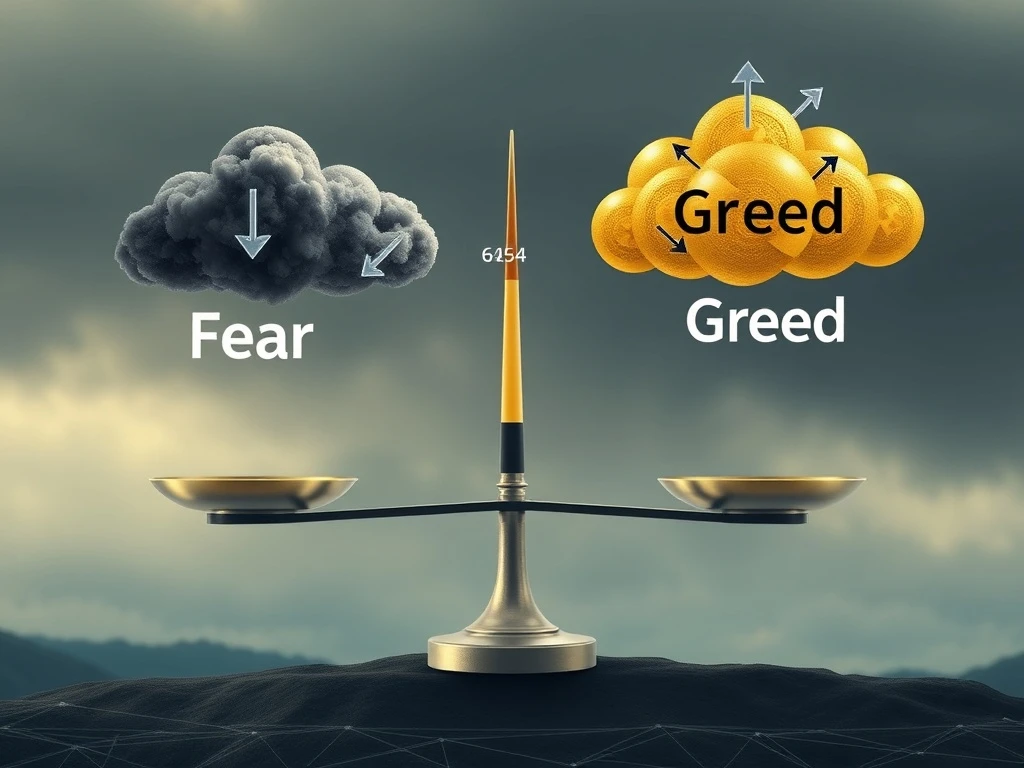
The cryptocurrency market is a dynamic environment. It often sees rapid shifts in investor sentiment. Recently, a significant change occurred. The Crypto Fear & Greed Index has surged. This movement indicates a notable shift in market psychology. Understanding this index helps investors gauge market mood.
The Crypto Fear & Greed Index: A Critical Overview
The Crypto Fear & Greed Index serves as a vital barometer. It measures current market sentiment. Data provider Alternative calculates this important metric. The index ranges from 0 (extreme fear) to 100 (extreme greed). A recent jump has caught many investors’ attention. The index moved from a neutral stage to ‘Greed.’ This indicates growing optimism among participants. It also reflects increased confidence in digital assets. Furthermore, this shift can influence short-term market dynamics.
The index recently reached 64. This marks a 15-point increase from the previous day. Such a rapid ascent often signals a change. Investors are clearly feeling more confident. They are perhaps more willing to take risks. This sentiment can drive further market activity. Consequently, prices might see upward pressure. However, understanding the components of this index is crucial. It provides deeper insight into its movements.
How the Crypto Fear & Greed Index Works
The index uses a blend of factors. These factors provide a comprehensive view of market sentiment. Each component carries a specific weighting. This ensures a balanced calculation. Here are the key elements:
- Volatility (25%): This measures current price fluctuations. It compares them to average values. High volatility often signals a fearful market. However, increasing volatility during an uptrend can suggest greed.
- Trading Volume (25%): High trading volumes in a rising market indicate strong buying pressure. This suggests greed. Conversely, low volumes can reflect fear or indecision.
- Social Media Mentions (15%): This factor analyzes social media discussions. It tracks specific hashtags and keywords. Increased positive mentions suggest optimism. Negative mentions, however, point to fear.
- Surveys (15%): These surveys gather direct investor opinions. They ask about future market expectations. This provides a direct measure of sentiment.
- Bitcoin’s Market Capitalization Dominance (10%): Bitcoin’s dominance reflects its share of the total crypto market. Rising dominance can indicate fear. Investors might move to safer assets like Bitcoin. Falling dominance often suggests a risk-on environment. Altcoins gain traction in such periods.
- Google Search Volume (10%): This tracks search queries related to cryptocurrencies. A surge in searches for terms like ‘Bitcoin price prediction’ or ‘buy crypto’ often indicates growing interest and potential greed.
Each of these factors contributes to the overall score. Together, they paint a clear picture. They show whether the market leans towards fear or greed. This composite approach makes the index a valuable tool.
Understanding ‘Greed’ in the Cryptocurrency Market
A reading of 64 falls squarely into the ‘Greed’ category. This stage typically ranges from 55 to 74. What does ‘Greed’ truly signify for the cryptocurrency market? Primarily, it suggests strong buying interest. Investors feel optimistic. They expect prices to rise further. This can lead to increased capital inflow. Moreover, it often fuels upward price momentum. People might fear missing out (FOMO). This drives them to buy. Consequently, prices can accelerate rapidly.
However, ‘Greed’ also carries a cautionary note. Historically, extreme greed can precede market corrections. When everyone is optimistic, a market might become overbought. This means prices could be unsustainably high. Therefore, investors should approach periods of high greed with caution. It is important to avoid impulsive decisions. Market tops often coincide with peak greed levels. Conversely, market bottoms often align with extreme fear.
Bitcoin’s Role in Shifting Investor Sentiment
Bitcoin remains the market leader. Its price movements heavily influence overall sentiment. When Bitcoin’s price rises, optimism spreads. This often pulls altcoins higher too. A strong Bitcoin performance boosts the entire market. It instills confidence in investors. Therefore, Bitcoin’s stability and growth are crucial. They directly impact the Fear & Greed Index. The index’s recent move to ‘Greed’ likely reflects Bitcoin’s recent price action. Furthermore, Bitcoin’s dominance can also play a role. A stable or rising dominance suggests investors trust Bitcoin. This is often seen as a sign of strength for the broader market. The current environment indicates robust interest in Bitcoin. This underpins the prevailing ‘Greed’ sentiment.
Conversely, a sharp drop in Bitcoin’s price can trigger fear. This quickly shifts the index downwards. Bitcoin’s role as a bellwether asset is undeniable. Its performance shapes investor perceptions. The current index reading suggests Bitcoin is performing well. It also indicates strong investor belief in its future trajectory. This positive outlook is a key driver for the entire crypto ecosystem.
Navigating the Market: Strategies During ‘Greed’
When the Crypto Fear & Greed Index signals ‘Greed,’ investors face a dilemma. Should they join the rally? Or should they exercise caution? Experienced traders often use this index as a contrarian indicator. This means they consider selling when the market is extremely greedy. They might consider buying when the market is extremely fearful. This strategy aims to capitalize on market extremes. However, it requires discipline and a long-term perspective.
For most investors, a ‘Greed’ reading suggests increased vigilance. Consider these points:
- Review your portfolio: Evaluate your current holdings. Are they aligned with your risk tolerance?
- Take profits: Consider taking partial profits on highly appreciated assets. This reduces risk exposure.
- Avoid FOMO: Resist the urge to buy assets solely because their prices are soaring. Do thorough research.
- Set stop-losses: Protect your investments by setting stop-loss orders. These limit potential losses.
- Diversify: Spread your investments across different assets. This mitigates risk.
Ultimately, the index is a tool, not a crystal ball. It provides valuable context. It helps investors understand prevailing market emotions. However, it should complement other analytical methods. Fundamental analysis and technical analysis remain crucial. They offer deeper insights into asset valuations. They also help identify potential entry and exit points. Combining these approaches leads to more informed decisions.
Historical Context and Future Implications for Investor Sentiment
Looking back, the Crypto Fear & Greed Index has provided useful signals. Periods of extreme greed often precede market tops. For example, during the 2021 bull run, the index frequently hit extreme greed levels (75+). These peaks were often followed by significant corrections. Similarly, periods of extreme fear (below 20) have historically marked excellent buying opportunities. The March 2020 crash, for instance, saw the index plunge to single digits. This presented a prime opportunity for long-term investors. Understanding these patterns helps contextualize current readings.
The current reading of 64 suggests strong positive momentum. However, it is not yet in the ‘extreme greed’ territory. This might indicate room for further growth. But it also warrants careful monitoring. The market could continue its upward trajectory. Or, it could consolidate or correct. Factors like macroeconomic news, regulatory developments, and institutional adoption will also play a role. Therefore, continuous observation of the index and broader market conditions is essential. Investors must remain agile. They must adapt their strategies as sentiment evolves. This ensures they can capitalize on opportunities. It also helps them mitigate potential risks.
Conclusion: Monitoring the Crypto Fear & Greed Index
The Crypto Fear & Greed Index moving to 64 marks a significant shift. It indicates growing optimism and ‘Greed’ within the cryptocurrency market. This reflects improving investor sentiment. While this is a positive sign for many, it also calls for prudence. The index serves as a powerful indicator of market psychology. It helps investors understand collective emotions. However, it is just one tool among many. Always combine it with comprehensive research. This includes fundamental and technical analysis. By doing so, investors can make more informed decisions. They can navigate the volatile crypto landscape effectively. This approach helps maximize potential gains. It also helps minimize potential losses. Stay informed and remain disciplined.
Frequently Asked Questions (FAQs)
Q1: What is the Crypto Fear & Greed Index?
The Crypto Fear & Greed Index is a tool that measures the current sentiment of the cryptocurrency market. It ranges from 0 (extreme fear) to 100 (extreme greed), calculated based on various market factors.
Q2: What does a ‘Greed’ reading on the index mean?
A ‘Greed’ reading, like 64, indicates that investors are becoming more optimistic and confident in the market. They expect prices to rise further, which can lead to increased buying activity and potential price surges. However, it also suggests caution as markets can become overbought.
Q3: How is the Crypto Fear & Greed Index calculated?
The index is calculated using six weighted factors: volatility (25%), trading volume (25%), social media mentions (15%), surveys (15%), Bitcoin’s market capitalization dominance (10%), and Google search volume (10%).
Q4: How should investors use the Crypto Fear & Greed Index?
Investors can use the index as a contrarian indicator, considering selling during extreme greed and buying during extreme fear. It’s a valuable tool for understanding market psychology but should be combined with other analytical methods like fundamental and technical analysis for well-rounded decision-making.
Q5: Does the index only apply to Bitcoin?
While Bitcoin’s market capitalization dominance is a component of the index and its price heavily influences overall sentiment, the Crypto Fear & Greed Index reflects the broader cryptocurrency market sentiment, not just Bitcoin.
Q6: Is a high ‘Greed’ score always bad for the market?
Not necessarily. A high ‘Greed’ score indicates strong buying interest and positive momentum. However, historically, extreme greed levels have often preceded market corrections, suggesting a need for caution and risk management rather than outright panic.
Related News
- Polymarket Portugal Ban: Shocking 48-Hour Shutdown Order Rocks Crypto Prediction Markets
- Trend Research’s Strategic $30M USDT Deposit to Binance Reveals Massive Ethereum Bet and $50M Unrealized Loss
- Bitcoin Hash Ribbons Indicator Reveals Crucial Buy Signal as Market Eyes $90,000 Threshold