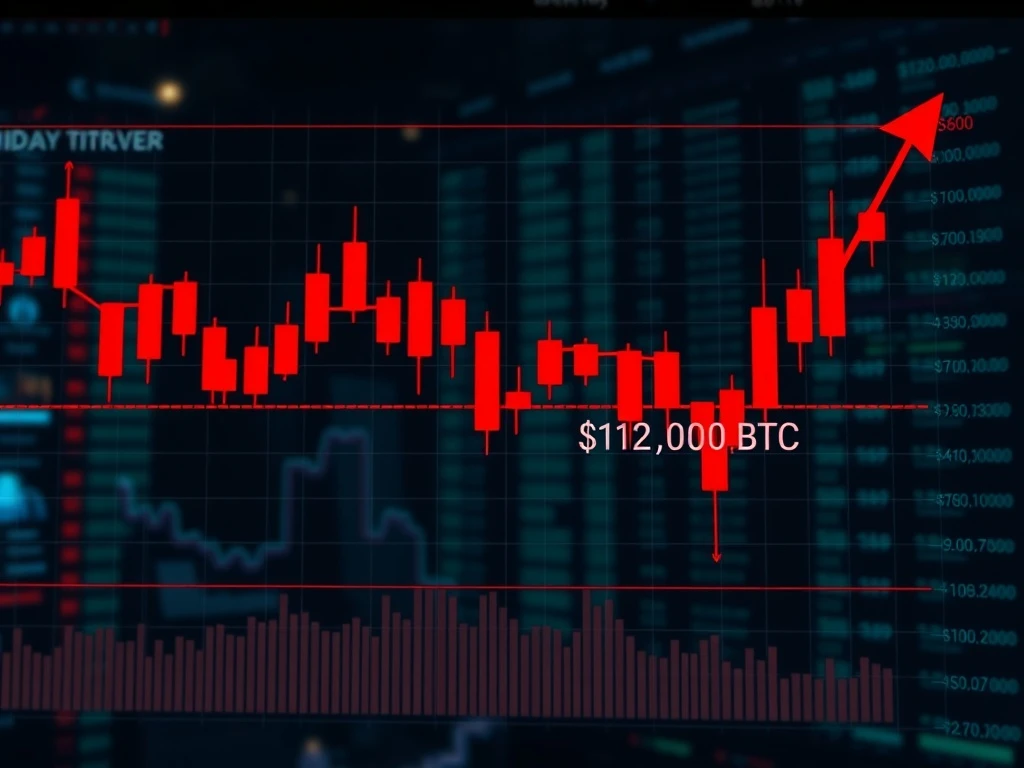
The cryptocurrency world is abuzz with recent developments. Specifically, a notable **Bitcoin price drop** has captured significant attention. Crypto News Room market monitoring confirms BTC has fallen below a crucial threshold. This immediate shift signals important movements within the broader **cryptocurrency market**.
Bitcoin Price Drop Explained: BTC Dips Below $122,000
According to recent market observations, Bitcoin (BTC) has experienced a significant downturn. Currently, BTC is trading at $121,982.4 on the Binance USDT market. This movement marks a dip below the $122,000 level, a figure many analysts closely monitor. This particular **Bitcoin price drop** represents more than just a numerical change; it often triggers broader reactions across the digital asset ecosystem. Investors and traders alike are now evaluating the potential implications of this shift. Understanding the context of such movements is vital for anyone engaged in **Bitcoin trading**.
Furthermore, this decline follows a period of fluctuating prices. Bitcoin, known for its dynamic nature, frequently exhibits such rapid changes. Therefore, this recent fall warrants a closer look into the factors at play. The $122,000 mark served as a psychological and technical support level for many. Its breach often suggests a shift in market sentiment. Traders frequently use such levels to inform their strategies. Consequently, the current price point below this level becomes a key data point for immediate analysis.
Unpacking the BTC Market Analysis: What Drove the Decline?
A comprehensive **BTC market analysis** often reveals multiple contributing factors to price movements. Several elements could be influencing the current **Bitcoin price drop**. Firstly, broader macroeconomic trends play a significant role. Global inflation concerns, interest rate hikes by central banks, and geopolitical tensions can all impact investor appetite for risk assets like Bitcoin. Investors often move funds from riskier assets to safer havens during periods of economic uncertainty. Secondly, specific cryptocurrency-related news might also contribute. Regulatory announcements, major exchange developments, or even significant whale movements can trigger substantial price swings. Finally, technical indicators themselves can lead to cascading effects. Breaking a key support level, for instance, often triggers automatic sell orders, accelerating a downward trend.
Moreover, the interplay of these factors creates a complex market environment. A single event rarely causes such a drop in isolation. Instead, it is usually a confluence of various influences. Therefore, a thorough **BTC market analysis** requires examining these interconnected elements. Understanding these drivers helps market participants anticipate future movements. It also provides crucial context for short-term price action. Ultimately, the market reacts to a blend of fundamental, technical, and psychological forces.
Global Economic Headwinds and the Cryptocurrency Market
Global economic conditions exert considerable influence over the **cryptocurrency market**. For instance, rising inflation rates in major economies can prompt central banks to tighten monetary policy. Higher interest rates typically make traditional investments, such as bonds, more attractive. This shift can draw capital away from speculative assets like cryptocurrencies. Furthermore, geopolitical events introduce uncertainty. Such events often lead to a decrease in risk-taking behavior among investors. Consequently, the demand for volatile assets like Bitcoin may diminish.
In addition, the correlation between Bitcoin and traditional financial markets has grown. Bitcoin once moved largely independently. However, it now often mirrors movements in equity markets, particularly tech stocks. Therefore, when traditional markets face headwinds, the **cryptocurrency market** frequently follows suit. This interconnectedness means that understanding global economic trends is increasingly essential for crypto investors. It provides valuable insight into potential market directions. Therefore, monitoring these broader economic indicators is crucial for informed decision-making.
Navigating Bitcoin Trading in Volatile Conditions
Engaging in **Bitcoin trading** requires a robust strategy, especially during periods of high **market volatility**. A sudden **Bitcoin price drop** can present both risks and opportunities. Traders must first prioritize risk management. Setting stop-loss orders helps limit potential losses if the price continues to fall. Moreover, avoiding emotional decisions is paramount. Panic selling often leads to unfavorable outcomes. Instead, maintaining a disciplined approach is crucial. Many experienced traders advocate for dollar-cost averaging (DCA). This strategy involves investing a fixed amount regularly, regardless of the price. DCA can mitigate the impact of price swings over time.
Furthermore, understanding market sentiment becomes vital. Fear and Greed Index readings can offer insights into the prevailing mood. A high ‘fear’ reading, for example, might indicate potential overselling. Conversely, excessive ‘greed’ can signal an impending correction. Therefore, combining technical analysis with sentiment indicators provides a more holistic view. Diversifying portfolios also helps manage risk. While focusing on Bitcoin, considering other assets can cushion the impact of a single asset’s decline. Ultimately, successful **Bitcoin trading** in volatile markets hinges on preparation and adherence to a well-defined plan.
Understanding Market Volatility: A Constant in Crypto
The concept of **market volatility** is inherent to the cryptocurrency space. Bitcoin, in particular, has a history of dramatic price swings. This characteristic stems from several factors. Firstly, the relatively smaller market capitalization compared to traditional assets means that large trades can have a disproportionate impact. Secondly, the 24/7 nature of crypto markets allows for continuous price discovery, unlike traditional markets with defined trading hours. Thirdly, the rapid pace of technological innovation and regulatory changes introduces elements of uncertainty. These factors collectively contribute to Bitcoin’s reputation as a volatile asset.
Consequently, investors must recognize that **market volatility** is not an anomaly but a standard feature of the **cryptocurrency market**. While it can lead to significant gains, it also carries substantial risks. Therefore, a clear understanding of one’s risk tolerance is essential. Education about market cycles and historical price patterns can also help. Many long-term investors view dips, even a significant **Bitcoin price drop**, as opportunities. They believe in the underlying technology and long-term potential of Bitcoin. Therefore, adapting investment strategies to embrace, rather than fear, volatility is often key.
The Road Ahead: Future Outlook for Bitcoin
The future outlook for Bitcoin remains a subject of intense debate and analysis. Despite the recent **Bitcoin price drop**, many analysts maintain a long-term bullish perspective. They point to increasing institutional adoption, ongoing technological developments like the Lightning Network, and Bitcoin’s role as a store of value. However, short-term predictions are inherently challenging due to the inherent **market volatility**. Key resistance and support levels will be crucial to watch in the coming weeks. A sustained move above $125,000, for example, could signal a potential recovery. Conversely, further dips could test lower support zones.
Moreover, the regulatory landscape continues to evolve globally. Clearer regulations could bring more stability and institutional investment. However, restrictive policies could dampen enthusiasm. Therefore, staying informed about regulatory developments is vital for anyone in the **cryptocurrency market**. Ultimately, Bitcoin’s trajectory will depend on a complex interplay of market sentiment, macroeconomic conditions, and continued adoption. While the current price action demands attention, the long-term narrative for Bitcoin often focuses on its transformative potential. Investors should remain vigilant and base decisions on thorough **BTC market analysis** rather than immediate emotional reactions.
Conclusion
The recent **Bitcoin price drop** below $122,000 highlights the dynamic nature of the **cryptocurrency market**. This movement, observed on the Binance USDT market, underscores the constant **market volatility** inherent in digital assets. While such declines can trigger concern, they are a regular feature of Bitcoin’s journey. A comprehensive **BTC market analysis** reveals various influencing factors, from global economics to specific market mechanics. For those engaged in **Bitcoin trading**, understanding these elements and adopting disciplined strategies are crucial. The path ahead for Bitcoin will undoubtedly involve further fluctuations, yet its fundamental role in the digital economy continues to evolve.
Frequently Asked Questions (FAQs)
Q1: What does the Bitcoin price drop below $122,000 signify?
A1: A **Bitcoin price drop** below $122,000 indicates a breach of a significant technical and psychological support level. This often suggests a shift in short-term market sentiment and can trigger further downward pressure as stop-loss orders are activated.
Q2: What factors typically contribute to such a significant BTC market movement?
A2: Several factors can contribute to a notable **Bitcoin price drop**. These include broader macroeconomic concerns (like inflation or interest rate hikes), regulatory news, large-scale liquidations, shifts in investor sentiment, and technical chart patterns indicating weakness. A comprehensive **BTC market analysis** usually points to a combination of these elements.
Q3: How does market volatility impact Bitcoin trading strategies?
A3: **Market volatility** significantly impacts **Bitcoin trading** by increasing both potential gains and losses. Traders often adjust strategies by implementing stricter risk management (e.g., stop-loss orders), considering dollar-cost averaging, and paying closer attention to market sentiment indicators to navigate the rapid price swings effectively.
Q4: Is this Bitcoin price drop unique, or is market volatility common in the cryptocurrency market?
A4: This **Bitcoin price drop** is not unique. **Market volatility** is a common and inherent characteristic of the **cryptocurrency market**. Bitcoin has a history of dramatic price swings, often experiencing significant percentage changes in short periods due to its relatively smaller market cap, 24/7 trading, and evolving regulatory landscape.
Q5: What should investors do during periods of Bitcoin price drops?
A5: During a **Bitcoin price drop**, investors should prioritize a disciplined approach. This often means avoiding emotional decisions, reviewing their original investment thesis, and considering strategies like dollar-cost averaging. For those with a long-term perspective, such dips can sometimes be viewed as opportunities to accumulate more Bitcoin at a lower price, provided their risk tolerance allows.
Related News
- STKESOL Launch: SOL Strategies’ Revolutionary Liquid Staking Token Transforms Solana DeFi Landscape
- Supreme Court Trump Tariffs: Treasury Secretary Reveals Stunning Confidence in Policy Survival
- Trump Media Token Distribution: Groundbreaking Shareholder Initiative Launches via Crypto.com on February 2