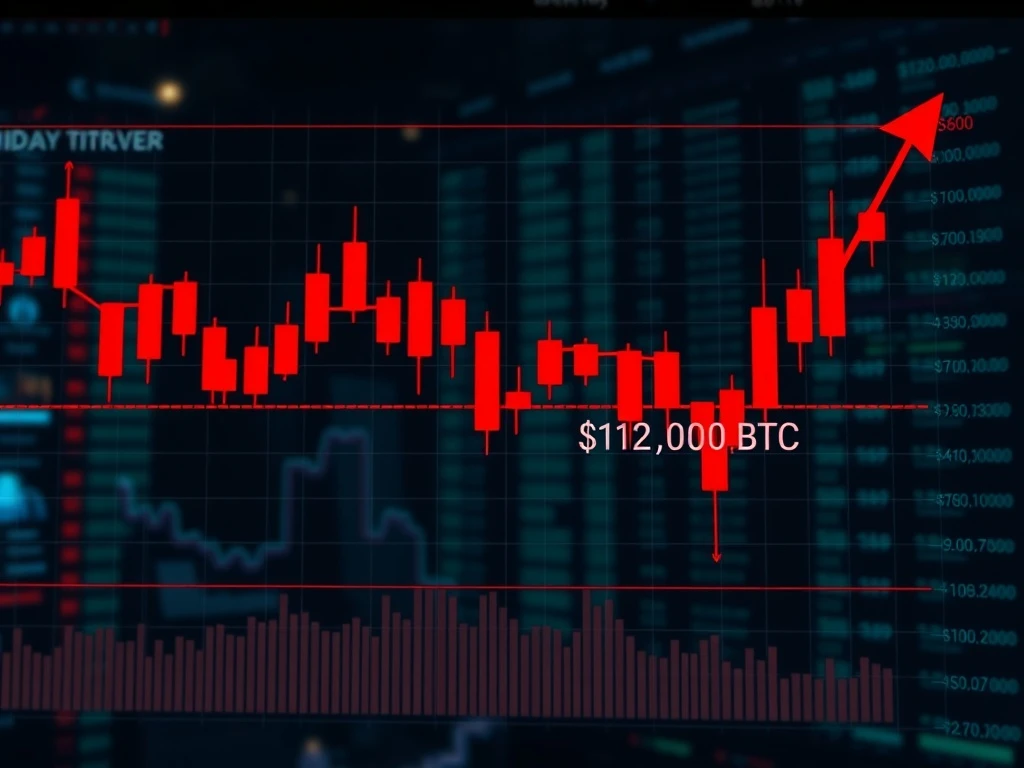
The cryptocurrency market experienced a significant shift recently. An urgent Bitcoin price drop saw the leading digital asset fall below the crucial $113,000 mark. This movement has sparked immediate concern and discussion among investors and analysts worldwide. According to Crypto News Room market monitoring, Bitcoin (BTC) is now trading at $112,923.08 on the Binance USDT market. Such fluctuations are not uncommon in the dynamic world of digital currencies. However, this particular drop warrants a closer look at its potential causes and broader implications for the market.
Understanding the Immediate Impact of the BTC Market Analysis
The sudden descent of Bitcoin below $113,000 has triggered a wave of reactions across the global financial landscape. Initially, this sharp decline led to increased selling pressure, as some traders moved to secure profits or minimize potential losses. Furthermore, the specific price point of $112,923.08 on the Binance USDT market highlights the precise nature of this recent movement. This specific data point offers a real-time snapshot of the market’s current sentiment. Traders often monitor these specific levels closely. They use them to inform their short-term strategies. For many, a drop below a significant psychological or technical level, such as $113,000, can signal further downward momentum. Consequently, this can influence trading decisions for a wide range of participants. Our ongoing BTC market analysis indicates a period of heightened caution.
Moreover, the immediate impact extends beyond just the price. Trading volumes often surge during periods of high volatility. This indicates increased market activity. Liquidation events for leveraged positions can also occur, adding to the downward pressure. Therefore, understanding these immediate effects is crucial for anyone participating in the crypto space. It helps investors react prudently. It also allows them to assess potential risks more effectively. This sudden price action often creates opportunities for both buyers and sellers. However, it also demands careful consideration and strategic planning.
Deciphering Cryptocurrency Volatility and Its Drivers
Cryptocurrency volatility remains a defining characteristic of the digital asset market. Unlike traditional financial assets, cryptocurrencies often experience rapid and substantial price swings. Several factors contribute to this inherent instability. Firstly, the market’s relatively smaller size compared to global stock or bond markets means that large trades, often by ‘whales’ (individuals or entities holding significant amounts of crypto), can have a disproportionate impact on prices. Secondly, the 24/7 nature of crypto trading, without the closing bells of traditional exchanges, allows for continuous price discovery and reaction to news. This constant activity can amplify movements.
Additionally, regulatory uncertainty plays a significant role. Different countries adopt varying stances on cryptocurrency, from outright bans to embracing innovation. These shifting landscapes create an environment of unpredictability. Furthermore, technological developments and security breaches can also sway market sentiment dramatically. For instance, a major hack on an exchange or a breakthrough in blockchain technology can cause immediate price reactions. Understanding these underlying drivers helps investors contextualize current price movements. It also aids in developing a more resilient investment approach. Investors must acknowledge this inherent volatility. They should prepare for it. They must also learn to navigate it successfully.
Key Factors Shaping Current Digital Asset Trends
The broader economic environment significantly influences digital asset trends. Global macroeconomic factors, such as inflation rates, interest rate adjustments by central banks, and geopolitical tensions, often dictate investor appetite for risk assets. When inflation rises, investors might seek safe havens. Conversely, when interest rates increase, traditional investments might become more attractive. This can divert capital away from cryptocurrencies. Recent global economic uncertainties have certainly contributed to the cautious sentiment observed across financial markets, including crypto.
Furthermore, the ongoing evolution of regulatory frameworks worldwide continues to shape market dynamics. Clarity or lack thereof from governments regarding crypto taxation, classification, and trading rules can introduce significant shifts. Institutional adoption also plays a vital role. As more large financial institutions, corporations, and even sovereign states show interest in or integrate digital assets, it can lend credibility and stability to the market. However, any perceived slowdown in this adoption can also trigger negative sentiment. Finally, technological advancements within the blockchain ecosystem, such as upgrades to network infrastructure or the emergence of new decentralized applications (dApps), also drive long-term trends. These innovations promise greater utility and efficiency. However, they also introduce new complexities and risks. Monitoring these diverse factors is essential for anticipating future market movements.
In-Depth BTC Market Analysis and Investor Sentiment
A comprehensive BTC market analysis involves looking beyond immediate price charts. It requires examining underlying data and understanding collective investor psychology. On-chain metrics, for instance, provide invaluable insights into network activity. These include:
- Active Addresses: Indicates the number of unique addresses involved in transactions, signaling network usage.
- Exchange Inflows/Outflows: Large inflows to exchanges can suggest an intent to sell, while outflows often indicate accumulation.
- Miner Behavior: Miners selling large portions of their holdings can signal financial pressure or a bearish outlook.
Technical analysis also plays a crucial role. Traders use various indicators to predict future price movements. Common tools include moving averages, the Relative Strength Index (RSI), and Bollinger Bands. These help identify potential support and resistance levels. Moreover, investor sentiment, often gauged by the Crypto Fear & Greed Index, provides a snapshot of the market’s emotional state. High fear can lead to panic selling. High greed can signal an overheated market. During the recent price drop, sentiment likely shifted towards fear. This collective emotional response can amplify market movements. Understanding these components is vital for making informed decisions. It moves beyond simple price observation. It delves into the deeper mechanics of market behavior.
Navigating the Current Crypto News Landscape
The sheer volume of crypto news can be overwhelming. Investors must learn to filter reliable information from speculation and misinformation. Reputable news sources, expert analysis, and on-chain data platforms are crucial tools. During periods of price volatility, the market often becomes a breeding ground for FUD (Fear, Uncertainty, and Doubt). Therefore, critical thinking is paramount. Always verify information from multiple credible sources. Do not make impulsive decisions based on sensational headlines alone. Furthermore, understanding the difference between short-term noise and long-term trends is essential. A single news event might cause a temporary dip. However, it may not alter Bitcoin’s fundamental value proposition over an extended period. Developing a structured approach to consuming news helps in maintaining a clear perspective. It prevents emotional reactions from dictating investment choices. Always prioritize factual reporting and expert insights over speculative rumors.
Strategies for Investors Amidst Price Fluctuations
Navigating significant price drops requires a disciplined approach. Investors can employ several strategies to mitigate risk and potentially capitalize on market movements. Firstly, Dollar-Cost Averaging (DCA) is a popular method. This involves investing a fixed amount of money at regular intervals, regardless of the asset’s price. Consequently, investors buy more when prices are low and less when prices are high. This strategy reduces the impact of volatility. Secondly, setting stop-loss orders can protect capital. A stop-loss order automatically sells an asset if its price falls to a predetermined level. This limits potential losses. Thirdly, diversification across different cryptocurrencies and asset classes can spread risk. Relying solely on one asset, even Bitcoin, can expose an investor to greater volatility. Furthermore, maintaining a long-term perspective is often beneficial. Historically, Bitcoin has recovered from numerous significant price corrections. This resilience suggests that short-term drops may be part of a larger growth trajectory. Finally, only invest what you can afford to lose. This fundamental principle of risk management applies universally. It is particularly important in the volatile crypto market. These strategies help build a more robust investment portfolio.
Historical Precedents and What They Tell Us About Bitcoin Price Drop Events
A look back at Bitcoin’s history reveals a pattern of significant price corrections followed by remarkable recoveries. The current Bitcoin price drop, while concerning for some, is not an isolated event. For instance, in 2018, Bitcoin plummeted from nearly $20,000 to around $3,000, a decline of over 80%. Similarly, in 2021, after reaching an all-time high, BTC experienced a substantial correction. Yet, each time, the digital asset demonstrated resilience. It eventually surpassed previous peaks. These historical precedents offer valuable lessons. They suggest that strong underlying fundamentals and growing adoption often drive long-term value. Market cycles are a natural part of any asset’s journey. Bitcoin’s ability to bounce back reinforces its position as a leading digital store of value. Therefore, understanding these historical patterns can help investors maintain perspective. It can also prevent panic during downturns. The technology and community supporting Bitcoin continue to evolve. This strengthens its foundation despite short-term fluctuations. This historical context provides a crucial backdrop for current market events.
The Broader Ecosystem: Altcoins and Market Contagion
Bitcoin’s movements often act as a bellwether for the broader cryptocurrency market. When Bitcoin experiences a significant drop, altcoins typically follow suit. This phenomenon is known as ‘market contagion.’ Bitcoin’s dominance, which measures its market capitalization relative to the total crypto market, plays a crucial role here. A high Bitcoin dominance often means altcoins are more sensitive to BTC’s price action. Conversely, during periods of strong altcoin performance, Bitcoin dominance might decrease. The recent price drop likely caused a ripple effect. Many altcoins saw their values decline as well. Investors often de-risk during downturns. They move capital from smaller, more volatile altcoins back into Bitcoin or stablecoins. This flight to safety can exacerbate altcoin losses. Therefore, understanding Bitcoin’s influence is vital for altcoin investors. It helps them anticipate broader market movements. It also aids in managing their diversified portfolios more effectively. The interconnectedness of the crypto ecosystem means that few assets are truly immune to Bitcoin’s gravitational pull. Monitoring Bitcoin’s health provides insights into the overall market’s stability.
The recent urgent Bitcoin price drop below $113,000 serves as a stark reminder of the inherent volatility in the cryptocurrency market. While such movements can be unsettling, they are a fundamental aspect of digital asset trading. Informed decision-making, based on thorough BTC market analysis and a clear understanding of cryptocurrency volatility, remains paramount. Staying updated with reliable crypto news and recognizing broader digital asset trends are crucial for navigating these challenging periods. As the market continues to evolve, a disciplined and long-term perspective will serve investors best.
Frequently Asked Questions (FAQs)
Q1: What caused the recent Bitcoin price drop below $113,000?
A1: The exact causes of specific price movements are often multifaceted. However, factors contributing to recent drops can include global macroeconomic concerns (like inflation or interest rate hikes), regulatory uncertainty, significant sell-offs by large holders (‘whales’), or broader market sentiment shifts. Our BTC market analysis indicates a combination of these elements likely played a role.
Q2: Is this a normal level of cryptocurrency volatility for Bitcoin?
A2: Yes, cryptocurrency volatility is a well-known characteristic of the Bitcoin market. Bitcoin has experienced numerous significant price corrections throughout its history, often followed by periods of recovery and new all-time highs. This recent drop, while substantial, falls within historical patterns of market fluctuation.
Q3: What should investors do during a Bitcoin price drop?
A3: During a Bitcoin price drop, investors typically consider several strategies. These include dollar-cost averaging (DCA), which involves buying fixed amounts regularly to average out the purchase price; setting stop-loss orders to limit potential losses; and diversifying their portfolios. Maintaining a long-term perspective and avoiding impulsive decisions based on emotion are also crucial.
Q4: How do global economic factors influence digital asset trends?
A4: Global economic factors, such as inflation, interest rates, and geopolitical stability, significantly influence digital asset trends. When traditional markets face uncertainty or interest rates rise, investors may become more risk-averse, potentially leading to capital outflows from cryptocurrencies. Conversely, some see Bitcoin as a hedge against inflation, influencing its demand during specific economic conditions.
Q5: Where can I find reliable crypto news and analysis?
A5: To find reliable crypto news and analysis, focus on established cryptocurrency news outlets, reputable financial news sources that cover crypto, and platforms that provide on-chain data and expert market commentary. Always cross-reference information and be wary of sensational or unverified claims, especially during volatile market periods.
Q6: Will Bitcoin recover from this price drop?
A6: While no one can predict the future with certainty, Bitcoin has historically demonstrated resilience, recovering from numerous significant price drops over its existence. Its long-term trajectory has generally been upward, driven by increasing adoption, technological advancements, and a growing ecosystem. However, recovery timelines can vary significantly.
Related News
- Bitcoin Crash Warning: Peter Schiff’s Dire Prediction as Dollar Collapse Fears Intensify
- Bitcoin Holders Capitulate: Unprecedented 30-Day Loss-Selling Streak Sparks Market Analysis
- Pump.fun Launches Ambitious $3 Million Fund to Revolutionize Memecoin Startup Ecosystem