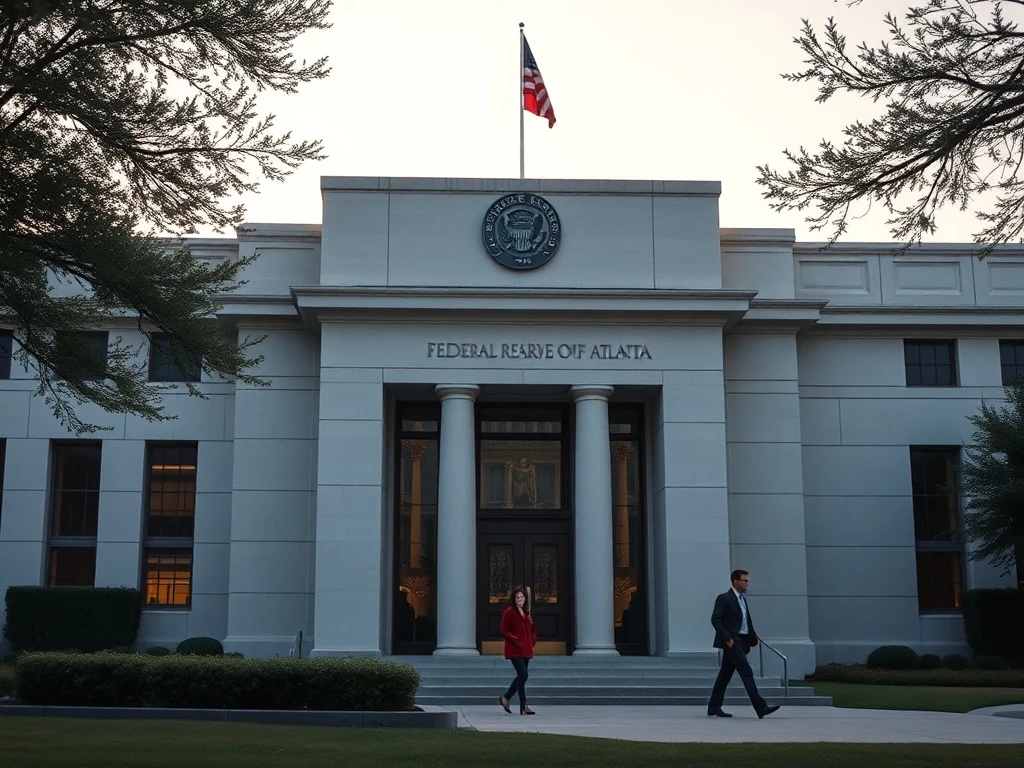
In a significant development for U.S. monetary policy leadership, Atlanta Federal Reserve Bank President Raphael Bostic will retire on February 28, 2025, marking the end of his current term and prompting immediate questions about the Federal Reserve’s future direction. The announcement, confirmed by official sources on Tuesday, reveals that First Vice President Cheryl Venable will assume the role of interim president, creating a pivotal transition moment for one of America’s most influential regional Federal Reserve banks.
Atlanta Fed President Retirement Timeline and Immediate Implications
The Federal Reserve Bank of Atlanta confirmed Raphael Bostic’s retirement plans through official channels yesterday. Consequently, the institution will undergo a leadership transition at a critical juncture for monetary policy. Bostic, who assumed the presidency in June 2017, has served during one of the most turbulent economic periods in recent history. His tenure spanned the pre-pandemic expansion, the COVID-19 crisis response, and the subsequent inflation battle.
Cheryl Venable, currently First Vice President and Chief Operating Officer, will serve as interim president beginning March 1, 2025. The Atlanta Fed’s board of directors will immediately commence a national search for a permanent successor. This transition occurs as the Federal Reserve System continues navigating complex economic challenges including:
- Inflation management toward the 2% target
- Interest rate normalization following aggressive tightening
- Financial stability monitoring amid geopolitical tensions
- Employment market rebalancing post-pandemic
Raphael Bostic’s Legacy and Federal Reserve Contributions
Raphael Bostic brought unique perspectives to the Federal Open Market Committee throughout his tenure. As the first African American to lead a regional Federal Reserve bank, his career path included academic positions at the University of Southern California and government roles at the Department of Housing and Urban Development. During his leadership, Bostic consistently emphasized several policy priorities:
| Policy Area | Bostic’s Emphasis | Notable Contributions |
|---|---|---|
| Housing Markets | Affordability and access | Research on racial disparities in housing |
| Labor Economics | Inclusive employment | Analysis of skills gaps in Southeast |
| Digital Currency | Careful innovation | Atlanta Fed’s digital dollar research |
| Climate Risk | Financial system resilience | Supervisory guidance development |
Market analysts immediately noted Bostic’s retirement announcement. Specifically, they highlighted his recent voting patterns on the FOMC. Throughout 2023 and 2024, Bostic generally supported Chairman Jerome Powell’s approach to inflation control. However, he occasionally expressed more cautious views about the pace of interest rate increases.
Expert Analysis of Leadership Transition Timing
Monetary policy experts emphasize the significance of this transition timing. The Federal Reserve currently faces delicate balancing acts between inflation control and economic growth preservation. According to historical Federal Reserve leadership patterns, regional bank president transitions typically require six to nine months for permanent replacements. Therefore, the interim leadership period under Cheryl Venable could extend through much of 2025.
Former Federal Reserve officials note that regional bank presidents bring diverse regional economic perspectives to FOMC deliberations. The Atlanta Fed’s district covers the Sixth Federal Reserve District, including Alabama, Florida, Georgia, and parts of Louisiana, Mississippi, and Tennessee. This region has experienced significant economic transformation recently, particularly in technology migration and manufacturing expansion.
Cheryl Venable’s Background and Interim Leadership Expectations
Cheryl Venable brings substantial Federal Reserve System experience to her interim role. She joined the Atlanta Fed in 2018 after serving at the Federal Reserve Bank of Richmond. Her career includes extensive operations management and payments system expertise. During her tenure as First Vice President, Venable oversaw several critical functions:
- Banking supervision and regulatory compliance
- Financial services operations for the Southeast
- Technology infrastructure modernization initiatives
- Research department coordination and budgeting
Federal Reserve observers expect continuity during the interim period. Venable has participated in FOMC meetings as an alternate for Bostic previously. Consequently, she understands current policy debates thoroughly. The Atlanta Fed’s research agenda will likely continue focusing on regional economic monitoring, particularly regarding:
First, supply chain developments in Southeastern ports. Second, labor market dynamics in growing metropolitan areas. Third, housing affordability challenges across the district. Fourth, climate-related economic risks specific to coastal regions.
Federal Reserve Leadership Landscape in 2025
The Atlanta Fed transition occurs amid broader Federal Reserve leadership considerations. Several regional bank presidents have reached or will approach retirement eligibility in coming years. This natural turnover creates opportunities for demographic and professional diversity within the Federal Reserve System. The selection process for permanent successors typically involves:
Initially, the Atlanta Fed’s board of directors forms a search committee. Subsequently, they engage executive search firms for national candidate identification. Then, they conduct extensive interviews and background checks. Finally, they submit recommendations to the Federal Reserve Board of Governors in Washington for approval.
Historical precedent suggests several potential candidate profiles. Often, selections come from within the Federal Reserve System. Alternatively, candidates emerge from academic economics departments. Sometimes, financial industry leaders receive consideration. Regardless of background, successful candidates must demonstrate:
- Monetary policy expertise and economic research capability
- Regional economic understanding of the Southeast
- Leadership experience in complex organizations
- Communication skills for public explanation of policy
Market and Economic Policy Implications
Financial markets generally view Federal Reserve leadership transitions as neutral events when planned appropriately. The announced timeline allows for orderly succession planning. However, analysts will monitor several specific implications. Monetary policy continuity remains the primary concern. The Atlanta Fed president rotates into FOMC voting membership periodically.
Bostic’s next scheduled voting year would have been 2026. Therefore, his retirement timing minimizes immediate FOMC composition changes. The permanent successor will assume voting responsibilities according to the established rotation schedule. Regional economic representation maintains importance. The Southeast has emerged as a national economic growth engine recently.
Conclusion
The Atlanta Fed President retirement announcement marks a significant leadership transition within the Federal Reserve System. Raphael Bostic’s departure in February 2025 concludes an eight-year tenure characterized by thoughtful policy contributions and regional economic advocacy. Cheryl Venable’s interim leadership ensures continuity during the succession process. This Atlanta Fed President retirement occurs amid complex monetary policy challenges, making the permanent successor selection particularly consequential for future economic stability and growth.
FAQs
Q1: When exactly will Raphael Bostic retire as Atlanta Fed President?
Raphael Bostic will retire on February 28, 2025, when his current term officially ends, according to the Federal Reserve Bank of Atlanta’s announcement.
Q2: Who will lead the Atlanta Fed immediately after Bostic’s retirement?
Cheryl Venable, currently First Vice President and Chief Operating Officer, will serve as interim president beginning March 1, 2025, while the board searches for a permanent successor.
Q3: How does this retirement affect Federal Reserve interest rate decisions?
The retirement timing minimizes immediate FOMC impact since Bostic wasn’t scheduled to vote in 2025, and interim leadership typically maintains existing policy approaches during transitions.
Q4: What was Raphael Bostic’s most significant contribution to monetary policy?
Bostic consistently emphasized inclusive economic growth, housing affordability research, and careful digital currency exploration while providing important Southeast regional perspectives to FOMC deliberations.
Q5: How long will the interim leadership period likely last?
Federal Reserve regional bank president searches typically require six to nine months, suggesting Cheryl Venable may serve as interim president through much of 2025 before a permanent appointment.
Related News
- A16z Crypto Predictions 2026: Three Groundbreaking Forecasts That Will Reshape Digital Finance
- Monero Shatters 8-Year Record: Privacy Coin Soars Past $650 Amid Regulatory Shifts
- OKX FOGO Listing: Strategic Expansion Adds Spot Trading for Emerging Digital Asset