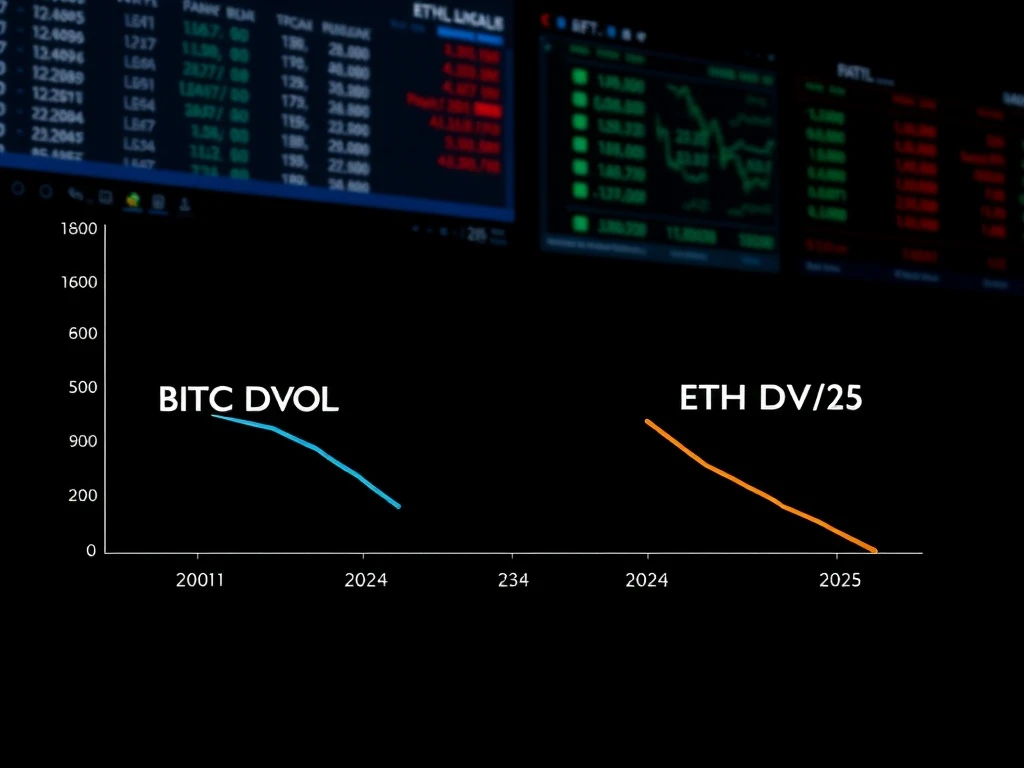
Global cryptocurrency markets are experiencing a remarkable shift toward stability as Bitcoin and Ethereum options markets reveal plunging short-term volatility metrics, reaching levels not seen in years despite facing significant macroeconomic headwinds. According to data from leading crypto derivatives exchange Deribit, the 30-day implied volatility index for Bitcoin (DVOL) has dropped to 40, marking its lowest point since October 2025, while Ethereum’s equivalent metric has fallen to 60, reaching a nadir not witnessed since September 2024. This development suggests that sophisticated investors are pricing in reduced expectations for sharp market movements in the near term, even as traditional risk factors including geopolitical tensions, slowing ETF demand, and a strengthening U.S. dollar continue to influence broader financial markets.
Understanding the Volatility Plunge in Crypto Options
Implied volatility represents the market’s forecast of likely price movements for an asset, derived directly from options prices. When this metric declines significantly, it indicates that traders anticipate smaller price swings in the coming period. The current readings of 40 for Bitcoin DVOL and 60 for Ethereum DVOL represent substantial drops from historical averages. For context, Bitcoin’s DVOL frequently exceeded 70 during periods of market stress in 2023 and 2024, while Ethereum’s metric regularly surpassed 80 during the same timeframe. This downward trend in volatility expectations has developed gradually over the past six months, coinciding with increased institutional participation and maturing market structures.
Several factors contribute to this declining volatility environment. First, the growing adoption of cryptocurrency options as hedging instruments has created more efficient price discovery mechanisms. Second, regulatory clarity in major jurisdictions has reduced uncertainty premiums previously baked into options pricing. Third, the expansion of institutional-grade custody solutions and trading infrastructure has attracted more stable capital to the space. Market analysts note that declining volatility often precedes significant directional moves, though the current data suggests expectations for gradual price appreciation rather than dramatic spikes.
Historical Context and Market Implications
To understand the significance of current volatility levels, we must examine historical patterns. Bitcoin’s DVOL reached its all-time high of 167 in March 2020 during the COVID-19 market panic, while Ethereum’s peak of 182 occurred during the DeFi summer of 2020. The current readings represent approximately 76% and 67% reductions from those extremes respectively. This historical comparison reveals how dramatically market expectations have shifted from crisis-mode pricing to relative calm.
The table below illustrates key volatility milestones:
| Asset | Current DVOL | Previous Low | Date of Previous Low | All-Time High DVOL |
|---|---|---|---|---|
| Bitcoin (BTC) | 40 | 42 | October 2025 | 167 (March 2020) |
| Ethereum (ETH) | 60 | 62 | September 2024 | 182 (August 2020) |
Market implications of this volatility compression are multifaceted. Lower implied volatility typically translates to:
- Reduced options premiums: Cheaper hedging costs for institutional investors
- Increased leverage appetite: More attractive conditions for options strategies
- Improved risk modeling: More predictable outcomes for quantitative funds
- Enhanced capital efficiency: Lower margin requirements for derivatives positions
These conditions generally favor systematic trading strategies and institutional adoption, potentially creating a virtuous cycle of increased liquidity and further volatility reduction. However, some analysts caution that extremely low volatility environments often precede significant market moves, as complacency can lead to underpricing of tail risks.
Contrasting Signals: Volatility vs. Macroeconomic Headwinds
The current low volatility readings present a fascinating contradiction when viewed against prevailing macroeconomic conditions. Traditional finance theory suggests that volatility should increase during periods of economic uncertainty, yet cryptocurrency markets appear to be defying this expectation. Several concurrent factors create this unusual dynamic:
Geopolitical tensions have remained elevated throughout 2025, with ongoing conflicts affecting global supply chains and energy markets. Meanwhile, demand for cryptocurrency exchange-traded funds (ETFs) has shown signs of moderation following explosive growth in 2024. Additionally, the U.S. dollar has maintained relative strength against major currencies, creating headwinds for dollar-denominated assets including cryptocurrencies. Despite these challenges, options markets continue to price in stability.
This divergence may reflect several structural developments within cryptocurrency markets. The maturation of derivatives markets has provided more sophisticated risk management tools. Increased institutional participation has brought more stable capital with longer investment horizons. Furthermore, regulatory progress in major jurisdictions has reduced uncertainty about the legal status of digital assets. These structural improvements appear to be outweighing traditional macroeconomic concerns in options pricing models.
Expert Analysis: Decoding the Market’s Message
Financial analysts specializing in derivatives markets offer nuanced interpretations of current volatility data. According to derivatives strategists, declining implied volatility alongside stable spot prices typically indicates one of two scenarios: either markets are becoming more efficient with better price discovery, or participants are underestimating potential risks. The consensus among interviewed experts leans toward the former explanation, citing several supporting factors.
First, the growth of cryptocurrency options markets has been exponential. Deribit’s options volume has increased approximately 300% since 2023, creating deeper liquidity and more robust pricing mechanisms. Second, the participant base has diversified significantly beyond retail speculators to include hedge funds, family offices, and corporate treasuries. These institutional players typically employ more sophisticated risk management approaches that dampen volatility. Third, the correlation between cryptocurrency volatility and traditional market volatility has decreased over time, suggesting decoupling from conventional risk factors.
However, some cautionary voices note that volatility regimes tend to be cyclical. Periods of exceptionally low volatility often give way to volatility spikes when unexpected events occur. The current environment may represent a temporary calm before significant catalysts emerge, such as regulatory decisions, technological breakthroughs, or macroeconomic shifts. Options markets, while sophisticated, cannot perfectly predict black swan events that could disrupt prevailing trends.
Technical Factors Driving Volatility Compression
Beyond macroeconomic considerations, specific technical developments within cryptocurrency markets contribute to declining volatility. The options market structure has evolved significantly in recent years, with several key innovations:
- Improved market makers: Sophisticated algorithmic market makers now provide tighter spreads and deeper liquidity
- Cross-margining systems Enhanced risk management frameworks allow more capital efficiency
- Volatility products: Introduction of volatility ETFs and structured products has improved hedging capabilities
- Regulatory frameworks: Clearer rules for derivatives trading have reduced regulatory uncertainty premiums
These technical improvements have created a more resilient market ecosystem capable of absorbing shocks without dramatic price dislocations. Additionally, the growing integration between spot and derivatives markets has improved price discovery mechanisms. When spot markets experience temporary dislocations, arbitrage opportunities quickly bring prices back in line, reducing sustained volatility.
The maturation of cryptocurrency options also reflects in changing term structure patterns. Historically, cryptocurrency volatility curves exhibited steep backwardation (front-month volatility higher than back-month). Recently, these curves have flattened significantly, indicating more balanced expectations across time horizons. This normalization suggests that markets are pricing risks more efficiently rather than simply reacting to short-term sentiment shifts.
Comparative Analysis: Cryptocurrency vs. Traditional Asset Volatility
To contextualize current cryptocurrency volatility levels, we can compare them with traditional asset classes. Bitcoin’s current 30-day implied volatility of 40% compares to approximately 15% for the S&P 500 and 20% for gold. While still higher than traditional assets, the gap has narrowed considerably from historical differences exceeding 100 percentage points. This convergence suggests several possibilities:
Cryptocurrency markets may be maturing toward traditional asset volatility profiles as institutional participation increases. Alternatively, traditional markets may be experiencing elevated volatility due to economic uncertainty, reducing the relative difference. Most likely, both trends are occurring simultaneously, reflecting broader financial market integration. This convergence has important implications for portfolio construction, as the diversification benefits of cryptocurrencies may evolve as correlation patterns change.
The volatility ratio between Bitcoin and Ethereum also warrants examination. Historically, Ethereum has exhibited higher volatility than Bitcoin, reflecting its different use cases and development stage. The current DVOL readings of 40 for Bitcoin and 60 for Ethereum maintain this relationship but at compressed levels. This suggests that while both assets are experiencing volatility reduction, their relative risk profiles remain consistent with historical patterns.
Conclusion
The declining short-term volatility in Bitcoin and Ethereum options markets represents a significant milestone in cryptocurrency market maturation. Current DVOL readings of 40 for Bitcoin and 60 for Ethereum, reaching multi-year lows, signal that sophisticated investors anticipate reduced near-term price fluctuations despite facing considerable macroeconomic headwinds. This development reflects structural improvements including increased institutional participation, enhanced derivatives infrastructure, and regulatory progress. While low volatility environments can sometimes precede significant market moves, current conditions suggest growing market efficiency rather than complacency. As cryptocurrency options markets continue to evolve, their volatility metrics will provide increasingly valuable insights into market expectations and risk perceptions, serving as crucial indicators for both traders and long-term investors navigating the dynamic digital asset landscape.
FAQs
Q1: What does implied volatility measure in cryptocurrency options?
Implied volatility represents the market’s expectation of future price fluctuations for an asset, derived from options prices. Higher values indicate expectations for larger price swings, while lower values suggest anticipated stability.
Q2: Why is Bitcoin’s DVOL lower than Ethereum’s?
Bitcoin typically exhibits lower volatility than Ethereum due to its larger market capitalization, greater institutional adoption, and more established position as a digital store of value. Ethereum’s higher volatility reflects its ongoing development and diverse use cases beyond pure monetary function.
Q3: How do low volatility levels affect options traders?
Low implied volatility reduces options premiums, making protective puts cheaper for hedgers but decreasing potential returns for volatility sellers. This environment generally favors certain strategies like covered calls while making pure volatility plays less attractive.
Q4: Can volatility remain low indefinitely?
Historical patterns across all asset classes show that volatility regimes are cyclical. Periods of low volatility typically give way to higher volatility when unexpected events occur or market conditions change significantly.
Q5: What factors could cause volatility to increase again?
Potential volatility catalysts include regulatory announcements, technological breakthroughs or failures, macroeconomic policy shifts, security incidents at major exchanges or protocols, and unexpected adoption developments from corporations or governments.
Related News
- Bitcoin’s Public Ledger Paradox: The Critical Barrier Preventing Central Bank Adoption
- Strategic Expansion: H100 Group’s Ambitious Acquisition of Future Holdings to Conquer Swiss Market
- Cryptocurrency ETFs Reveal Stark Divergence: Bitcoin and Ethereum Struggle While Solana and XRP Show Remarkable Resilience