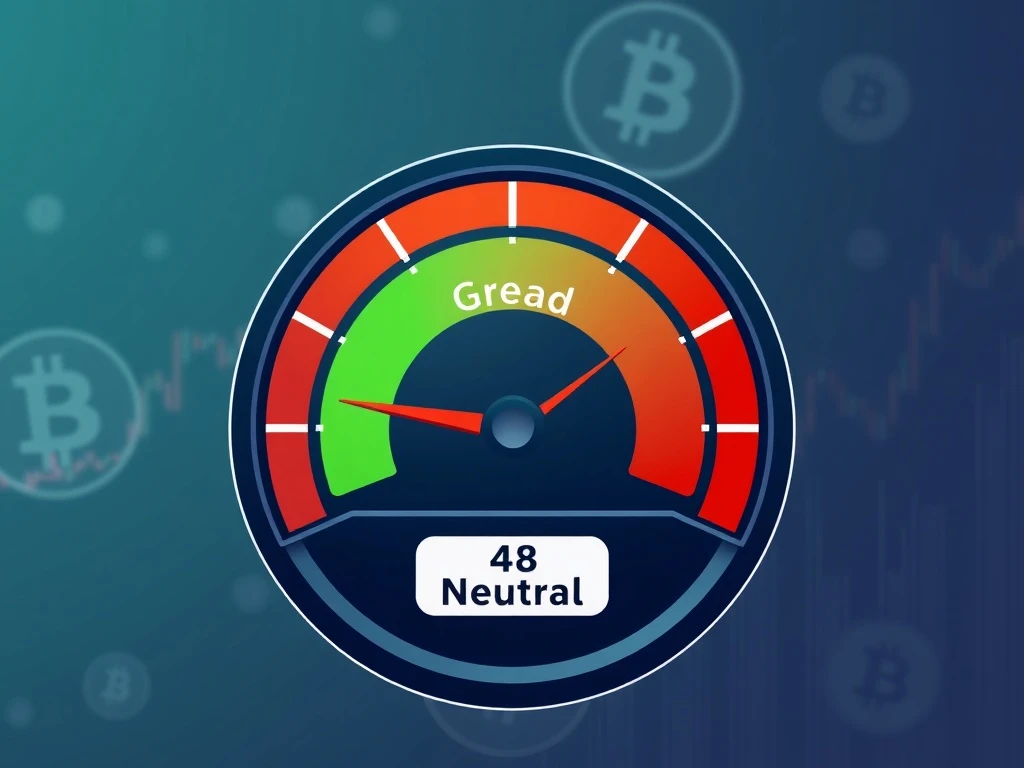
Global cryptocurrency markets witnessed a significant psychological shift on April 2, 2025, as the widely monitored Crypto Fear & Greed Index climbed 22 points to a reading of 48, officially moving from the ‘Fear’ zone into ‘Neutral’ territory. This pivotal movement signals a notable cooling of investor anxiety and provides a crucial barometer for understanding current market dynamics. The index, a composite measure of market emotion, serves as a foundational tool for analysts and traders worldwide.
Understanding the Crypto Fear & Greed Index Calculation
Alternative’s Crypto Fear & Greed Index functions as a multifaceted sentiment thermometer. It synthesizes data from six distinct sources to generate its daily score. Market volatility and trading volume each contribute 25% to the final calculation. Social media sentiment and market surveys each account for 15%. Finally, Bitcoin’s dominance share and relevant Google search trends each provide the remaining 10%. Consequently, the index avoids reliance on any single metric, creating a more robust emotional snapshot.
Historically, readings below 25 indicate ‘Extreme Fear,’ often correlating with potential buying opportunities. Scores above 75 signal ‘Extreme Greed,’ which can precede market corrections. The neutral zone, between 46 and 54, suggests a balanced, less emotionally-driven market environment. The recent jump from 26 to 48 represents one of the most substantial single-day improvements in several months, reflecting a rapid change in collective investor psychology.
Analyzing the Drivers Behind the Sentiment Shift
Several concurrent factors likely propelled the index into neutral ground. First, a stabilization in Bitcoin’s price above key support levels reduced overall market volatility. Second, trading volume data shows increased activity from institutional entities, suggesting more measured participation. Furthermore, social media analysis reveals a decrease in panic-driven commentary and a rise in technical discussion. Survey data from retail and professional investors also indicates growing, albeit cautious, optimism.
Bitcoin’s market cap dominance held relatively steady, suggesting altcoins are not disproportionately driving the sentiment change. Google search volume for terms like ‘crypto crash’ has demonstrably fallen, while searches for ‘crypto recovery’ have risen modestly. This collective data paints a picture of a market transitioning from a reactive, fear-based state to a more analytical and steady phase.
Historical Context and Comparative Analysis
Comparing the current 48 reading to historical data provides essential context. For instance, during the market troughs of late 2022, the index spent prolonged periods in ‘Extreme Fear,’ often dipping below 20. Conversely, during the bull market peaks of late 2024, it frequently hovered in ‘Extreme Greed’ above 80. The current neutral reading is reminiscent of the consolidation phases that typically follow periods of high volatility, acting as a reset before the next sustained directional move.
The table below illustrates recent index ranges and their general market interpretations:
| Index Range | Sentiment Label | Typical Market Phase |
|---|---|---|
| 0-24 | Extreme Fear | Potential capitulation or buying zone |
| 25-45 | Fear | Caution and negative bias prevail |
| 46-54 | Neutral | Balanced, data-driven decision making |
| 55-74 | Greed | Growing optimism and risk appetite |
| 75-100 | Extreme Greed | Speculative frenzy, high risk of correction |
The Practical Impact on Trader and Investor Behavior
A neutral sentiment reading directly influences market participant strategies. For long-term investors, a neutral index often validates a ‘hold’ or disciplined ‘dollar-cost averaging’ approach, as emotional extremes are absent. For active traders, it can signal a shift towards range-bound strategies rather than trend-following, as momentum may be less pronounced. Financial advisors frequently use this data to counsel clients against making fear-based or greed-driven portfolio decisions.
Market analysts note that neutral periods can foster healthier price discovery. Asset valuations rely more on fundamental developments, such as protocol upgrades or regulatory clarity, and less on herd mentality. This environment often benefits projects with strong fundamentals, as hype and fear subside. Consequently, capital allocation within the crypto ecosystem can become more efficient during these phases.
Expert Perspectives on Sentiment Indicators
Leading market psychologists emphasize that sentiment indicators like the Fear & Greed Index are contrarian tools at extremes but confirmatory tools in the middle. ‘When the index is at 10 or 90, it’s a powerful contrary signal,’ states Dr. Lena Vance, a behavioral finance researcher. ‘However, when it’s near 50, it primarily confirms that the market is in a state of equilibrium, where other fundamental and technical factors should take precedence in analysis.’
This view is echoed by veteran analysts who track the index alongside on-chain data, such as exchange flows and holder composition. The convergence of neutral sentiment with stabilizing on-chain metrics provides a stronger signal than either dataset alone. Therefore, the current shift to 48 is most significant when viewed as part of a broader mosaic of market health indicators.
Conclusion
The Crypto Fear & Greed Index’s move to a neutral 48 marks a critical inflection point for market psychology. It reflects a departure from the fear that dominated recent weeks and suggests a period of calmer, more rational evaluation. While not predictive of future price direction, this shift establishes a new baseline for sentiment. Market participants should monitor whether the index stabilizes in this neutral zone or begins trending toward greed or fear, as either movement will provide the next key insight into the collective crypto mindset. The index remains an indispensable tool for navigating the market’s emotional landscape.
FAQs
Q1: What does a ‘Neutral’ reading on the Crypto Fear & Greed Index mean?
A neutral reading, typically between 46 and 54, indicates a balanced market sentiment. It suggests that investors are not driven predominantly by extreme fear or greed, and decision-making may be more influenced by fundamental and technical analysis rather than emotion.
Q2: How often is the Crypto Fear & Greed Index updated?
The index is calculated and published daily by Alternative.me. It provides a real-time snapshot of market sentiment based on the previous 24 hours of data from its six component sources.
Q3: Can the index predict future Bitcoin or cryptocurrency prices?
No, the index is not a predictive tool. It is a descriptive measure of current sentiment. However, historically, extreme readings (both high and low) have often coincided with market reversals, making it a useful contrarian indicator at those extremes.
Q4: Why is Bitcoin’s dominance part of the Fear & Greed Index calculation?
Bitcoin’s share of the total cryptocurrency market cap is included as a ‘safe haven’ indicator. When fear is high, investors often flock to Bitcoin, increasing its dominance. When greed is high, capital may flow into riskier altcoins, decreasing Bitcoin’s dominance.
Q5: How should a retail investor use this information?
Retail investors can use the index as a gauge of market emotion to avoid common behavioral pitfalls. For example, a neutral reading can encourage disciplined investment strategies rather than impulsive buying or selling. It is best used in conjunction with personal research and risk assessment.
Related News
- Crypto Policy Shift Accelerates as Lawmakers Champion Crucial Protections for Non-Custodial Blockchain Innovators
- Spot Silver Shatters Records: Historic Rally Propels Price Above $90 Per Ounce
- DZ Bank’s Revolutionary meinKrypto Platform Launches Under MiCA, Bringing Bitcoin and Ethereum to Millions