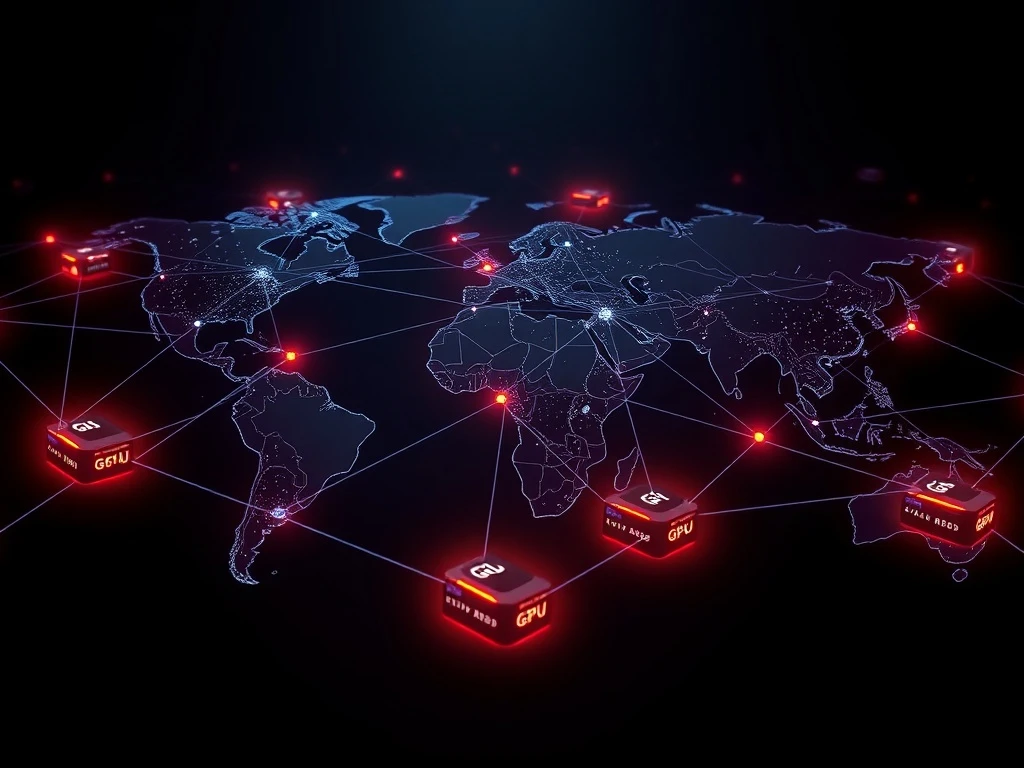
In a groundbreaking development for distributed computing, Salad.com and Golem Network announced a strategic partnership today to pilot decentralized GPU cloud infrastructure, potentially transforming how computational resources are accessed and utilized globally. This collaboration represents a significant milestone in the evolution of distributed computing networks, combining Salad.com’s established user base with Golem Network’s proven decentralized infrastructure. The pilot program, launching in Q2 2025, aims to create a more accessible and efficient marketplace for GPU computing power, addressing growing demand from artificial intelligence researchers, video rendering professionals, and scientific computing applications.
Decentralized GPU Cloud Infrastructure Represents Computing Evolution
The partnership between Salad.com and Golem Network creates a novel approach to GPU resource allocation. Traditionally, GPU cloud services have operated through centralized providers like Amazon Web Services, Google Cloud, and Microsoft Azure. These centralized models often create bottlenecks during peak demand periods and maintain pricing structures that exclude smaller researchers and developers. Conversely, the decentralized GPU cloud infrastructure model leverages idle computing resources from individual users and smaller data centers worldwide. This distributed approach potentially increases resource availability while decreasing costs for end-users. The collaboration specifically targets the growing computational demands of artificial intelligence training, scientific simulations, and complex rendering tasks that require substantial GPU resources.
Salad.com brings established infrastructure to this partnership, having operated since 2018 as a platform that allows users to share their computer’s idle resources in exchange for rewards. The company has built a community of over one million registered users who collectively contribute computing power. Golem Network, founded in 2016, provides the decentralized protocol layer that enables secure, peer-to-peer transactions of computing resources. Their GLM token facilitates payments within the ecosystem. Together, these organizations create a complete solution for decentralized GPU cloud infrastructure that connects resource providers with consumers through blockchain-based verification and payment systems.
Technical Architecture and Implementation Framework
The pilot program employs a multi-layered technical architecture designed for reliability and scalability. At the protocol level, Golem Network’s decentralized infrastructure handles task distribution, verification, and payment settlement using smart contracts on the Ethereum blockchain. Salad.com’s application layer provides user-friendly interfaces for both resource providers and consumers. Resource providers install lightweight software that automatically allocates idle GPU cycles to approved computing tasks. Consumers submit jobs through a web interface or API, specifying their computational requirements, budget constraints, and completion deadlines. The system then matches these requirements with available resources across the distributed network.
Security represents a critical consideration in this decentralized GPU cloud infrastructure. The implementation includes several protective measures. First, all computing tasks run within isolated sandbox environments to prevent unauthorized access to provider systems. Second, a verification layer uses redundant computation and cryptographic proofs to ensure task completion accuracy. Third, payment escrow mechanisms protect both providers and consumers during transactions. Finally, reputation systems track participant behavior across the network, creating economic incentives for reliable performance. This comprehensive security approach addresses common concerns about decentralized computing models while maintaining the efficiency advantages of distributed systems.
Market Context and Competitive Landscape
The decentralized computing market has evolved significantly since early blockchain-based projects emerged nearly a decade ago. Current estimates suggest the global GPU cloud market will exceed $15 billion by 2025, driven primarily by artificial intelligence and machine learning applications. Traditional cloud providers currently dominate this space, but their centralized models face criticism for creating vendor lock-in, unpredictable pricing, and regional availability disparities. Several decentralized alternatives have emerged alongside Golem Network, including Akash Network, Render Network, and iExec. Each platform emphasizes different aspects of decentralized computing, with varying approaches to resource allocation, payment systems, and use case specialization.
Salad.com’s partnership with Golem Network distinguishes itself through several strategic advantages. The collaboration combines Salad.com’s established user community with Golem Network’s mature protocol infrastructure. This combination potentially accelerates network effects that are crucial for decentralized systems. Additionally, the partnership focuses specifically on GPU resources rather than general computing, allowing for specialized optimization. The table below compares key characteristics of different decentralized computing approaches:
| Platform | Primary Focus | Consensus Mechanism | Payment Token |
|---|---|---|---|
| Golem Network | General Computing | TrueBit-inspired | GLM |
| Akash Network | Container Deployment | Tendermint-based | AKT |
| Render Network | Graphics Rendering | Proof-of-Render | RNDR |
| Salad-Golem Pilot | GPU Cloud Infrastructure | Multi-tier Verification | GLM + Salad Balance |
Potential Impacts on Computing Accessibility and Innovation
This decentralized GPU cloud infrastructure partnership could significantly impact computing accessibility across multiple sectors. Researchers in academic institutions, particularly those with limited funding, may gain affordable access to computational resources previously available only to well-funded corporations. Independent AI developers could prototype and train models without substantial upfront infrastructure investment. Video production studios might render complex scenes more economically by tapping into distributed resources during off-peak hours globally. Scientific computing applications in fields like climate modeling, pharmaceutical research, and materials science could benefit from the scalable, on-demand nature of decentralized GPU cloud infrastructure.
The economic implications extend beyond direct cost savings. By creating a global marketplace for GPU resources, the partnership could establish more efficient pricing mechanisms that reflect real-time supply and demand. Resource providers, including individuals with powerful gaming computers and small data centers with excess capacity, could monetize otherwise idle assets. This creates new revenue streams while increasing overall computational resource utilization globally. The decentralized model also enhances resilience by distributing resources across geographical regions and independent providers, reducing vulnerability to localized outages or service disruptions that affect centralized cloud providers.
Implementation Timeline and Development Roadmap
The pilot program follows a carefully structured implementation timeline designed to ensure system stability and user experience quality. Phase one, beginning in April 2025, involves limited testing with selected enterprise partners and existing Salad.com community members. This initial stage focuses on basic GPU computing tasks with straightforward verification requirements. Phase two, scheduled for July 2025, expands the user base while introducing more complex workload types, including AI training jobs and scientific simulations. Phase three, launching in October 2025, represents full public availability with comprehensive feature sets and refined user interfaces.
Technical development priorities include several key areas. First, the teams will optimize task distribution algorithms to minimize latency and maximize resource utilization. Second, they will enhance verification mechanisms to handle increasingly complex computational tasks. Third, they will develop specialized tooling for common use cases like machine learning framework integration and rendering pipeline compatibility. Fourth, they will create comprehensive monitoring and analytics dashboards for both providers and consumers. Finally, they will establish governance mechanisms for the decentralized GPU cloud infrastructure ecosystem, potentially involving token holders in decision-making processes about protocol upgrades and fee structures.
Regulatory Considerations and Industry Standards
Decentralized computing platforms operate within evolving regulatory frameworks that vary significantly across jurisdictions. The Salad.com and Golem Network partnership must navigate several regulatory considerations. Data privacy regulations, including GDPR in Europe and various state-level laws in the United States, impose requirements on data processing and storage. The decentralized nature of the infrastructure creates unique challenges for compliance, as computational tasks may execute across multiple jurisdictions with differing legal standards. The partnership addresses these concerns through several mechanisms. First, they implement strict data handling protocols that minimize sensitive information exposure during computation. Second, they provide tools for users to specify geographical preferences for task execution. Third, they maintain transparent records of resource allocation and data processing for audit purposes.
Industry standards represent another important consideration for decentralized GPU cloud infrastructure adoption. The partnership actively participates in standards development organizations focused on distributed computing and blockchain technologies. They contribute to working groups defining interoperability standards between different decentralized computing platforms. Additionally, they collaborate with academic institutions and industry consortia to establish best practices for security, performance measurement, and user protection in decentralized computing environments. These efforts aim to build trust among enterprise users who typically require compliance with established industry standards before adopting new technological approaches.
Conclusion
The partnership between Salad.com and Golem Network to pilot decentralized GPU cloud infrastructure represents a significant advancement in distributed computing technology. This collaboration combines established user communities with mature protocol infrastructure to create a potentially transformative approach to computational resource allocation. The decentralized GPU cloud infrastructure model addresses several limitations of traditional centralized cloud services while creating new economic opportunities for resource providers worldwide. As the pilot program progresses through 2025, its success could accelerate adoption of decentralized computing models across multiple industries, particularly in artificial intelligence development, scientific research, and media production. The ultimate impact may extend beyond technical infrastructure to influence how societies access and utilize computational resources in an increasingly digital global economy.
FAQs
Q1: What exactly is decentralized GPU cloud infrastructure?
A1: Decentralized GPU cloud infrastructure refers to distributed networks that pool graphics processing units from multiple independent providers worldwide. Unlike traditional centralized cloud services operated by single companies, these networks use blockchain technology and peer-to-peer protocols to connect resource providers with consumers, creating more accessible and potentially more affordable computing resources.
Q2: How does the partnership between Salad.com and Golem Network work technically?
A2: The partnership combines Salad.com’s user application layer with Golem Network’s decentralized protocol infrastructure. Salad.com provides the interface for users to share idle GPU resources or access distributed computing power. Golem Network handles the underlying task distribution, verification, and payment settlement through smart contracts on the Ethereum blockchain, using their GLM token for transactions.
Q3: What types of computing tasks are suitable for this decentralized GPU cloud infrastructure?
A3: The infrastructure primarily supports parallelizable computing tasks that benefit from GPU acceleration. Suitable applications include artificial intelligence model training, scientific simulations, video rendering, cryptographic computations, and data analysis tasks. The pilot program initially focuses on well-defined workloads with clear verification requirements before expanding to more complex applications.
Q4: How does this decentralized approach compare to traditional cloud GPU services in terms of cost?
A4: Decentralized GPU cloud infrastructure typically offers more competitive pricing by eliminating intermediary margins and utilizing otherwise idle resources. However, costs vary based on supply and demand dynamics within the marketplace. The model provides particularly significant savings for burst computing needs and irregular workloads that don’t justify long-term commitments to traditional cloud services.
Q5: What security measures protect users of decentralized GPU cloud infrastructure?
A5: Multiple security layers protect both resource providers and consumers. Computing tasks execute within isolated sandbox environments to prevent system access. Verification mechanisms use redundant computation and cryptographic proofs to ensure accurate results. Payment escrow systems protect financial transactions, and reputation tracking creates economic incentives for reliable participation. These combined measures address common security concerns in decentralized computing environments.
Related News
- Ripple Secures Pivotal Preliminary EMI License Approval in Luxembourg, Unlocking EU Stablecoin Expansion
- Binance Wallet Perpetual Futures: Revolutionary ASTER Integration Unlocks Decentralized Trading
- Visa’s Revolutionary Stablecoin Remittance Service with BVNK Partnership Transforms Global Payments