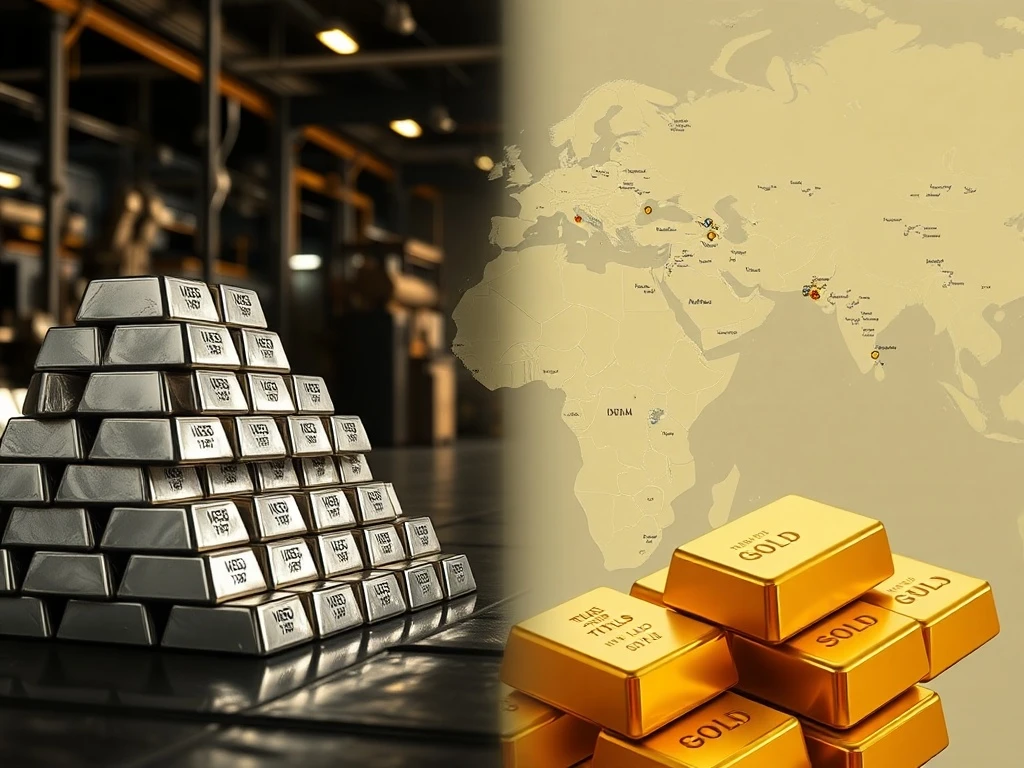
Global precious metals markets entered unprecedented territory this week as silver prices approached the $100 per ounce threshold for the first time in history, while gold continued its ascent above $3,200 amid escalating geopolitical tensions. The simultaneous surge in both metals reveals distinct but interconnected market dynamics reshaping global commodity flows and investment strategies. Industrial shortages have created structural deficits in silver markets, whereas safe-haven demand continues driving gold valuations higher. These parallel movements signal broader economic shifts with significant implications for manufacturers, investors, and policymakers worldwide.
Silver’s Industrial Demand Creates Structural Shortage
The silver market currently faces a perfect storm of supply constraints and accelerating demand. Global silver production declined by 4.2% in 2024 according to the Silver Institute’s latest report, marking the third consecutive year of decreasing output. Meanwhile, industrial consumption increased by 8.7% during the same period. This widening gap between supply and demand has created what analysts describe as a structural deficit. The photovoltaic industry alone consumed 180 million ounces of silver in 2024, representing 15% of total global demand. Electric vehicle manufacturers have similarly increased their silver usage by 22% year-over-year for electrical components and battery technologies.
Mining operations continue facing significant challenges across primary producing regions. Labor disputes in Peru disrupted operations at three major mines during the first quarter of 2025. Environmental regulations in Mexico have delayed expansion projects at key silver districts. Additionally, declining ore grades at established mines have reduced output efficiency despite technological improvements. These production constraints coincide with rising industrial requirements across multiple sectors. Semiconductor manufacturers have increased their silver consumption by 18% annually since 2022. Medical device companies have expanded their use of silver nanoparticles in antimicrobial applications. Consequently, visible inventories at major exchanges have declined to their lowest levels since 2010.
Geopolitical Tensions Drive Gold’s Safe-Haven Appeal
Gold prices surpassed $3,200 per ounce this week as geopolitical uncertainties intensified across multiple regions. Central bank purchases reached record levels during the first quarter of 2025, with reported acquisitions totaling 228 metric tons according to World Gold Council data. The People’s Bank of China increased its gold reserves for the thirteenth consecutive month, adding 16 tons in March alone. Similarly, the National Bank of Poland announced a 30-ton purchase program extending through 2026. These institutional movements reflect growing concerns about currency stability and diversification needs amid trade tensions and sanctions regimes.
Regional Conflicts and Monetary Policy Impacts
Escalating conflicts in Eastern Europe and the Middle East have significantly influenced investor behavior. The ongoing situation has prompted European Union members to reconsider their strategic reserve allocations. Meanwhile, the Federal Reserve’s monetary policy decisions continue creating uncertainty about interest rate trajectories. Historically, gold performs well during periods of monetary policy transition. Current market conditions suggest this relationship remains intact. Retail investment demand has correspondingly increased, with physical gold bar and coin purchases rising 14% year-over-year in Western markets. Exchange-traded funds have reported consistent inflows totaling $4.2 billion during the first quarter.
Currency depreciation concerns have further supported gold’s ascent. The Japanese yen reached a 34-year low against the U.S. dollar in April 2025, prompting increased gold purchases among Japanese investors. Similarly, emerging market currencies have faced pressure from capital outflows and inflation concerns. These conditions have traditionally driven demand for gold as a store of value. The metal’s performance during recent equity market volatility has reinforced its defensive characteristics. Gold mining stocks have outperformed broader market indices by 18% year-to-date, reflecting improved profitability margins at current price levels.
Market Dynamics and Price Correlation Analysis
The relationship between silver and gold prices has entered an unusual phase characterized by simultaneous strength rather than the traditional ratio trading. Historically, the gold-to-silver ratio has averaged approximately 60:1 over the past decade. Current levels near 32:1 represent a significant deviation from this historical norm. This compression suggests silver is outperforming gold on both relative and absolute bases. Several factors explain this phenomenon. First, silver’s dual role as both monetary and industrial metal creates unique demand drivers. Second, supply constraints affect silver more acutely due to its status as a byproduct of base metal mining. Third, investment demand for silver has increased among retail investors seeking exposure to both precious metals and industrial growth themes.
Market analysts point to specific technical and fundamental indicators supporting continued strength. Silver’s 200-day moving average has provided consistent support throughout the current rally. Trading volumes have increased 42% compared to the same period last year. Open interest in futures contracts has reached record levels, indicating sustained institutional participation. Meanwhile, physical delivery requests at major depositories have exceeded available inventory on multiple occasions. These conditions suggest the current price movement reflects genuine supply-demand imbalances rather than speculative positioning alone.
Industrial Applications Driving Silver Demand
Silver’s unique properties continue creating new applications across technology sectors. The renewable energy transition represents perhaps the most significant demand driver. Solar panel manufacturers have increased their silver loading per panel by approximately 15% to improve efficiency ratings. Global solar installations reached 350 gigawatts in 2024, requiring approximately 120 million ounces of silver. Projections suggest this demand could increase to 200 million ounces annually by 2030. Electric vehicle manufacturers have similarly expanded their silver usage. Each electric vehicle contains between 0.5 and 1.0 ounces of silver for various electrical components. With global EV production expected to reach 40 million units annually by 2030, automotive demand alone could consume 30 million ounces of silver.
Electronics manufacturing continues representing a substantial portion of silver demand. The proliferation of 5G infrastructure has increased silver usage in antenna components and connectivity modules. Consumer electronics have maintained consistent demand despite market saturation concerns. Medical applications represent another growth area, particularly for antimicrobial coatings and diagnostic equipment. The healthcare sector consumed approximately 60 million ounces of silver in 2024, with projected growth of 7% annually through 2030. These diverse demand sources create a resilient consumption base less susceptible to economic cycles than traditional industrial metals.
Investment Implications and Portfolio Considerations
The current precious metals environment presents both opportunities and challenges for investors. Financial advisors generally recommend maintaining exposure to both gold and silver, though allocation percentages require careful consideration. Gold typically serves as a portfolio stabilizer during periods of market stress. Silver offers greater growth potential but with correspondingly higher volatility. Historical analysis suggests optimal allocations range between 5% and 10% of total portfolio value for most investors. However, current market conditions might justify temporary overweight positions. Physical ownership through bars and coins provides direct exposure but involves storage and insurance considerations. Exchange-traded funds offer convenience and liquidity, though they introduce counterparty risk.
Mining equities represent another avenue for participation. Companies with strong production growth profiles and conservative balance sheets have generally outperformed during precious metals rallies. However, operational risks including labor disputes, environmental regulations, and geopolitical factors require careful evaluation. Royalty and streaming companies offer alternative exposure with potentially lower operational risk. These companies provide financing to miners in exchange for future production at fixed prices. Their business models typically generate consistent cash flows with limited exposure to operating costs. Regardless of approach, diversification across multiple vehicles generally reduces specific risks while maintaining precious metals exposure.
Regulatory Environment and Market Transparency
Market regulators have increased their scrutiny of precious metals trading amid the current price volatility. The Commodity Futures Trading Commission has announced enhanced position reporting requirements for large traders. Similarly, the London Bullion Market Association has implemented stricter standards for physical delivery specifications. These regulatory developments aim to improve market transparency and prevent potential manipulation. However, they also increase compliance costs for market participants. The increased regulatory attention reflects growing recognition of precious metals’ importance within global financial systems. Central banks have correspondingly improved their reporting standards under International Monetary Fund guidelines.
Transparency initiatives have extended to supply chain verification as well. The London Platinum and Palladium Market launched a comprehensive traceability program in 2024. Similar initiatives are under development for silver and gold markets. These programs aim to ensure responsible sourcing and prevent conflict materials from entering legitimate supply chains. Environmental, social, and governance considerations have become increasingly important for institutional investors. Mining companies with strong ESG profiles typically command valuation premiums compared to peers with weaker records. This trend has accelerated capital allocation toward companies demonstrating sustainable practices and community engagement.
Conclusion
The simultaneous surge in silver and gold prices reflects distinct but interconnected market dynamics with significant implications for global economies. Silver’s approach toward $100 per ounce stems primarily from structural supply deficits meeting accelerating industrial demand. Gold’s ascent above $3,200 responds to geopolitical uncertainties and monetary policy concerns. Both movements signal broader shifts in commodity markets and investment strategies. The current environment requires careful analysis of fundamental drivers rather than reaction to price movements alone. Investors should consider both metals’ unique characteristics when constructing portfolios. Similarly, industrial consumers must evaluate supply chain resilience amid tightening physical availability. The silver price surge and gold’s geopolitical rally together represent a pivotal moment in precious metals markets with lasting consequences for multiple economic sectors.
FAQs
Q1: What specific factors are driving silver prices toward $100 per ounce?
The primary drivers include structural supply deficits from declining mine production, accelerating industrial demand from solar panel and electric vehicle manufacturing, and increased investment interest amid broader commodity strength. Supply constraints have been particularly acute in major producing regions facing operational challenges.
Q2: How do geopolitical tensions specifically affect gold prices?
Geopolitical tensions increase safe-haven demand as investors seek assets with perceived stability during uncertainty. They also prompt central bank purchases for reserve diversification, create currency volatility that enhances gold’s appeal, and potentially disrupt mining operations in affected regions, reducing supply.
Q3: What is the current gold-to-silver ratio and why does it matter?
The ratio currently stands near 32:1, meaning one ounce of gold buys approximately 32 ounces of silver. This represents a significant compression from the historical average near 60:1. The ratio matters because it indicates relative valuation between the two metals and helps investors identify potential opportunities.
Q4: How are renewable energy technologies affecting silver demand?
Solar panel manufacturing represents the largest renewable energy demand source, consuming approximately 120 million ounces annually. Silver’s superior electrical conductivity makes it essential for efficient energy conversion. Each standard solar panel contains 15-20 grams of silver, with usage increasing as manufacturers improve panel efficiency.
Q5: What investment vehicles are available for precious metals exposure?
Options include physical bullion (bars and coins), exchange-traded funds tracking spot prices or mining companies, futures and options contracts on commodity exchanges, mining company stocks, and royalty/streaming companies. Each vehicle carries distinct risk profiles, liquidity characteristics, and tax implications.
Related News
- Bitget Wallet’s Visionary Strategy: Jamie Elkaleh Reveals Crypto’s Inevitable March Toward Mainstream Finance
- Crypto ETFs Revolutionized Global Liquidity Flows in 2025: A Market Transformation
- Cryptocurrency’s Consumer Value Questioned: Minneapolis Fed President Delivers Scathing Assessment