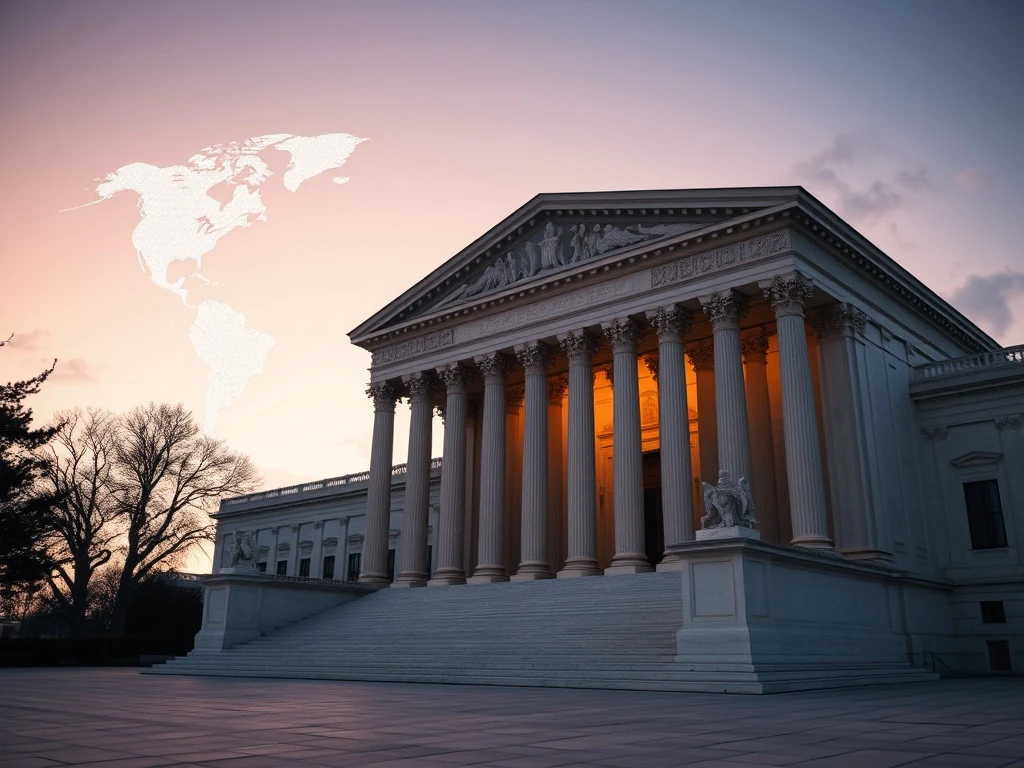
WASHINGTON, D.C. — January 14, 2025 — The United States Supreme Court notably withheld its anticipated ruling on the legality of former President Donald Trump’s sweeping global tariffs today, creating immediate uncertainty across international markets and trade negotiations. This unexpected delay during the Court’s scheduled opinion session leaves a pivotal question about presidential trade authority unanswered, consequently affecting billions in global commerce. Legal experts and trade analysts now scrutinize the implications of this postponement, while businesses await clarity on tariff enforcement.
Supreme Court Delays Critical Tariff Ruling
The Supreme Court did not issue its expected decision on Wednesday, January 14. Consequently, the legal status of tariffs imposed under Section 232 of the Trade Expansion Act of 1962 remains contested. These tariffs, targeting steel, aluminum, and various goods from multiple nations, have sparked significant legal challenges. Moreover, the Court’s silence prolongs a complex debate about executive power versus congressional authority over international trade. This specific delay follows extensive oral arguments presented last fall, where justices questioned the scope of presidential discretion.
Historically, the Court has approached trade authority cases with considerable caution. For instance, the legal framework established by cases like United States v. Curtiss-Wright Export Corp. grants the executive branch broad foreign affairs powers. However, recent challenges argue that the Trump administration exceeded statutory limits. The current delay suggests the justices may require more time to reconcile these historical precedents with contemporary trade realities. Therefore, the eventual ruling will likely set a major precedent for future administrations.
Background and Legal Context of the Tariff Dispute
The legal challenges center on tariffs implemented beginning in 2018. The Trump administration cited national security concerns to justify these measures under Section 232. Importantly, affected trading partners and domestic importers filed numerous lawsuits. They argued the tariffs represented an overreach of presidential authority. Furthermore, they contended the administration improperly invoked national security for economic objectives. A consolidated case reached the Supreme Court after conflicting rulings in lower courts.
Key legal questions include:
- Statutory Interpretation: Does Section 232 grant the President essentially unlimited discretion?
- National Security Nexus: Must a genuine, direct threat to national security exist?
- Judicial Review: Can courts review the factual basis of a Section 232 determination?
The following table outlines the primary tariff actions under legal scrutiny:
| Product | Tariff Rate | Effective Date | Primary Legal Challenge |
|---|---|---|---|
| Steel Imports | 25% | March 2018 | American Institute for International Steel |
| Aluminum Imports | 10% | March 2018 | Multiple industry coalitions |
| Various Goods (List 3 & 4) | Up to 25% | 2019-2020 | Section 301-related challenges |
Expert Analysis on the Delay’s Significance
Constitutional law scholars note that delays often signal deep divisions or complex drafting. “A withheld opinion typically means the justices are crafting a nuanced decision or navigating significant disagreements,” explains Dr. Eleanor Vance, a professor of constitutional law at Georgetown University. “Given the profound implications for separation of powers, the Court understands it must get this ruling precisely right.” Meanwhile, trade policy analysts highlight the practical consequences. “Every day without a ruling injects uncertainty into supply chains and investment decisions,” states Marcus Chen, a senior fellow at the Peterson Institute for International Economics. “Businesses operating globally need predictable rules.”
Immediate Market and International Reaction
Financial markets reacted swiftly to the news of the delay. Major indices experienced heightened volatility, particularly for sectors like manufacturing and automotive that are sensitive to input costs. Additionally, currency markets reflected the uncertainty, with the US dollar showing fluctuations against major trading partners’ currencies. International trade representatives expressed cautious disappointment. The European Union’s trade commissioner noted they are “monitoring the situation closely” while reaffirming their legal position. Similarly, officials from Canada and Mexico emphasized their hope for a timely resolution consistent with international trade rules.
The delay also impacts ongoing and future trade negotiations. For example, US Trade Representative offices may face constraints in discussions until the legal parameters are clear. Consequently, partner countries might hesitate to commit to new agreements without knowing the limits of US executive tariff authority. This situation creates a tangible diplomatic and economic holding pattern. Therefore, the Court’s eventual ruling will directly influence the United States’ bargaining power and credibility in international forums like the World Trade Organization.
Historical Precedents and Potential Outcomes
The Supreme Court has a limited but impactful history with trade authority cases. Past rulings have generally deferred to the executive branch on national security matters. However, the scale and economic rationale of the recent tariffs present a novel test. Legal precedent from cases such as Federal Energy Regulatory Commission v. Mississippi suggests the Court seeks to avoid micromanaging policy. Yet, the sheer economic magnitude of these tariffs—affecting hundreds of billions in trade—pushes the boundaries of traditional deference.
Potential ruling scenarios include:
- Broad Presidential Authority Upheld: The Court could rule the tariffs fall within the President’s lawful discretion, setting a powerful precedent for future actions.
- Authority Limited or Remanded: The Court might rule that lower courts must apply a stricter standard of review, sending the case back for further proceedings.
- Statute Found Unconstitutional: A less likely but possible outcome where the Court finds Section 232 delegates too much legislative power, violating the non-delegation doctrine.
Each outcome carries distinct ramifications. A ruling for broad authority empowers future presidents but may invite retaliatory measures from allies. Conversely, a limiting ruling could constrain trade policy tools but provide more predictability for businesses. The delay itself, therefore, becomes a period of strategic assessment for all stakeholders as they prepare for these various possibilities.
Conclusion
The US Supreme Court’s decision to withhold its ruling on the legality of Trump’s global tariffs creates a significant period of legal and economic uncertainty. This delay underscores the profound complexity of balancing executive authority with congressional intent in international trade. The eventual decision will not only resolve the immediate tariff disputes but will also redefine the boundaries of presidential power for decades. Consequently, businesses, trading partners, and legal scholars must now wait as the justices deliberate on this landmark case that sits at the intersection of law, economics, and national security.
FAQs
Q1: What exactly did the Supreme Court decide on January 14?
The Court did not issue any ruling. It withheld its decision on the consolidated cases challenging the legality of the tariffs imposed by the Trump administration under Section 232 authority.
Q2: Why would the Supreme Court delay a ruling like this?
Delays often occur when cases are exceptionally complex, when the justices are deeply divided, or when they are carefully crafting an opinion that will have far-reaching legal consequences. This case involves major separation-of-powers questions.
Q3: How does this delay affect current tariffs on imported goods?
The tariffs remain in effect during the delay. The legal challenges have not resulted in an injunction, so the tariff rates imposed during the Trump administration continue to be collected unless modified by subsequent presidential action.
Q4: What is the main legal argument against the tariffs?
Opponents argue that Section 232 of the Trade Expansion Act does not grant the President unlimited, unreviewable power to impose tariffs by merely citing national security. They claim the administration applied the law too broadly, using it for economic protectionism rather than genuine security threats.
Q5: When can we expect a final ruling now?
The Supreme Court typically releases opinions on scheduled days until the term ends in late June or early July. The ruling could come on any future opinion day, but there is no guaranteed timeline. The next scheduled opinion days will be announced by the Court.
Related News
- Alpaca Series D Funding: The $150M Power Move That Redefines Tokenization Infrastructure
- Bitget Wallet’s Visionary Strategy: Jamie Elkaleh Reveals Crypto’s Inevitable March Toward Mainstream Finance
- Crypto ETFs Revolutionized Global Liquidity Flows in 2025: A Market Transformation