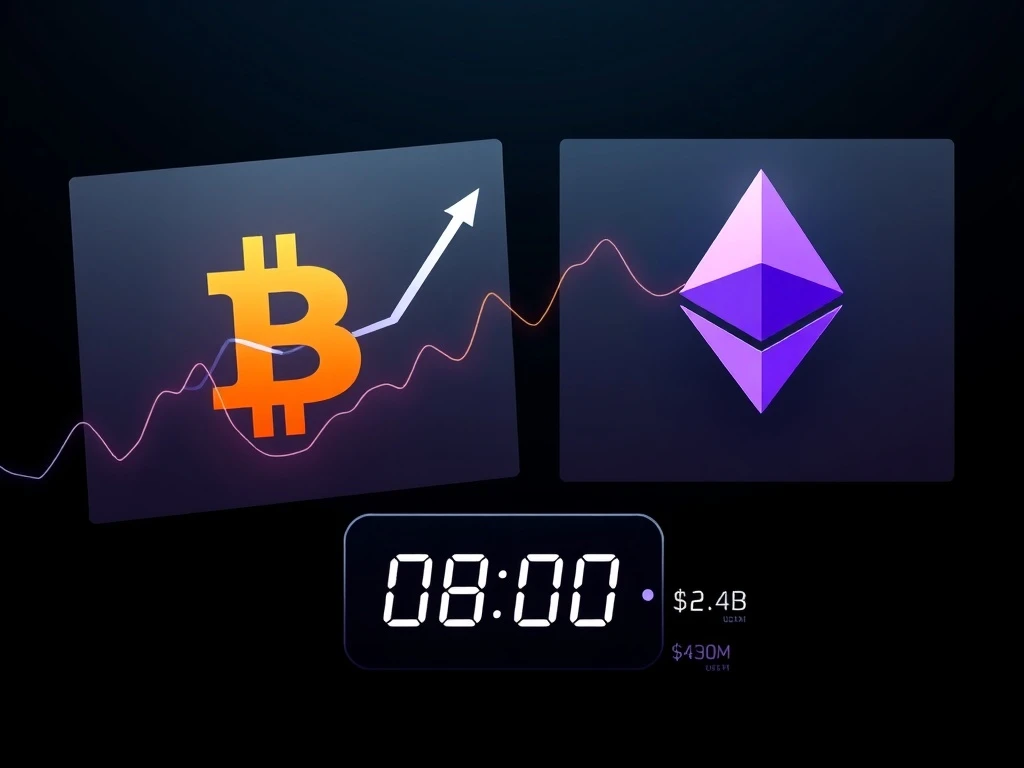
Global cryptocurrency markets face a significant liquidity test today as a colossal batch of Bitcoin and Ethereum options contracts reaches its expiration date. According to verified data from Deribit, the world’s leading crypto options exchange, Bitcoin options with a staggering notional value of $2.4 billion are set to expire at 08:00 UTC on January 16, 2025. Simultaneously, Ethereum options worth $430 million will also mature. This dual expiry event represents one of the largest single-day expiries of the year, drawing intense scrutiny from institutional traders and market analysts worldwide for its potential to influence short-term price action and volatility.
Breaking Down the $2.4 Billion Bitcoin Options Expiry
Deribit’s data provides critical metrics for understanding the market’s positioning ahead of the Bitcoin options expiry. The notional value of $2.4 billion underscores the substantial capital tied to these derivative contracts. Furthermore, the put/call ratio of 1.25 indicates a market sentiment leaning slightly toward caution or hedging. Specifically, this ratio shows that the total open interest in put options, which profit if Bitcoin’s price falls, is 25% greater than the open interest in call options, which profit from price increases. This skew often suggests that a larger portion of traders are either hedging against downside risk or speculating on a price decline.
Another pivotal figure is the max pain price, calculated at $92,000. This theoretical price point represents the strike price at which the maximum number of options contracts would expire worthless, causing the greatest financial loss to option buyers and the greatest gain to option sellers. Market mechanics often see prices gravitate toward this level as expiration approaches, as large writers of options may engage in hedging activities that exert gravitational pull. The current spot price of Bitcoin relative to this $92,000 level will be a key focus for traders throughout the session.
Ethereum’s $430 Million Derivatives Moment
While smaller in scale, the concurrent Ethereum options expiry remains a major market event. The $430 million notional value highlights Ethereum’s entrenched position as the second-largest asset in the crypto derivatives landscape. The put/call ratio for these Ethereum contracts stands at 0.98, presenting a notably different picture than Bitcoin. A ratio below 1.0 signals that call open interest slightly outweighs put open interest, implying a marginally more bullish or less defensive stance among Ethereum options traders. This divergence between Bitcoin and Ethereum sentiment is a common occurrence analysts monitor for relative strength signals.
The max pain price for Ethereum is set at $3,200. This level will serve as a crucial benchmark for ETH’s price stability as the expiry window closes. The interaction between the spot price and this strike price cluster can lead to increased volatility, particularly in the final hours before settlement. Historically, large expiry events have sometimes acted as catalysts for breakout moves or increased trading volume as positions are rolled, closed, or exercised.
Mechanics and Market Impact of Options Expiration
Options expiration is a routine but critical event in regulated financial markets, and crypto derivatives have adopted similar mechanics. When these contracts expire, holders must decide to either exercise their right to buy or sell the underlying asset at the strike price or let the contract expire worthless. For writers (sellers) of the options, large expiries necessitate the unwinding of delta-hedging positions. This process involves buying or selling the underlying spot asset to remain market neutral, which can create noticeable, albeit often temporary, price pressure.
The scale of today’s expiry, particularly for Bitcoin, means the potential for market impact is elevated. However, experienced analysts caution against attributing major long-term trend changes solely to expiry events. Instead, these events often amplify existing market sentiment or liquidity conditions. The data from Deribit, considered the industry benchmark for options volume, provides a transparent snapshot of institutional and sophisticated trader positioning heading into this event.
Historical Context and Volatility Expectations
Large quarterly and monthly options expiries have become standard events in the crypto calendar. Comparing today’s $2.4 billion Bitcoin expiry to historical data shows it ranks among the top monthly expiries, though not unprecedented. For context, the notional value is influenced by both the number of contracts and the current high price of Bitcoin. The $92,000 max pain price reflects where the largest cluster of open interest resides, offering insight into where many traders initially expected the price to be at this date.
Volatility, as measured by metrics like the Deribit Bitcoin Volatility Index (DVOL), often compresses in the days leading up to a major expiry as uncertainty is resolved, only to potentially expand afterward as new positions are established. Traders monitor the “gamma” of the market—the rate of change in an option’s delta—which is typically highest near the spot price. A high gamma environment near expiry can lead to a “pin risk,” where the spot price gets pinned near a high-open-interest strike price, such as the max pain level, due to hedging activity.
Expert Analysis on Derivatives Market Maturation
The sheer size of today’s expiry event is itself evidence of the cryptocurrency derivatives market’s profound maturation since its inception. From negligible volumes a few years ago, the market now regularly processes billions of dollars in expiring contracts, attracting participation from hedge funds, family offices, and corporate treasuries. This growth correlates with improved infrastructure, clearer regulatory frameworks in certain jurisdictions, and the development of more sophisticated risk management products.
Market structure experts point to the put/call ratios as a sentiment gauge, not a direct price predictor. A ratio above 1.0 for Bitcoin could indicate hedging by large holders (“whales”) or institutions protecting portfolios, rather than outright bearish speculation. Similarly, Ethereum’s near-even ratio suggests a balanced, if uncertain, outlook. The true market impact will be determined by the interplay of spot market flows, broader macroeconomic conditions, and any unforeseen news events coinciding with the expiry window.
Conclusion
The simultaneous expiry of $2.4 billion in Bitcoin options and $430 million in Ethereum options today represents a significant event for digital asset markets, testing liquidity and trader positioning. Data from Deribit reveals key metrics: a cautious put/call skew for Bitcoin with max pain at $92,000, and a more balanced sentiment for Ethereum with max pain at $3,200. While such expiries can induce short-term volatility due to hedging unwinds, they are primarily a reflection of existing market structure rather than a fundamental driver. As the crypto derivatives ecosystem continues to mature, these large-scale expiry events will remain critical moments for gauging institutional sentiment and market technicals, providing valuable data points for all market participants monitoring the evolving landscape of Bitcoin options and Ethereum derivatives.
FAQs
Q1: What does a put/call ratio of 1.25 mean?
A put/call ratio of 1.25 means the total open interest in put options is 25% higher than in call options. This often indicates a market that is slightly more defensive, with more traders hedging against or betting on a price decline than those betting on a rise.
Q2: What is the “max pain” price?
The max pain price is the strike price at which the total value of all expiring options contracts would be minimized, causing the maximum financial loss to options buyers. It is calculated by summing the value of all in-the-money puts and calls at each strike price.
Q3: How can an options expiry affect the spot price of Bitcoin or Ethereum?
As expiry approaches, market makers and large option writers who have hedged their positions may buy or sell the underlying asset to adjust their exposure. This hedging activity can create temporary buying or selling pressure in the spot market, sometimes pulling the price toward high-open-interest strike levels.
Q4: Is Deribit the only exchange for crypto options?
No, Deribit is the largest by volume, but other exchanges like CME, OKX, and Binance also offer crypto options. Deribit’s data is widely cited because it commands a dominant market share, especially for Bitcoin and Ethereum options.
Q5: What happens to options contracts at expiry?
At expiry, in-the-money options may be automatically exercised (depending on the exchange and contract type), granting the buyer the right to buy or sell the underlying asset at the strike price. Out-of-the-money options expire worthless. Traders often close or roll their positions before expiry to manage risk.
Related News
- Russia Crypto Regulation: Central Bank Demands Drastic Transaction Reporting from All Financial Institutions
- Silver Generational Bottom: Expert Predicts Inevitable Long-Term Bull Market Ahead
- Bitcoin Rally to $100K: Analysts Warn of a Cautious Rebound, Not a Trend Reversal