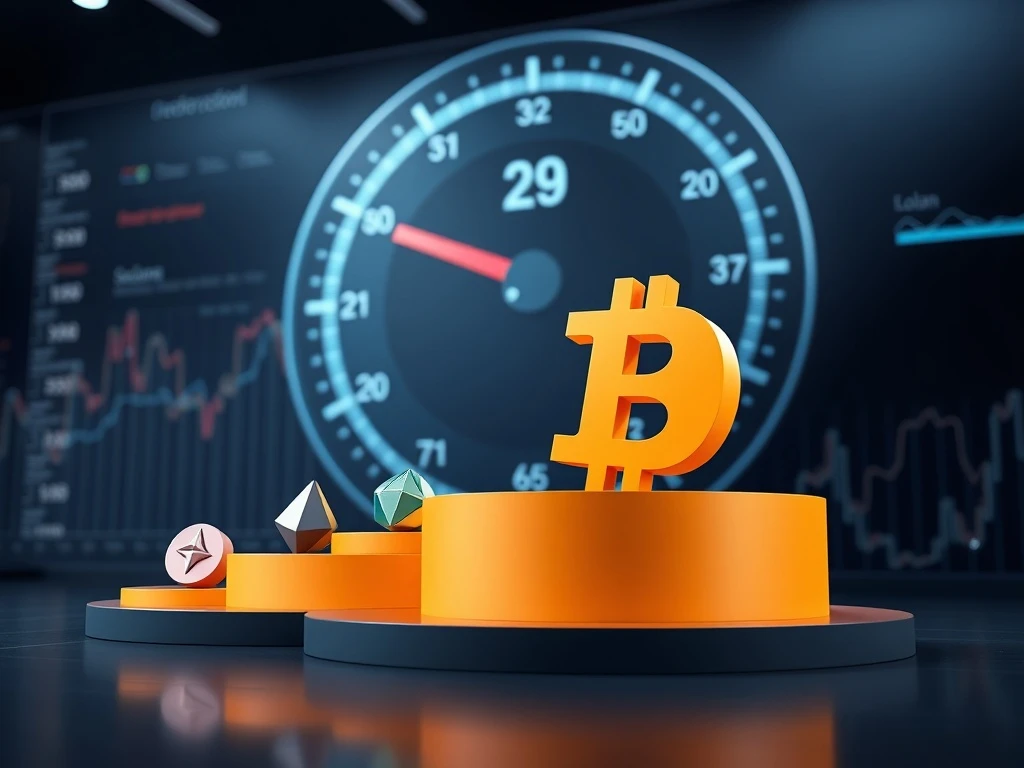
The cryptocurrency market’s pulse quickened today as a key sentiment gauge, the Altcoin Season Index, recorded a significant three-point drop to a score of 26. This notable decline signals a potential pivot in market dynamics, moving investors further from the exuberant ‘altcoin season’ and closer to a phase of Bitcoin-centric strength. Market analysts are now scrutinizing this shift, which reflects the comparative 90-day performance of the top 100 digital assets against the original cryptocurrency.
Decoding the Altcoin Season Index Drop
CoinMarketCap’s Altcoin Season Index serves as a crucial barometer for market sentiment. The index operates on a clear, quantitative methodology. It analyzes the price performance of the top 100 cryptocurrencies by market capitalization over a rolling 90-day period, deliberately excluding stablecoins and wrapped tokens. The core function of the index is to determine which asset class is leading the market. A formal ‘altcoin season’ is declared only when 75% of these top assets outperform Bitcoin during that timeframe. Consequently, the index score ranges from 0 to 100, where a higher score indicates stronger altcoin momentum. The recent drop to 26, therefore, represents a substantial move away from that threshold, strongly suggesting Bitcoin is reclaiming its leadership role.
This metric provides invaluable context for both retail and institutional investors. For instance, it helps differentiate between a broad-based crypto bull market and one driven primarily by Bitcoin’s narrative, such as ETF approvals or macroeconomic factors. Historically, scores persistently below 50 have correlated with periods where Bitcoin’s market dominance ratio—its share of the total crypto market cap—rises. The current reading implies that less than a third of major altcoins are keeping pace with Bitcoin’s trajectory, a stark contrast to conditions during previous altcoin rallies.
Historical Context and Market Cycle Analysis
Understanding the index’s movement requires examining past market cycles. Notably, the last major altcoin season, where the index sustained readings above 75, occurred in early 2021. During that period, decentralized finance (DeFi) and non-fungible token (NFT) projects saw exponential growth, dramatically outperforming Bitcoin. Conversely, the latter half of 2023 and early 2024 were characterized by a ‘Bitcoin season,’ driven by anticipation and eventual approval of spot Bitcoin ETFs in the United States. The index frequently languished in the 20-40 range during those months.
The current decline from 29 to 26 may indicate a reversion to this earlier trend. Several interconnected factors could be contributing to this shift. Firstly, Bitcoin’s price often leads market cycles, with capital eventually rotating into altcoins. After a period of altcoin strength, profit-taking can cause capital to flow back into Bitcoin, perceived as a relative safe haven. Secondly, broader macroeconomic conditions, such as interest rate expectations and geopolitical uncertainty, frequently impact Bitcoin first due to its status as ‘digital gold.’ Altcoins typically exhibit higher beta, meaning they amplify Bitcoin’s moves, both up and down.
Expert Perspective on Capital Rotation
Market analysts often describe this dynamic as ‘capital rotation.’ In a typical cycle, Bitcoin appreciates first, attracting mainstream attention and liquidity. Subsequently, investors seeking higher returns begin allocating to altcoins, boosting their relative performance. The Altcoin Season Index captures this exact phenomenon. When the index falls, it suggests that rotation is slowing or reversing. Seasoned traders monitor this data alongside other on-chain metrics, such as exchange flows and wallet activity, to gauge market health. The three-point single-day drop is significant because it represents a rapid change in sentiment, not just a gradual drift.
Implications for Investors and Traders
The falling index score carries practical implications for different market participants. For long-term investors, a lower score does not necessarily signal an exit point for altcoins but may suggest a period of consolidation or underperformance relative to Bitcoin. It underscores the importance of a diversified, strategic asset allocation rather than chasing short-term trends. For active traders, the index provides a tactical signal. A declining score might prompt a reassessment of risk exposure, potentially shifting some altcoin holdings into Bitcoin or stablecoins to reduce portfolio volatility.
Key considerations during such a phase include:
- Risk Assessment: Altcoins generally carry higher volatility and project-specific risks.
- Correlation Check: During Bitcoin seasons, altcoin correlations with BTC often increase, reducing diversification benefits.
- Fundamental Analysis: A broad market shift highlights the need to evaluate altcoin projects on their individual merits and adoption metrics.
Furthermore, sector performance within the altcoin universe becomes critical. Even in a Bitcoin-dominated market, specific sectors like decentralized physical infrastructure (DePIN) or real-world assets (RWA) may demonstrate resilience. However, the aggregate index score suggests such outperformance is not yet widespread enough to constitute a season.
The Road Ahead and Market Sentiment
Predicting the future trajectory of the Altcoin Season Index remains challenging. A sustained move below 25 would firmly cement the current period as a Bitcoin season. However, cryptocurrency markets are notoriously cyclical. Catalysts for a reversal could include successful major protocol upgrades, breakthrough announcements in blockchain scalability, or a surge in decentralized application usage that is independent of Bitcoin’s price action. Market observers will also watch for a stabilization in Bitcoin’s dominance, which often precedes the next leg of altcoin expansion.
The index itself is a lagging indicator, based on 90-day performance. Therefore, it confirms trends rather than predicting them. Astute market participants combine it with leading indicators, such as futures market funding rates and social sentiment analysis, to form a more complete picture. The current data, while indicating a shift, does not preclude a rapid recovery in altcoin momentum should market conditions change. Nevertheless, the three-point drop serves as a clear, data-driven warning that the easy gains of a broad altcoin rally may be on pause.
Conclusion
The decline of the Altcoin Season Index to 26 marks a pivotal moment in the current market cycle, underscoring Bitcoin’s resurgent dominance. This movement away from the altcoin season threshold provides investors with a crucial, objective framework for understanding capital flows and relative asset performance. While altcoins remain integral to the blockchain ecosystem, the index clearly signals a period where Bitcoin is setting the pace. Monitoring this metric, alongside fundamental and on-chain data, will be essential for navigating the evolving and often unpredictable cryptocurrency landscape. The Altcoin Season Index, therefore, acts not as a crystal ball, but as a vital compass for strategic positioning in a complex digital asset market.
FAQs
Q1: What does an Altcoin Season Index score of 26 mean?
An index score of 26 indicates that only a minority of the top 100 altcoins are outperforming Bitcoin over the past 90 days. It is far from the 75 threshold needed to declare an ‘altcoin season,’ suggesting the market is currently in a phase of Bitcoin strength or ‘Bitcoin season.’
Q2: How is the Altcoin Season Index calculated?
CoinMarketCap calculates the index by comparing the 90-day price performance of the top 100 cryptocurrencies (excluding stablecoins and wrapped tokens) against Bitcoin’s performance over the same period. The score reflects the percentage of those altcoins outperforming BTC.
Q3: Does a low index score mean altcoins are losing value?
Not necessarily. A low score means altcoins are underperforming Bitcoin. They could still be appreciating in absolute terms, but at a slower rate than Bitcoin. It indicates relative performance, not absolute price direction.
Q4: How often does the Altcoin Season Index change?
The index is updated regularly by CoinMarketCap, typically daily, as it is based on rolling 90-day performance data. Significant single-day moves, like a 3-point drop, reflect sharp changes in the underlying comparative performance data.
Q5: Should I sell my altcoins if the index is falling?
The index is one tool among many. A falling index suggests a shift in market leadership but is not a direct sell signal. Investment decisions should be based on individual portfolio strategy, risk tolerance, and the fundamental outlook for each specific asset, not on a single metric.
Related News
- Crypto Futures Liquidations: Devastating $145M Wipeout Hammers Long Positions Across Major Markets
- Megatel Token: Texas Construction Firm’s Revolutionary Crypto Payment Plan Gains SEC Green Light
- Russia Crypto Regulation: Central Bank Demands Drastic Transaction Reporting from All Financial Institutions