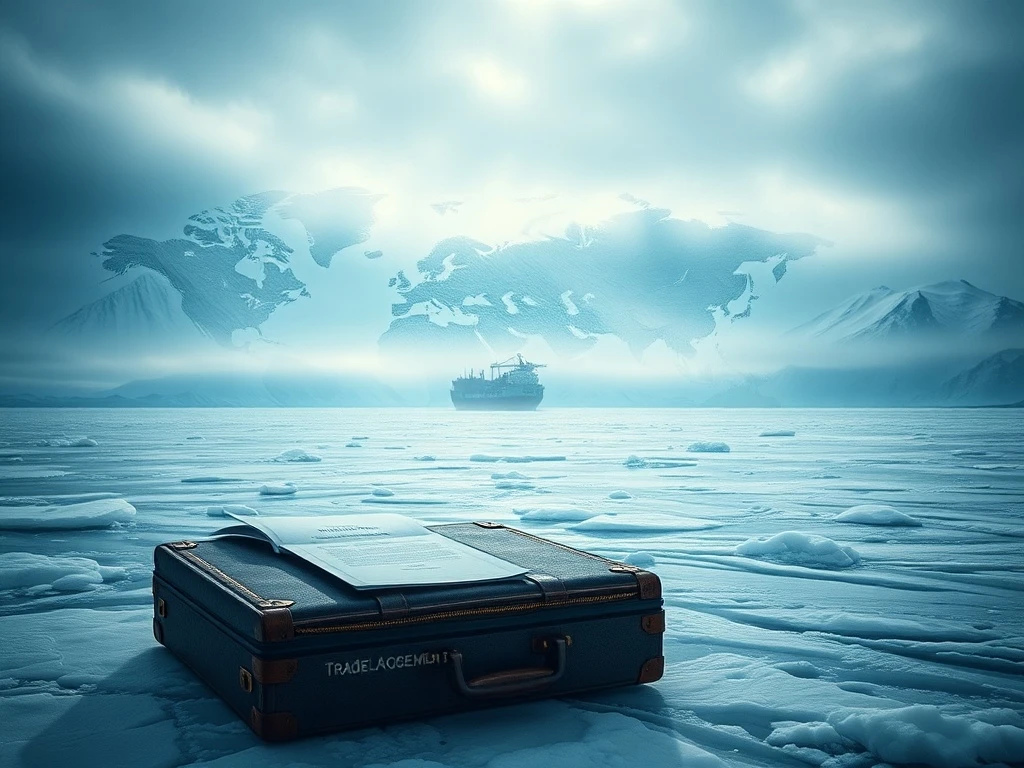
WASHINGTON, D.C. – In a move that has sent shockwaves through diplomatic circles, former President Donald Trump has reportedly threatened to impose severe tariffs on any nation that opposes a potential United States annexation of Greenland, reigniting a contentious geopolitical debate and raising alarms about the future of Arctic sovereignty and international trade norms. This unprecedented tariff threat, emerging from private discussions with advisors, directly links trade policy to territorial ambitions in one of the world’s most strategically vital regions.
Trump’s Greenland Annexation Vision and the Tariff Ultimatum
Historical records and geopolitical analysts confirm Trump’s longstanding interest in acquiring Greenland, the world’s largest non-continental island. During his presidency, he famously floated the idea of purchasing the autonomous Danish territory, an offer Denmark’s leadership swiftly and publicly rebuffed. Consequently, this new strategy represents a significant escalation. Instead of a purchase, the concept now involves a potential annexation, with opposition met not through diplomatic channels, but with the blunt instrument of economic coercion via tariffs.
This approach fundamentally alters the geopolitical calculus. Traditionally, territorial disputes involve diplomatic negotiations, legal arguments under international law, and sometimes military posturing. However, by wielding tariffs as a retaliatory weapon, the threat merges economic statecraft with expansionist policy. Experts note this creates a dangerous precedent where trade relationships become conditional on geopolitical acquiescence.
Geopolitical Repercussions and International Backlash
The immediate international reaction has been one of profound concern and condemnation. Key allies and strategic partners find themselves in a precarious position. For instance, NATO members like Canada and Norway, who have their own Arctic claims and responsibilities, would face immense pressure. Similarly, the European Union, already navigating complex trade relations with the US, would view such conditional tariffs as a direct assault on the rules-based international order.
Denmark, which handles Greenland’s foreign and defense policy, has reiterated its unwavering position. “Greenland is not for sale. Greenland is not for annexation. It is a self-governing part of the Kingdom of Denmark,” a senior Danish diplomat stated, requesting anonymity due to the sensitivity of the matter. The Danish government is reportedly consulting with EU and NATO partners on a coordinated response should the threat materialize.
Expert Analysis: A Breach of Sovereignty and Norms
Dr. Anya Petrova, a Senior Fellow at the Geopolitical Strategy Institute, explains the gravity of the situation. “This isn’t merely a trade threat; it’s an attempt to weaponize economic interdependence to force territorial concessions,” she states. “It bypasses the United Nations Charter, which prohibits the threat or use of force against the territorial integrity of any state. While tariffs are not kinetic force, their use to compel a sovereign nation to relinquish territory is a corrosive violation of international norms.” Petrova further notes that such a move would likely trigger retaliatory sanctions, fragmenting global trade networks centered on the Arctic’s emerging shipping routes.
Economic Impacts and the Global Trade System
The threat of tariffs carries significant weight due to the interconnected nature of the global economy. The Trump administration’s previous use of tariffs under Section 232 and 301 of U.S. trade law demonstrated their disruptive power. A new wave targeting specific nations over Greenland could have cascading effects:
- Supply Chain Disruption: Critical minerals and rare earth elements, which Greenland possesses, are essential for green technology and defense manufacturing. Tariffs could choke these supply chains.
- Market Volatility: Global financial markets would react negatively to the heightened geopolitical risk and potential for a multi-front trade war.
- Inflationary Pressure: Increased costs on imports from targeted nations would likely be passed on to American consumers, contradicting the stated goal of economic protectionism.
A comparative analysis of potential tariff impacts is revealing:
| Potential Target Nation | Key US Imports (2024 Data) | Projected Economic Impact of 25% Tariffs |
|---|---|---|
| European Union | Machinery, Vehicles, Pharmaceuticals | High: Disrupts auto & aerospace sectors, increases drug costs |
| Canada | Energy, Automobiles, Aluminum | Very High: Directly impacts integrated North American supply chains |
| China | Electronics, Consumer Goods | Severe: Re-ignites full-scale trade war, affects vast range of goods |
The Strategic Arctic Context and Resource Competition
Understanding the tariff threat requires context about the Arctic’s growing importance. Climate change is rapidly melting sea ice, opening new shipping lanes like the Northern Sea Route and access to vast untapped resources. The region is estimated to hold:
- 13% of the world’s undiscovered oil.
- 30% of its undiscovered natural gas.
- Significant deposits of rare earth minerals, zinc, iron ore, and gemstones.
Greenland sits at the gateway to these resources and future shipping corridors. Control over Greenland grants a nation a commanding geopolitical position in the High North. Russia has been aggressively modernizing its Arctic military bases, while China declares itself a “near-Arctic state” and invests heavily in polar research. For the United States, securing a permanent, sovereign foothold via Greenland annexation is seen by some strategists as a counter to these rivals, albeit through a highly controversial and legally dubious method.
Legal and Sovereignty Challenges to Annexation
Any move toward annexation faces insurmountable legal hurdles under contemporary international law. The principle of self-determination, enshrined in the UN Charter, is paramount. Greenland’s population of approximately 56,000 people, primarily Indigenous Inuit, holds the right to determine their own political status. In 2008, Greenland voted for increased self-governance, and polls consistently show overwhelming opposition to becoming part of the United States.
“International law is clear,” states Professor Liam Chen, an expert in territorial law at Harvard University. “The annexation of territory against the will of its people is prohibited. The 1933 Montevideo Convention sets out the criteria for statehood, including a permanent population and a defined territory. Greenland meets these criteria in its relationship with Denmark. Using tariffs to pressure other countries to ignore this reality does not change the fundamental illegality of the act itself.”
Conclusion
Donald Trump’s threat to impose tariffs on nations opposing a Greenland annexation represents a pivotal and dangerous moment in modern geopolitics. It conflates economic policy with territorial expansion in a manner that challenges the foundational norms of sovereignty and international law. While the strategic value of the Arctic is undeniable, pursuing it through coercion risks triggering widespread trade conflict, alienating critical allies, and undermining the global order. The global community now watches to see if this tariff threat remains rhetorical or evolves into a tangible policy, a decision that will have profound consequences for diplomacy, trade, and security in the 21st century.
FAQs
Q1: Has the United States ever seriously tried to buy Greenland before?
A1: Yes. The most famous attempt was in 1946 when President Harry S. Truman offered Denmark $100 million in gold for Greenland. The offer was rejected. President Donald Trump revived the idea in 2019, publicly expressing interest in purchasing the island, which was again met with a firm refusal from Danish leadership.
Q2: What gives the US any legal claim or right to annex Greenland?
A2: Under modern international law, the United States has no legal claim to Greenland. Greenland is an autonomous territory within the Kingdom of Denmark. Its people possess the right to self-determination. Annexation without the consent of the people of Greenland and Denmark would be a clear violation of the United Nations Charter and other international treaties.
Q3: How would tariffs actually force a country to change its position on Greenland?
A3: The theory is that by making trade with the US economically painful, targeted nations would calculate that acquiescing on the geopolitical issue is less costly than enduring a trade war. However, this assumes nations will prioritize short-term economic gain over principles of sovereignty, alliance integrity, and international law—a risky assumption, especially for close allies.
Q4: What is Greenland’s official position on this matter?
A4: The Government of Greenland has consistently and unequivocally stated that the island is not for sale or transfer. Greenlandic leaders emphasize their path toward full independence from Denmark and their commitment to developing their resources and future on their own terms, in cooperation with international partners, not under coercion.
Q5: Could this tariff threat realistically be implemented?
A5: Legally, a U.S. president has broad authority to impose tariffs on national security or trade deficit grounds, as demonstrated in recent years. Politically and strategically, however, implementing such tariffs specifically to punish opposition to an annexation would be unprecedented and would likely face fierce domestic and international legal challenges, as well as immediate retaliatory measures, making it a highly destabilizing action.
Related News
- Anchorage Digital’s Bold Move: $200M-$400M Funding Round Signals Imminent 2025 IPO Ambitions
- Gold Price Prediction: Stunning Momentum Analysis Forecasts $8,500 Gold and $300 Silver Targets
- Steak ‘n Shake Boldly Expands Bitcoin Treasury to $10M, Doubling Down on Digital Reserve Strategy