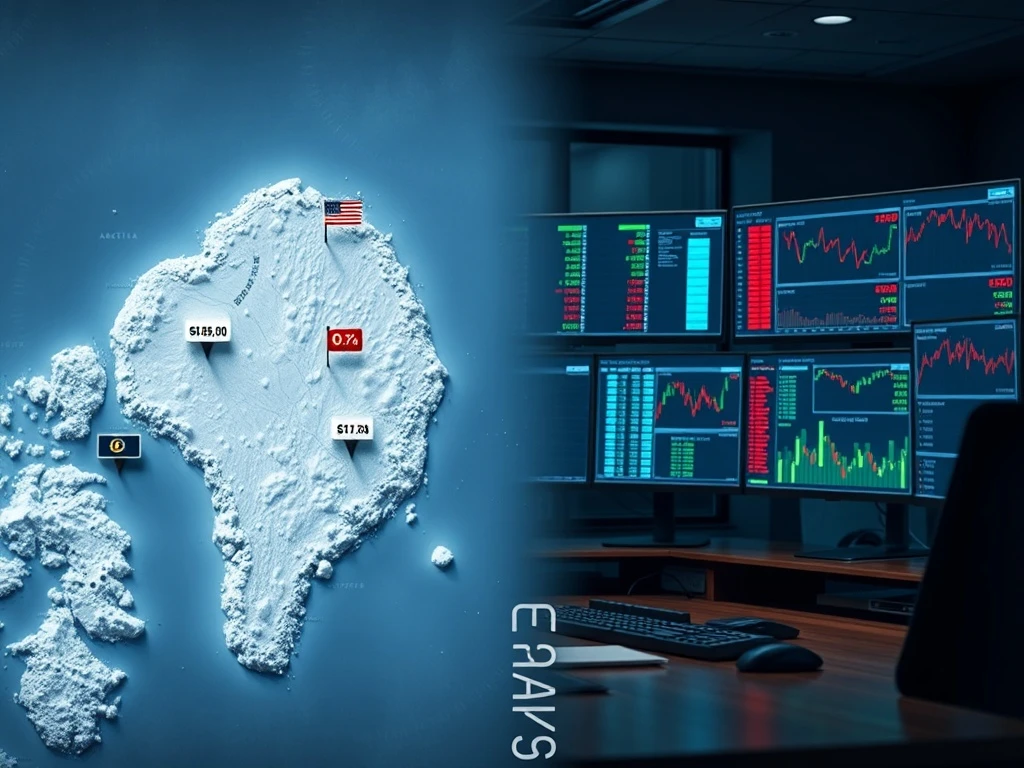
WASHINGTON, D.C., March 2025 – Former President Donald Trump’s renewed public interest in acquiring Greenland has triggered unprecedented volatility across political prediction markets, transforming what many analysts once dismissed as an ‘absurd’ geopolitical notion into a seriously tracked financial instrument with rapidly shifting odds. This development represents a fascinating convergence of cryptocurrency trading psychology, geopolitical forecasting, and the evolving landscape of Arctic resource competition.
Trump’s Greenland Strategy Resurfaces Prediction Market Interest
Prediction markets across multiple platforms have recorded extraordinary trading volume increases following Trump’s recent comments about Greenland’s strategic value. Platforms like Polymarket, PredictIt, and Kalshi have seen Greenland-related contract volumes surge by over 300% in the past week alone. Meanwhile, cryptocurrency markets have demonstrated correlated volatility, particularly in projects focused on Arctic resource development and geopolitical hedging instruments.
The current market sentiment reflects a significant shift from previous assessments. In 2019, when Trump first floated the idea of purchasing Greenland from Denmark, prediction markets assigned the probability of any territorial transfer below 5%. Today, aggregated market data suggests traders now price the probability of some form of enhanced U.S. control or special arrangement with Greenland at approximately 18-22% within the next three years.
Geopolitical Context and Arctic Resource Competition
Several converging factors explain this dramatic shift in market perception. First, climate change has accelerated Arctic ice melt, opening new shipping routes and making previously inaccessible mineral and energy resources more feasible to extract. Greenland possesses substantial deposits of rare earth elements, uranium, and potential oil reserves that have gained strategic importance amid global supply chain reconfiguration.
Second, geopolitical tensions have intensified Arctic competition. Russia has significantly expanded its military presence in the region, while China has pursued scientific and economic partnerships with Arctic nations through its Polar Silk Road initiative. These developments have heightened Washington’s strategic focus on the region’s security implications.
Third, Greenland’s political dynamics have evolved. The territory’s government has expressed growing interest in economic independence from Denmark, though public opinion remains divided about closer ties with the United States versus maintaining current arrangements.
Market Mechanics and Trading Patterns
Prediction markets operate as financial instruments where traders buy and sell contracts based on event outcomes. The price of a contract represents the market’s collective probability assessment of that event occurring. Several distinct contract types have emerged across platforms:
- Binary contracts: Simple yes/no propositions on whether the U.S. will acquire any form of sovereignty over Greenland territory by specific dates
- Multi-outcome contracts: More nuanced instruments covering various potential arrangements including long-term leases, military base expansions, or resource development partnerships
- Timeline contracts: Instruments predicting when specific milestones might occur, with varying payout structures based on temporal accuracy
Trading data reveals several notable patterns. Institutional traders have generally taken more skeptical positions, while retail traders, particularly those active in cryptocurrency markets, have demonstrated greater optimism about dramatic geopolitical shifts. This divergence creates interesting arbitrage opportunities across different prediction platforms and traditional financial markets.
Historical Precedents and Territorial Acquisition Mechanisms
Modern territorial transfers between sovereign nations remain exceptionally rare, but historical precedents provide context for market assessments. The United States has previously acquired territory through several mechanisms:
| Territory | Year | Mechanism | Contemporary Relevance |
|---|---|---|---|
| Louisiana Purchase | 1803 | Treaty and purchase from France | Demonstrates precedent for large-scale territorial acquisition through financial transaction |
| Alaska Purchase | 1867 | Treaty and purchase from Russia | Shows Arctic territory acquisition precedent and initial public skepticism |
| Danish West Indies | 1917 | Treaty and purchase from Denmark | Establishes precedent for U.S.-Denmark territorial transaction |
Legal experts note significant differences between historical precedents and the contemporary Greenland situation. Modern international law, particularly the United Nations Charter and various human rights conventions, establishes stronger protections for territorial integrity and self-determination. Any transfer would require consent from both Denmark (as the sovereign) and Greenland’s population, which exercises substantial autonomy under current arrangements.
Cryptocurrency Market Correlations and Hedging Activity
Interestingly, cryptocurrency markets have demonstrated correlated movements with Greenland prediction markets. Several patterns have emerged in trading data:
- Arctic-focused tokens: Cryptocurrencies associated with Arctic mining, shipping, or resource projects have shown increased volatility and generally positive momentum
- Geopolitical hedge instruments: Decentralized prediction markets and hedging platforms have seen increased activity, with traders using cryptocurrency positions to hedge against traditional market exposures
- Volatility spillover: Significant moves in prediction markets have occasionally preceded or coincided with volatility in major cryptocurrencies, suggesting interconnected trader psychology
This correlation reflects the growing integration between cryptocurrency markets and alternative investment strategies, including geopolitical forecasting. Traders increasingly view digital assets as tools for expressing views on unconventional risk factors that traditional markets may not efficiently price.
Expert Analysis and Market Implications
Geopolitical analysts offer varied perspectives on the market movements. Dr. Elena Rodriguez, Senior Fellow at the Center for Strategic Studies, notes: “Prediction markets often amplify short-term political rhetoric while underestimating institutional and diplomatic inertia. The legal, political, and practical barriers to any territorial transfer remain substantial, though market movements correctly reflect increased strategic attention to the Arctic region.”
Financial market specialists observe different dynamics. Michael Chen, Head of Alternative Data at Arctos Capital, explains: “We’re seeing classic momentum trading patterns amplified by social media and algorithmic strategies. The Greenland contracts have become a proxy for broader political volatility expectations, attracting traders who may care less about the specific outcome than about the trading dynamics themselves.”
From a regulatory perspective, these markets operate in complex jurisdictional spaces. U.S. commodity regulators have generally permitted prediction markets on political outcomes under specific conditions, while securities regulators monitor for market manipulation. The international nature of many platforms, particularly those utilizing blockchain technology, creates additional regulatory challenges.
Conclusion
Trump’s Greenland comments have catalyzed remarkable activity across prediction markets, transforming a seemingly improbable geopolitical notion into a seriously traded financial instrument. These market movements reflect broader trends including increased Arctic strategic competition, evolving territorial governance models, and the growing sophistication of alternative investment vehicles. While substantial obstacles remain to any territorial transfer, the prediction market frenzy provides valuable insights into how financial markets process unconventional political risks in the digital age. The convergence of cryptocurrency trading, geopolitical forecasting, and resource competition narratives suggests these markets will remain volatile barometers of Arctic geopolitical developments.
FAQs
Q1: What exactly are prediction markets and how do they work?
Prediction markets are financial markets where participants trade contracts whose payoffs depend on unknown future events. Prices in these markets reflect aggregated probability assessments about event outcomes, functioning as collective forecasting mechanisms.
Q2: How credible are prediction markets as forecasting tools?
Academic research generally finds prediction markets outperform polls and experts for many event types, though they remain imperfect. Their accuracy depends on trader diversity, liquidity, and proper incentive structures. Geopolitical events with long time horizons present particular challenges.
Q3: What legal mechanisms would allow the U.S. to acquire Greenland?
Any territorial transfer would require a treaty between the United States and Denmark, ratified by both nations’ legislative processes. Additionally, Greenland’s self-government institutions would likely need to consent under current autonomy arrangements, possibly through a referendum.
Q4: Why are cryptocurrency markets reacting to Greenland speculation?
Several factors drive this correlation: overlapping trader demographics, the use of cryptocurrencies to hedge unconventional risks, and specific blockchain projects focused on Arctic development. Some traders view digital assets as alternative hedges against geopolitical volatility.
Q5: How have previous U.S. territorial acquisitions proceeded?
Historical precedents like the Alaska Purchase involved treaties, financial compensation, and often initial public skepticism. Modern acquisitions would face additional legal requirements including international law considerations and self-determination principles that didn’t apply in earlier centuries.
Q6: What are the main arguments for and against U.S. interest in Greenland?
Proponents cite strategic positioning in the Arctic, resource access, and geopolitical competition with Russia and China. Opponents emphasize Greenlanders’ self-determination rights, diplomatic relations with allies, environmental concerns, and the financial costs of infrastructure development in extreme environments.
Related News
- Nansen AI Trading Solution Launches, Revolutionizing On-Chain Execution for Solana and Base
- Canaan Receives Critical Nasdaq Deficiency Notice After Shares Plunge Below $1.00 Threshold
- Terraform Labs Repayment Process Begins: Kroll Trustee Finally Notifies Claimants After 3-Year Wait