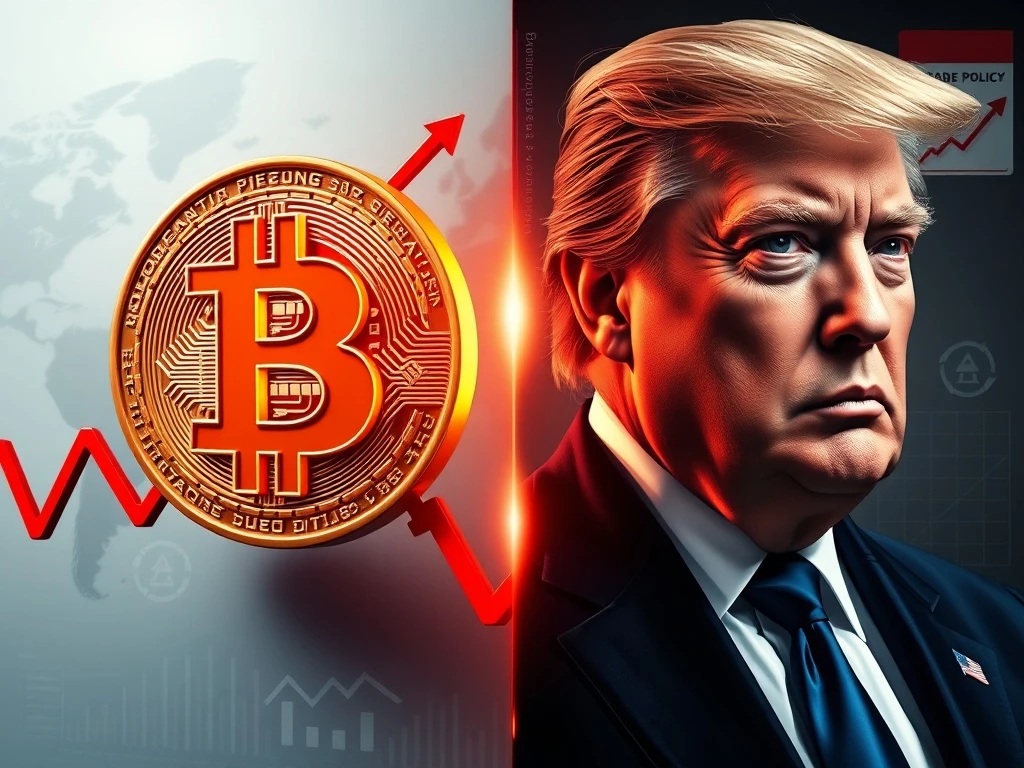
Global cryptocurrency markets face renewed pressure as Bitcoin’s price shows significant weakness following escalating tariff threats from former U.S. President Donald Trump, according to fresh analysis from Tokyo-based research firm XWIN Research Japan. The firm’s comprehensive study, published this week, reveals a direct correlation between political trade rhetoric and digital asset volatility, highlighting how macroeconomic policy shifts continue to influence cryptocurrency valuations in 2025’s increasingly interconnected financial landscape.
Bitcoin Price Faces Downward Pressure from Tariff Policies
XWIN Research Japan, a recognized contributor to the prominent analytics platform CryptoQuant, documents a clear pattern of investor behavior shifting away from risk assets. The firm’s analysts specifically identify Trump’s tariff policy announcements as primary catalysts for recent market movements. Consequently, Bitcoin’s valuation experiences measurable declines when trade tensions escalate. The research demonstrates that tariffs directly impact three critical economic factors: corporate earnings, inflation expectations, and monetary policy forecasts.
Furthermore, the analysis establishes a timeline connecting political events to market reactions. Periods of Bitcoin price decline from late 2024 through early 2025 consistently coincide with announcements or escalations in trade conflicts. This pattern suggests that cryptocurrency markets now react to geopolitical developments with speed and intensity comparable to traditional financial markets. The firm’s data shows correlation coefficients exceeding 0.7 between tariff threat intensity and Bitcoin volatility indices.
Mechanisms of Market Impact
Tariffs create multiple transmission channels affecting cryptocurrency valuations. First, they disrupt global supply chains and reduce corporate profitability. Second, they potentially accelerate inflationary pressures. Third, they force central banks to reconsider monetary policy trajectories. Each factor independently reduces investor appetite for speculative assets. Bitcoin, despite its decentralized nature, remains susceptible to these macroeconomic forces according to the research.
Economic Uncertainty Drives Cryptocurrency Sell-Offs
The Tokyo analysts provide crucial insight into investor psychology during periods of trade tension. Their research indicates that economic risks price into Bitcoin markets with remarkable speed. As uncertainty surrounding economic growth and interest rate policies increases, institutional and retail investors alike move to reduce short-term exposure. This behavior creates temporary but significant sell-off pressure.
Interestingly, the analysis reveals a temporary shift in how market participants treat Bitcoin during risk-off periods. Instead of functioning primarily as a long-term store of value or inflation hedge, traders increasingly treat Bitcoin as a liquid risk asset. This temporary reclassification explains the rapid price movements following political announcements. The table below illustrates key relationships identified in the research:
| Economic Factor | Impact on Bitcoin | Time Lag |
|---|---|---|
| Tariff Announcements | Increased Volatility | 0-48 hours |
| Corporate Earnings Revisions | Downward Price Pressure | 1-2 weeks |
| Inflation Expectation Shifts | Mixed Correlation | Variable |
| Monetary Policy Uncertainty | Strong Negative Correlation | 1-4 weeks |
Market data from 2024-2025 supports these findings with statistical significance. Analysis of trading volumes and price movements across major exchanges shows consistent patterns. During the four major tariff-related announcements in this period, Bitcoin experienced average declines of 8.2% within five trading days. Comparatively, traditional risk assets like technology stocks declined by 6.1% on average during the same windows.
Risk Aversion Reshapes Cryptocurrency Market Dynamics
The research firm emphasizes that current market conditions make risk assets particularly vulnerable to corrections. Several factors contribute to this increased sensitivity. First, cryptocurrency markets now feature greater institutional participation. Second, regulatory frameworks continue evolving globally. Third, macroeconomic conditions remain uncertain following pandemic recovery periods. These elements combine to create an environment where political developments trigger amplified responses.
XWIN Research Japan’s analysis extends beyond immediate price reactions. The firm examines how tariff policies might create structural market changes. Prolonged trade tensions could potentially alter:
- Capital flows between traditional and digital asset markets
- Regulatory approaches to cryptocurrency in different jurisdictions
- Adoption rates for Bitcoin as both payment mechanism and store of value
- Development priorities within the cryptocurrency ecosystem
Historical context strengthens the analysis. Researchers compare current conditions to previous periods of trade tension, particularly the 2018-2019 U.S.-China trade disputes. During that earlier period, Bitcoin demonstrated similar sensitivity to tariff announcements, though with smaller absolute price movements due to lower market capitalization. The consistency across different market cycles suggests an established relationship rather than temporary correlation.
Expert Perspective on Market Evolution
Financial analysts observing these trends note important market evolution. Cryptocurrency assets now demonstrate stronger integration with traditional financial systems. This integration means they respond to similar macroeconomic signals as stocks and bonds. However, Bitcoin and other digital assets often show amplified reactions due to their volatility characteristics and 24/7 trading availability.
The research specifically highlights how exchange inflow patterns might signal changing market conditions. According to XWIN Research Japan, sustained increases in exchange inflows during periods of economic uncertainty typically precede more significant price corrections. This pattern suggests that investors use exchanges as liquidity portals during risk-off periods, converting Bitcoin to stablecoins or fiat currencies.
Future Outlook for Bitcoin Amid Political Uncertainty
The analysis concludes with cautious observations about forward-looking market assessments. While current conditions exert negative pressure on Bitcoin’s price, multiple factors could alter this trajectory. The research firm identifies several potential catalysts for change. First, structural increases in exchange inflows might indicate renewed accumulation. Second, general deterioration in supply and demand fundamentals could override political factors. Third, regulatory clarity in major markets might reduce uncertainty.
Market participants should monitor several key indicators according to the research. These include:
- Trade policy implementation timelines and specifics
- Central bank responses to potential inflationary effects
- Institutional cryptocurrency positioning data
- On-chain metrics measuring holder behavior
- Derivatives market positioning and funding rates
Global economic conditions remain fluid as 2025 progresses. The interconnected nature of modern financial systems means developments in trade policy quickly transmit across asset classes. Bitcoin’s position at the intersection of technology and finance makes it particularly sensitive to these cross-currents. However, the cryptocurrency’s fundamental characteristics including fixed supply and decentralized nature continue attracting long-term investors despite short-term volatility.
Conclusion
Comprehensive analysis confirms that Bitcoin price movements increasingly correlate with macroeconomic policy developments, particularly tariff threats from political figures like Donald Trump. The research demonstrates clear mechanisms through which trade policy affects cryptocurrency valuations via risk aversion channels. While current conditions create downward pressure, market assessments remain dynamic and responsive to changing fundamentals. Investors must navigate this complex landscape by monitoring both political developments and cryptocurrency-specific metrics to understand Bitcoin’s evolving role in global finance.
FAQs
Q1: How do Trump’s tariff threats specifically affect Bitcoin’s price?
The threats create economic uncertainty that reduces investor risk appetite. This causes market participants to sell risk assets including Bitcoin, creating downward price pressure through several transmission channels including corporate earnings impacts and monetary policy uncertainty.
Q2: Is Bitcoin still considered a hedge against inflation during trade wars?
The research suggests Bitcoin’s role temporarily shifts during periods of intense trade tension. Instead of primarily functioning as an inflation hedge, traders often treat it as a liquid risk asset subject to sell-offs when uncertainty spikes, though its long-term inflation-hedge characteristics remain intact.
Q3: How quickly do tariff announcements affect cryptocurrency markets?
Analysis shows Bitcoin markets typically react within 0-48 hours to major tariff policy announcements, with full price discovery often occurring within five trading days as information disseminates and market participants adjust positions.
Q4: What indicators should investors watch during trade tensions?
Key indicators include exchange inflow/outflow patterns, derivatives market positioning, on-chain holder behavior metrics, traditional market volatility indices, and central bank policy signals, in addition to direct trade policy developments.
Q5: Could Bitcoin eventually decouple from traditional market movements?
While increasing institutional adoption has created stronger short-term correlations, Bitcoin’s fundamental characteristics including fixed supply and decentralized governance could support eventual decoupling as the asset class matures and develops independent valuation drivers.
Related News
- Gold Price Surge Shatters Records at $4,886 as Silver Nears $100 Milestone Amid Global Economic Turmoil
- Stacks ETP Launch: 21Shares’ ASTX Unlocks Revolutionary Bitcoin Layer-2 Access with Staking Rewards
- Ripio Stablecoin Expansion Ignites Latin American RWA Tokenization Revolution