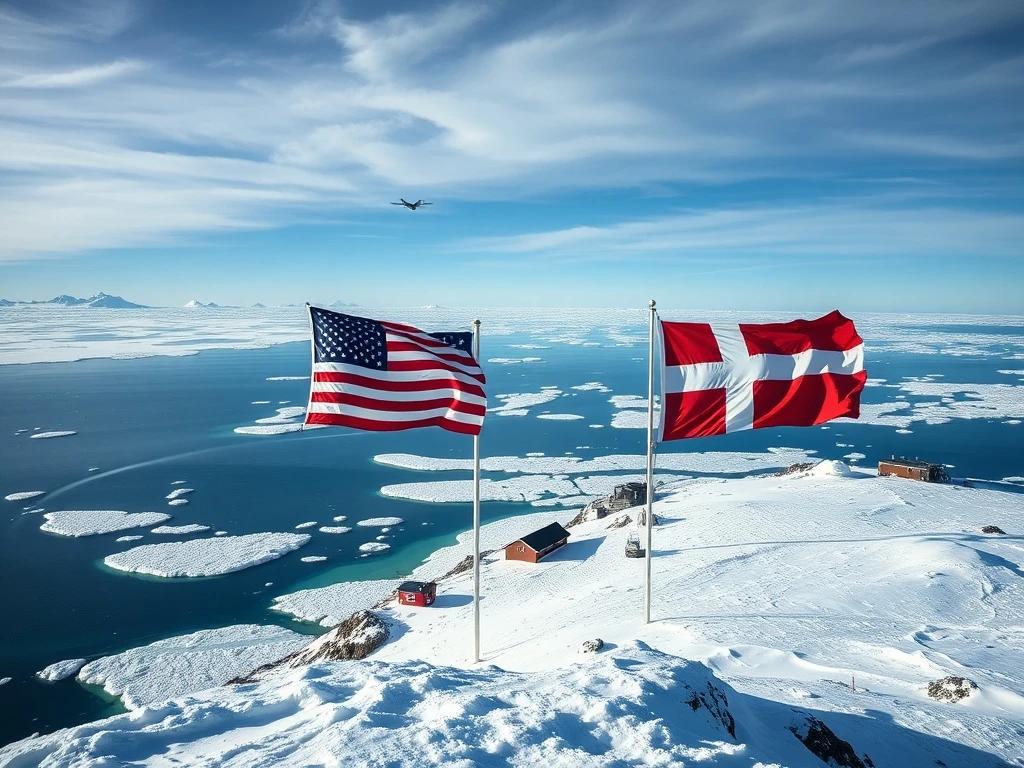
DAVOS, Switzerland — January 21, 2025: In a declaration that immediately reverberated through diplomatic channels worldwide, former U.S. President Donald Trump asserted Greenland constitutes United States territory essential for national security. He delivered these remarks during a special address at the World Economic Forum. This statement revives a contentious geopolitical issue with deep historical roots and significant implications for Arctic strategy.
Trump’s Greenland Territory Claim at Davos
Former President Trump made his position unequivocally clear during his high-profile appearance in Switzerland. “No country other than the United States can secure Greenland,” he stated firmly. He further characterized the massive Arctic island as “U.S. territory and necessary for national security.” This declaration represents the most direct territorial claim by a U.S. political figure in recent decades. The World Economic Forum setting amplified the statement’s global reach, ensuring immediate international scrutiny.
Historical context provides crucial background for this modern assertion. The United States first expressed serious interest in purchasing Greenland from Denmark in 1867. Secretary of State William H. Seward, who also orchestrated the Alaska purchase, explored the possibility. This interest resurfaced prominently in 1946 when President Harry S. Truman offered Denmark $100 million in gold for the island. Denmark’s refusal did not end strategic cooperation, however.
Historical Context of US-Greenland Relations
The modern U.S. relationship with Greenland stems from World War II dynamics. Following Germany’s 1940 occupation of Denmark, the United States assumed protective responsibility for Greenland under the 1941 “Agreement relating to the Defense of Greenland.” This agreement prevented the island from falling under Axis control. It established a precedent for ongoing American security involvement in the region. The Cold War dramatically intensified Greenland’s strategic value shortly thereafter.
In 1951, the United States and Denmark signed a revised defense agreement. This pact led to the construction of Thule Air Base in northwest Greenland. Thule became, and remains, the U.S. Air Force’s northernmost base. Its location provides critical early-warning radar coverage and space surveillance capabilities. The base’s strategic importance has only grown with advancements in missile technology and renewed great-power competition in the Arctic.
- 1867: First U.S. interest in purchasing Greenland emerges.
- 1940: U.S. protects Greenland after Denmark’s occupation.
- 1946: President Truman’s $100M purchase offer is rejected.
- 1951: Defense agreement establishes Thule Air Base.
- 2019: President Trump confirms interest in buying Greenland.
- 2025: Trump declares Greenland U.S. territory at Davos.
Geopolitical and Strategic Analysis
Greenland’s immense geographic significance explains persistent American interest. The island commands the northern Atlantic Ocean and approaches to the Arctic Sea. Its location offers unparalleled monitoring positions for submarine and air traffic between North America, Europe, and Russia. Melting polar ice caps are opening new shipping lanes and revealing untapped resource wealth, further elevating Greenland’s global strategic profile. Control of Greenland translates to substantial influence over future Arctic development.
Military experts consistently highlight several key advantages Greenland provides. The island hosts vital radar installations for the U.S. ballistic missile early-warning system. Thule Air Base supports satellite tracking and space operations. Its airfields can service long-range bombers and reconnaissance aircraft. Furthermore, Greenland’s proximity to the North Pole makes it invaluable for submarine operations beneath the Arctic ice. These capabilities form a cornerstone of North American aerospace defense.
International Law and Diplomatic Implications
Trump’s Davos statement directly challenges established international norms. Greenland is an autonomous territory within the Kingdom of Denmark. Its foreign and security policy remains under Copenhagen’s jurisdiction, though Greenland’s home rule government has increasing say over resource management. International law, particularly the United Nations Charter, prohibits the acquisition of territory by force and emphasizes the principle of self-determination. Unilateral claims without host-nation consent violate these core tenets.
The immediate diplomatic reaction from Denmark and Greenland has been one of firm rejection. Danish officials have repeatedly stated Greenland is not for sale and its status is non-negotiable. Greenland’s own government emphasizes its right to self-determination and its evolving relationship with Denmark. This position enjoys broad support within the Danish parliament and among the Greenlandic people. European Union allies have also expressed support for Danish sovereignty, viewing the claim as destabilizing.
| Country | Key Arctic Territory | Primary Military Installation | Strategic Focus |
|---|---|---|---|
| United States | Alaska, Interest in Greenland | Thule Air Base (Greenland), Eielson AFB (Alaska) | Missile Defense, Space Surveillance |
| Russia | Extensive Arctic coastline | Northern Fleet bases (Murmansk), Nagurskoye airbase | Bastion Defense, Resource Control |
| Canada | Northern archipelago | Canadian Forces Station Alert, Nanisivik Naval Facility | Sovereignty Patrols, Search & Rescue |
| Denmark/Greenland | Greenland | Hosts Thule AB, Station Nord | Environmental Security, Sovereignty |
Economic and Resource Dimensions
Beyond military considerations, Greenland possesses substantial untapped economic potential. The island’s subsurface may hold some of the world’s largest rare earth element deposits outside China. These minerals are critical for manufacturing electronics, renewable energy systems, and advanced weapons. Greenland’s continental shelf also likely contains significant oil and natural gas reserves. Furthermore, retreating ice is making these resources more accessible, though extraction poses severe environmental challenges.
Climate change fundamentally alters the Arctic equation. Receding ice caps are creating new, shorter shipping routes like the Northern Sea Route. These lanes could revolutionize global trade by connecting Asia to Europe via the Arctic, bypassing traditional chokepoints like the Suez Canal. Greenland’s position along these potential routes grants it future economic leverage. The island also possesses vast freshwater reserves in its ice sheet, a potentially crucial resource in a warming world. These factors make Greenland a strategic prize beyond pure military calculation.
Regional Reactions and Security Calculus
Neighboring Arctic states monitor Greenland’s status closely. Canada views any change in Greenland’s sovereignty as a direct concern for North American defense. Russia has significantly modernized its Arctic military infrastructure over the past decade, reopening Soviet-era bases and deploying new missile systems. Moscow would likely perceive a permanent U.S. annexation of Greenland as a major escalation, potentially triggering a renewed arms race in the High North. NATO allies balance support for Denmark with concerns about provoking Russia.
The people of Greenland themselves represent the most critical variable. The indigenous Inuit population comprises nearly 90% of Greenland’s 56,000 residents. Public opinion strongly favors full independence from Denmark, but on Greenland’s own terms and timeline. An involuntary transfer to another power, especially one making a unilateral claim, would face fierce local opposition. Greenland’s Self-Government Act of 2009 provides a pathway to independence, contingent on economic self-sufficiency. External territorial claims complicate this delicate political process.
Conclusion
Former President Trump’s assertion that Greenland is U.S. territory vital for national security has ignited a complex debate intersecting history, law, strategy, and climate. While the United States maintains a legitimate and substantial security interest in Greenland through established defense agreements, a unilateral territorial claim contradicts international law and diplomatic precedent. The statement underscores Greenland’s growing importance in an accessible Arctic and highlights the tension between great-power competition and the sovereignty of small nations. The ultimate status of Greenland will likely be determined not by external claims, but by the evolving will of its people and their relationship with Denmark, within the framework of an increasingly contested polar region.
FAQs
Q1: Has the U.S. ever tried to buy Greenland before?
A1: Yes. The most notable attempt was in 1946 when President Harry Truman offered Denmark $100 million in gold. Denmark refused the offer. Secretary of State William Seward also showed interest following the Alaska purchase in 1867.
Q2: What is the current legal status of Greenland?
A2: Greenland is an autonomous territory within the Kingdom of Denmark. It has its own government handling most domestic affairs, but Denmark manages foreign policy, security, and defense. It is not a sovereign state nor U.S. territory.
Q3: Why is Greenland considered strategically important?
A3: Greenland’s location provides critical early-warning radar coverage for North America, hosts Thule Air Base for space surveillance, and offers proximity to emerging Arctic shipping lanes and resource deposits. It is a key node in continental defense.
Q4: How did Denmark and Greenland respond to Trump’s statement?
A4: Both Danish and Greenlandic officials firmly rejected the claim. They reiterated that Greenland is not for sale and its future status is a matter for the people of Greenland and the Kingdom of Denmark to decide.
Q5: Does the U.S. have any military presence in Greenland today?
A5: Yes. The United States operates Thule Air Base in northwestern Greenland under a 1951 defense agreement with Denmark. The base performs missile warning, space surveillance, and satellite tracking functions for the U.S. Department of Defense.
Related News
- BTC Perpetual Futures Long/Short Ratio Reveals Critical Market Equilibrium Across Top Exchanges
- Cryptocurrency Trust Skyrockets Among Younger Americans, OKX Survey Reveals Stunning Bank Distrust
- Binance ELSA Perpetual Futures: Strategic Expansion of Crypto Derivatives Market with 20x Leverage