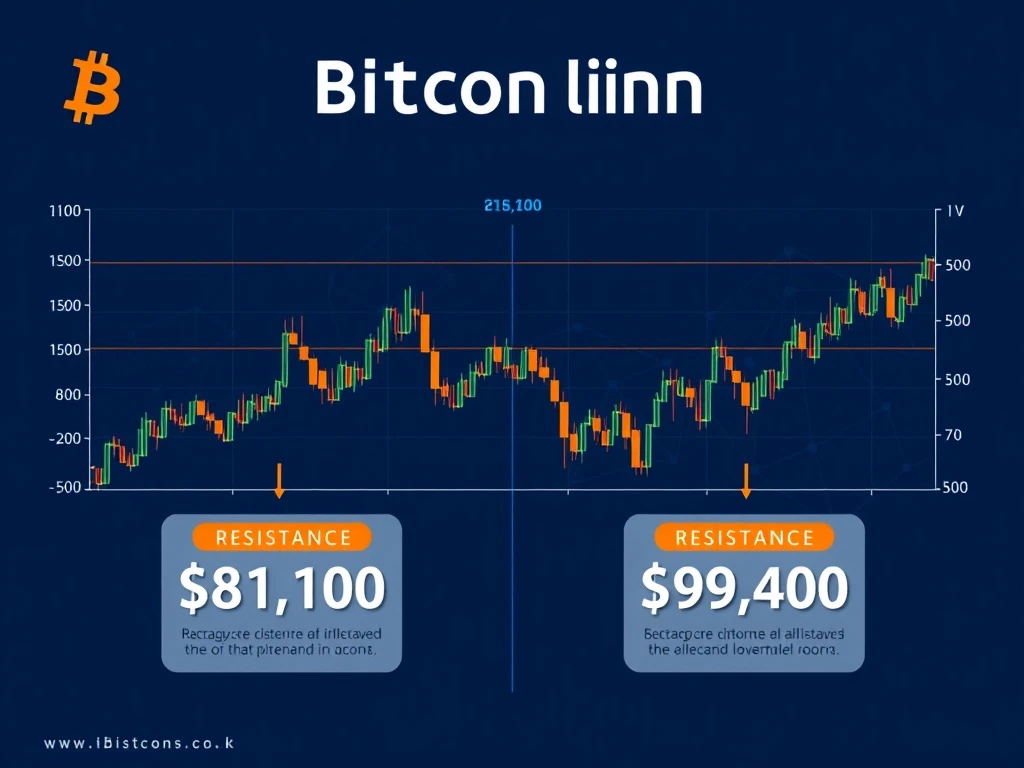
Global cryptocurrency markets face a critical juncture as Bitcoin demonstrates concerning consolidation patterns, with leading on-chain analytics firm Glassnode warning investors about potential prolonged sideways movement. According to their latest comprehensive report, Bitcoin currently trades within a defined range between $81,100 and $98,400, creating what analysts describe as a ‘price trap’ that could persist without significant demand recovery. This analysis arrives during a period of heightened market uncertainty, where institutional adoption continues to expand while retail sentiment remains cautious.
Bitcoin Price Analysis Reveals Critical Resistance Zones
Glassnode’s research team meticulously examined Bitcoin’s current market structure through multiple analytical frameworks. Their findings indicate that the $98,400 level represents more than just a psychological barrier. This price point specifically aligns with the short-term holder (STH) cost basis, creating concentrated selling pressure whenever Bitcoin approaches this threshold. The STH cohort typically includes investors who purchased Bitcoin within the last 155 days, and their behavior often signals market sentiment shifts.
Furthermore, Glassnode identified an even more substantial resistance cluster around the $100,000 mark. This zone contains significant historical supply that could impede upward momentum even if Bitcoin manages to breach the initial $98,400 barrier. The firm’s data shows that approximately 2.1 million BTC addresses acquired positions near this psychological level during previous market cycles, creating what technical analysts call a ‘supply overhang.’
The Mechanics of Range-Bound Markets
Range-bound markets typically emerge when buying and selling forces reach equilibrium. In Bitcoin’s current context, several factors contribute to this sideways movement. First, institutional accumulation continues at lower price levels, providing consistent support around $81,100. Second, profit-taking behavior intensifies near resistance zones, particularly from short-term holders seeking to realize gains. Third, macroeconomic uncertainty creates hesitation among new market entrants.
Historical data reveals that Bitcoin has experienced similar consolidation periods throughout its existence. For instance, between 2018 and 2019, Bitcoin traded within a $3,000 range for approximately 15 months before initiating its next significant bull run. Similarly, in 2020, the cryptocurrency consolidated for nearly 10 months before breaking out to new all-time highs. These precedents suggest that prolonged sideways movement, while frustrating for traders, often precedes substantial directional moves.
On-Chain Metrics Paint a Complex Picture
Glassnode’s analysis extends beyond simple price charts to examine fundamental blockchain metrics. Their report highlights several key indicators that support the sideways movement thesis:
- Network Realized Profit/Loss Ratio: This metric currently shows balanced profit-taking and loss-realization, indicating neither bulls nor bears dominate market dynamics.
- Exchange Net Flow: Bitcoin movements to exchanges have stabilized, suggesting reduced selling pressure but also limited new buying enthusiasm.
- MVRV Z-Score: This valuation metric positions Bitcoin in a neutral zone, neither severely undervalued nor overvalued relative to its realized capitalization.
- Active Address Growth: Network activity shows modest expansion but lacks the explosive growth characteristic of previous bull markets.
These metrics collectively suggest that Bitcoin exists in what analysts term a ‘waiting phase.’ Market participants appear to await clearer signals before committing to substantial directional positions. This behavior creates the perfect conditions for extended range-bound trading.
Comparative Analysis with Traditional Markets
Interestingly, Bitcoin’s current consolidation pattern mirrors developments in traditional financial markets. Major equity indices have similarly entered periods of reduced volatility and directional uncertainty. This correlation suggests that macroeconomic factors, rather than cryptocurrency-specific developments, may primarily drive current market conditions. Federal Reserve policies, inflation data, and geopolitical tensions create cross-asset class uncertainty that affects Bitcoin alongside traditional investments.
The table below illustrates key resistance and support levels identified in Glassnode’s analysis:
| Price Level | Significance | Market Impact |
|---|---|---|
| $81,100 | Primary Support Zone | Institutional accumulation area with strong buying interest |
| $98,400 | STH Cost Basis Resistance | Concentrated selling pressure from recent buyers |
| $100,000 | Psychological & Historical Resistance | Substantial supply overhang from previous cycles |
Demand Momentum: The Missing Catalyst
Glassnode’s conclusion emphasizes that without distinct recovery in demand momentum, meaningful breakout remains unlikely. Demand in cryptocurrency markets typically manifests through several channels: new capital inflows, increased network utility, or speculative enthusiasm. Currently, all three channels show moderate but insufficient activity for sustained price appreciation.
New capital inflows, as measured by stablecoin reserves on exchanges, have plateaued after significant growth earlier in the year. Network utility, while expanding through Lightning Network adoption and institutional infrastructure development, progresses at an evolutionary rather than revolutionary pace. Speculative enthusiasm, often measured through social media metrics and search trends, remains below levels associated with previous bull market peaks.
This demand analysis aligns with broader market observations. Trading volumes across major exchanges have declined approximately 30% from their yearly highs, indicating reduced participation. Similarly, options market data shows decreased positioning for extreme price movements in either direction, suggesting professional traders anticipate continued consolidation.
Historical Context and Future Scenarios
Examining Bitcoin’s price history reveals that consolidation periods typically resolve in one of three ways: breakout to new highs, breakdown to lower support levels, or continuation of the range-bound pattern. Glassnode’s current analysis suggests the third scenario appears most probable in the immediate future, given the confluence of technical and fundamental factors.
However, the firm notes that cryptocurrency markets remain exceptionally sensitive to external catalysts. Regulatory developments, macroeconomic policy shifts, or technological breakthroughs could rapidly alter the current equilibrium. For instance, clear regulatory frameworks in major economies might stimulate institutional demand, while unexpected monetary policy changes could trigger capital reallocation toward alternative assets like Bitcoin.
Conclusion
Bitcoin currently faces a challenging market environment characterized by defined resistance levels and insufficient demand momentum for sustained breakout. Glassnode’s comprehensive Bitcoin price analysis identifies specific technical barriers at $98,400 and $100,000 that require substantial buying pressure to overcome. Meanwhile, institutional support around $81,100 provides a foundation that prevents significant downside movement. This creates the perfect conditions for prolonged sideways trading that could test investor patience. Market participants should monitor on-chain metrics, particularly demand indicators and exchange flows, for early signals of the consolidation period’s resolution. Ultimately, Bitcoin’s fundamental value proposition remains intact, but current market dynamics suggest patience may prove necessary before the next significant directional move.
FAQs
Q1: What does ‘sideways movement’ mean in cryptocurrency markets?
Sideways movement refers to price action that remains within a defined range without establishing a clear upward or downward trend. This typically occurs when buying and selling forces reach equilibrium, creating consolidation periods that can last weeks or months.
Q2: How does Glassnode determine resistance and support levels?
Glassnode uses on-chain analytics to identify price levels where significant numbers of addresses acquired Bitcoin. These levels often become psychological barriers where holders may sell to break even or take profits, creating resistance, or buy to add to positions, creating support.
Q3: What is the short-term holder (STH) cost basis?
The STH cost basis represents the average acquisition price of Bitcoin purchased within the last 155 days. When Bitcoin approaches this level, recent buyers often sell to realize profits or minimize losses, creating concentrated selling pressure.
Q4: How long might Bitcoin remain in this sideways pattern?
Historical precedents suggest consolidation periods can last from several months to over a year. The duration typically depends on external catalysts, macroeconomic conditions, and developments in cryptocurrency adoption and regulation.
Q5: What indicators should investors watch for breakout signals?
Key indicators include sustained increases in trading volume, positive shifts in the Network Realized Profit/Loss ratio, significant capital inflows measured through stablecoin reserves, and breaking through identified resistance levels with conviction.
Related News
- Changpeng Zhao’s Bold Prediction: How Cryptocurrency Could Revolutionize Retirement Planning Amid AI Disruption
- Nordic Pension Funds Reassess US Holdings Amid Soaring Geopolitical Risk
- Alchemy Pay Expands U.S. Regulatory Reach with Four New Money Transmitter Licenses, Boosting Crypto Payment Legitimacy