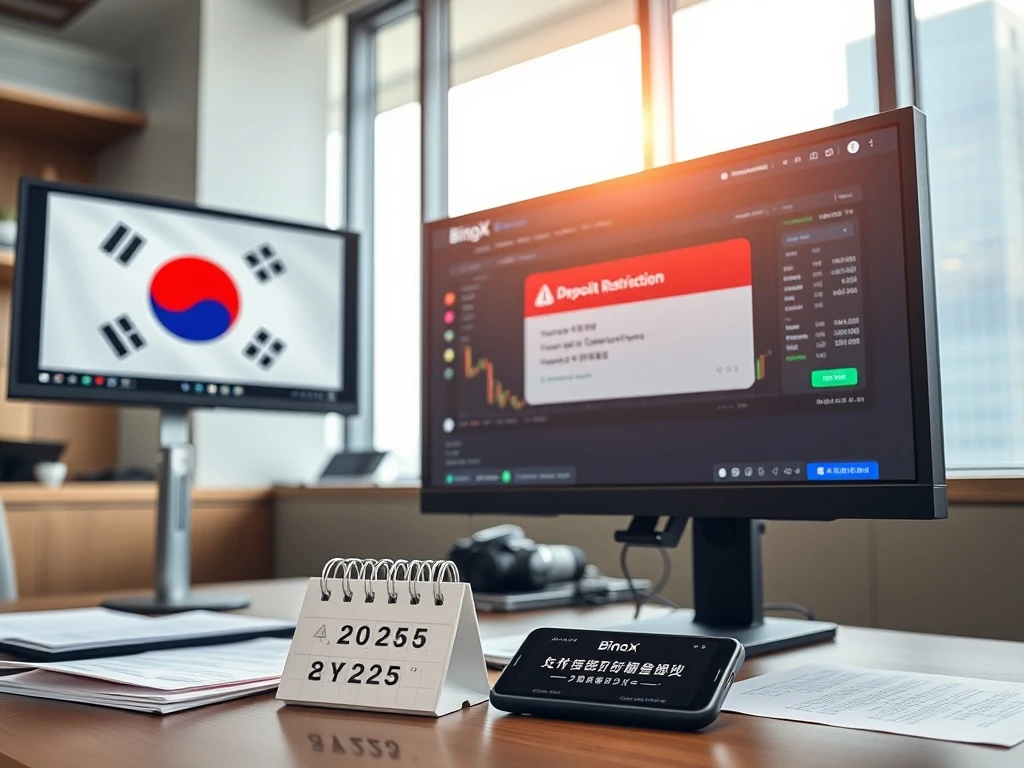
SEOUL, South Korea – March 2025: BingX, a prominent global cryptocurrency exchange, has implemented deposit restrictions for specific South Korean users, marking a significant development in the country’s ongoing regulatory tightening of digital asset platforms. This move follows coordinated actions by domestic exchanges and reflects broader compliance pressures affecting international crypto operators in one of Asia’s most active markets.
BingX South Korea Implements Deposit Restrictions
Multiple online trading communities first reported the BingX deposit limitations in early March 2025. Consequently, affected users received notifications citing “local regulatory requirements” as the primary reason. The exchange subsequently directed these users to customer service channels for further clarification. Moreover, this development represents a concrete enforcement action rather than a mere policy announcement.
Industry analysts immediately noted the timing’s significance. Specifically, the restrictions follow previous regulatory guidance affecting BingX’s standing with South Korean exchanges. For instance, both Upbit and Bithumb, the nation’s largest platforms, recently removed BingX from their lists of verified counterparties. Therefore, the deposit limitations appear connected to this broader regulatory repositioning.
South Korean Crypto Regulation Intensifies
South Korea’s financial authorities have progressively tightened digital asset regulations since 2021. The Financial Services Commission (FSC) and the Financial Intelligence Unit (FIU) lead these efforts. Their focus includes anti-money laundering (AML) compliance, user protection, and market stability. Furthermore, the Specific Financial Information Act (SFIA) amendments in 2023 mandated stricter reporting for all virtual asset service providers (VASPs).
International exchanges operating in South Korea face particular scrutiny. They must either register locally or ensure their overseas operations comply with Korean standards. The following table outlines key regulatory requirements for foreign exchanges:
| Requirement | Description | Deadline |
|---|---|---|
| Real-Name Verification | Bank partnerships for account verification | Mandatory since 2021 |
| AML Reporting | Suspicious transaction reports to FIU | Continuous |
| Travel Rule Compliance | Sender/receiver information sharing | Fully implemented 2024 |
| Exchange Verification | Domestic platforms vetting counterparts | Ongoing process |
Additionally, the Korea Financial Intelligence Unit conducts regular audits. Exchanges failing these audits risk operational limitations or complete exclusion from the Korean market.
Expert Analysis of Regulatory Trends
Financial regulation specialists observe consistent patterns in South Korea’s approach. Professor Kim Min-ji of Seoul National University’s Fintech Research Center explains, “Authorities prioritize consumer protection and systemic risk reduction. International exchanges must demonstrate robust compliance frameworks. The BingX situation likely involves specific deficiencies identified during verification processes.”
Market data supports this regulatory focus. The FSC reported a 40% increase in VASP inspections during 2024. Similarly, penalties for non-compliance rose by 65% year-over-year. These statistics indicate escalating enforcement rather than new legislation.
Immediate Impacts on Crypto Traders
South Korean users of BingX experience direct consequences from the deposit restrictions. Affected individuals cannot fund their exchange wallets through conventional methods. Therefore, they must explore alternative platforms or asset transfer mechanisms. However, many traders express frustration over limited advance notice.
The restrictions also create practical challenges:
- Portfolio Management: Users cannot rebalance positions easily
- Arbitrage Opportunities: Cross-exchange trading becomes difficult
- Withdrawal Timing: Existing assets remain accessible but new funds face blocks
- Tax Documentation: Transaction records may require manual reconciliation
Community forum discussions reveal concerns about asset security. Some users question whether restrictions precede broader account limitations. Nevertheless, BingX maintains that existing balances remain secure and withdrawable.
Comparative Analysis with Other Exchanges
BingX is not the first international exchange facing Korean regulatory challenges. Binance previously restricted Korean won trading pairs in 2021. Similarly, Bybit implemented user verification upgrades in 2023. However, the current situation differs because domestic exchanges initiated the verification removal.
The coordinated action by Upbit and Bithumb suggests regulatory coordination. Both exchanges cited “guidance from authorities” when delisting BingX as a verified counterpart. This precedent indicates possible future actions against other non-compliant platforms. Consequently, the market anticipates similar measures affecting additional international exchanges.
Technical Compliance Requirements
Exchange verification in South Korea involves multiple technical standards. Platforms must demonstrate secure wallet infrastructure, real-time monitoring systems, and reliable transaction reporting. Additionally, they need interoperable systems for travel rule compliance. Many international exchanges struggle with these specific technical integrations.
Data from the Korea Blockchain Association shows verification success rates. Only 35% of international applicants achieve full verification on first attempt. The majority require significant system modifications. This data explains why some exchanges face operational restrictions despite global presence.
Market Reactions and Price Effects
Cryptocurrency markets showed minimal direct price reaction to the BingX news. Major assets like Bitcoin and Ethereum maintained typical volatility patterns. However, Korean won trading volumes exhibited subtle shifts. Some analysts observed increased activity on fully compliant domestic platforms.
The broader implication involves market fragmentation. Regulatory divergence between jurisdictions creates operational complexities. International exchanges must navigate conflicting requirements across multiple regions. This fragmentation may eventually influence liquidity and price discovery mechanisms.
Future Implications for Global Exchanges
The BingX situation provides important lessons for cryptocurrency platforms worldwide. Regulatory compliance is becoming increasingly jurisdictional. Exceptions or waivers are disappearing as standards formalize. Therefore, exchanges must prioritize localized compliance teams and systems.
Several developments will likely follow:
- Enhanced Verification Systems: International exchanges upgrading Korean compliance
- Regional Partnerships: Collaborations with domestic financial institutions
- Technology Investments: Better integration with local regulatory systems
- User Education: Clearer communication about jurisdiction-specific rules
Market observers predict consolidation among compliant exchanges. Platforms demonstrating consistent regulatory adherence may gain competitive advantages. Conversely, exchanges ignoring jurisdictional requirements risk gradual market exclusion.
Conclusion
BingX deposit restrictions for South Korean users highlight cryptocurrency regulation’s evolving landscape. The situation demonstrates authorities’ increasing enforcement capabilities and coordination. Moreover, it underscores the importance of jurisdictional compliance for global exchanges. Affected traders must adapt to these changing conditions while monitoring broader regulatory developments. The BingX South Korea case will likely influence how international platforms approach similar markets worldwide, emphasizing that regulatory compliance is now fundamental to cryptocurrency exchange operations rather than optional.
FAQs
Q1: Why is BingX restricting deposits for South Korean users?
BingX cites local regulatory requirements as the reason. The restrictions follow South Korean exchanges Upbit and Bithumb removing BingX from their verified counterparty lists based on regulatory guidance.
Q2: Can affected users withdraw their existing funds from BingX?
Yes, according to available information. The restrictions apply specifically to new deposits. Existing balances remain accessible for withdrawal or trading, though users should confirm directly with customer service.
Q3: How does this relate to South Korea’s broader cryptocurrency regulations?
This action aligns with South Korea’s ongoing regulatory tightening under the Specific Financial Information Act. Authorities focus on anti-money laundering compliance, user protection, and proper exchange verification procedures.
Q4: Are other international exchanges facing similar restrictions in South Korea?
Several international exchanges have faced regulatory challenges in South Korea previously. The coordinated nature of recent actions against BingX suggests authorities may be applying standards more uniformly across platforms.
Q5: What should affected BingX users in South Korea do now?
Users should contact BingX customer service for specific account information. They may also consider diversifying across multiple compliant exchanges and ensuring proper documentation of all transactions for tax purposes.
Related News
- Crypto Mining Zoning Triumph: Kingsport, Tennessee Council Approves Landmark Ordinance for Digital Infrastructure
- Coinbase’s Crucial Quantum Council: Proactive Defense Against Blockchain’s Existential Threat
- Bitcoin Price Consolidates Near $90K Amid Market Volatility as Cooling PCE Inflation Fuels Remarkable Risk-On Sentiment