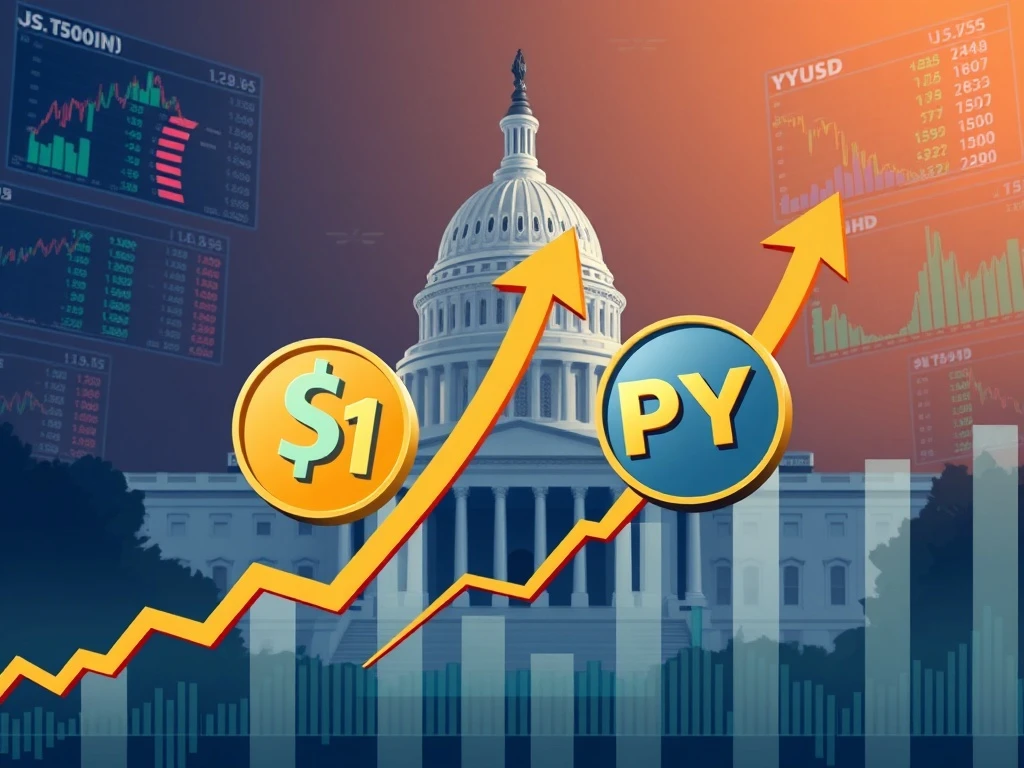
WASHINGTON, D.C., March 2025 – The cryptocurrency landscape witnesses a seismic shift as the Trump-endorsed USD1 stablecoin achieves a remarkable $4.9 billion issuance milestone, officially surpassing PayPal’s PYUSD in market capitalization. This development occurs amidst growing criticism of the project’s governance voting mechanisms, raising questions about decentralized finance principles in politically-aligned digital assets.
USD1 Stablecoin Market Dominance and Political Backing
The USD1 stablecoin now commands significant market presence with its $4.9 billion issuance. Consequently, it overtakes PayPal’s PYUSD, which currently maintains approximately $3.8 billion in circulation. This achievement represents more than mere numerical superiority. Specifically, it highlights the growing influence of politically-aligned digital assets in the stablecoin sector. The project benefits from former President Donald Trump’s endorsement, creating unique market dynamics. Furthermore, institutional adoption has accelerated since late 2024, according to blockchain analytics firm Chainalysis.
Market analysts observe several key factors driving USD1’s rapid growth. First, political alignment attracts specific investor demographics. Second, regulatory clarity improvements in 2024 created favorable conditions. Third, traditional financial institutions increasingly explore stablecoin integration. However, critics question whether political endorsement compromises decentralization principles. Meanwhile, PayPal continues expanding PYUSD’s ecosystem through merchant partnerships and cross-border payment solutions.
Governance Vote Controversy and Decentralization Concerns
Recent governance proposals within the USD1 ecosystem spark significant debate. Specifically, voting mechanisms allegedly concentrate decision-making power among early backers. Blockchain governance expert Dr. Elena Rodriguez comments, “The voting structure appears weighted toward initial stakeholders, potentially undermining true decentralized governance.” This criticism emerges as USD1 implements Protocol Upgrade Proposal 7, which modifies collateralization requirements.
The governance controversy centers on three primary issues:
- Voting Power Distribution: Approximately 60% of voting tokens remain with founding entities
- Proposal Thresholds: Community members require substantial token holdings to submit governance proposals
- Implementation Speed: Emergency provisions allow rapid changes without full community voting
Comparatively, PayPal’s PYUSD maintains centralized control through traditional corporate governance. Therefore, USD1 faces heightened scrutiny for claiming decentralized characteristics while exhibiting centralized tendencies. Blockchain transparency advocates demand improved voting mechanisms and clearer delegation processes.
Market Impact and Regulatory Implications
The stablecoin market experiences notable shifts following USD1’s ascent. Market data reveals changing investor preferences and regulatory attention. The following table illustrates key market changes between Q4 2024 and Q1 2025:
| Metric | USD1 | PYUSD | Market Average |
|---|---|---|---|
| Quarterly Growth | 42% | 18% | 22% |
| Institutional Holdings | 67% | 58% | 52% |
| Daily Transactions | 890,000 | 1.2 million | 750,000 |
| Geographic Distribution | 65% US | 48% US | 55% US |
Regulatory bodies monitor these developments closely. The Securities and Exchange Commission examines whether certain governance tokens constitute securities. Simultaneously, the Treasury Department evaluates stablecoin systemic risk factors. Federal Reserve Chair Jerome Powell recently stated, “Stablecoin growth necessitates appropriate regulatory frameworks to maintain financial stability.” Congressional committees plan hearings on politically-linked digital assets in April 2025.
Technical Architecture and Collateralization Analysis
USD1 employs a hybrid collateralization model combining traditional assets and cryptocurrency reserves. This approach differs significantly from PayPal’s fully fiat-backed structure. Technical analysis reveals USD1 maintains 82% cash and cash equivalents, 12% short-term Treasury securities, and 6% cryptocurrency reserves. Monthly attestations from auditing firm Deloitte verify these reserves since November 2024.
The technical implementation offers several advantages. First, cryptocurrency reserves provide yield generation opportunities. Second, diversified collateral reduces single-point failure risks. Third, blockchain integration enables transparent verification. However, cryptocurrency volatility introduces collateral ratio fluctuations. Therefore, the protocol implements automated rebalancing mechanisms when collateral values deviate beyond 5% thresholds.
Security audits identify potential vulnerabilities. Specifically, smart contract firm Quantstamp notes centralization risks in upgrade mechanisms. Additionally, oracle reliability concerns emerge for price feed accuracy. The development team addresses these issues through multi-signature requirements and diversified oracle networks. Meanwhile, PayPal’s centralized control allows rapid security updates but sacrifices censorship resistance.
Historical Context and Market Evolution
The stablecoin market evolves dramatically since 2020’s regulatory developments. Initially, Tether (USDT) and USD Coin (USDC) dominated the landscape. Subsequently, 2022-2023 witnessed increased regulatory scrutiny and transparency demands. Then, 2024 brought political endorsements and traditional financial institution entries. Currently, the market approaches $200 billion total capitalization with increasing diversification.
USD1’s emergence follows this historical trajectory. The project launched in early 2024 following Trump’s cryptocurrency advocacy during his presidential campaign. Initial skepticism greeted the announcement, but technical execution and marketing generated momentum. By mid-2024, USD1 achieved $1 billion issuance. Then, fourth-quarter institutional adoption propelled further growth. Now, the stablecoin challenges established players while navigating unique political associations.
Conclusion
The USD1 stablecoin achieves a significant milestone with $4.9 billion issuance, surpassing PayPal’s PYUSD in market presence. This development highlights the growing influence of politically-aligned digital assets within cryptocurrency markets. However, governance vote criticism raises important questions about decentralization principles in practice. Market evolution continues as regulatory frameworks develop and institutional adoption increases. The USD1 stablecoin story demonstrates how digital assets intersect with politics, finance, and technology in 2025’s financial landscape.
FAQs
Q1: What makes USD1 different from other stablecoins?
USD1 combines political endorsement with hybrid collateralization, maintaining both traditional assets and cryptocurrency reserves while facing unique governance challenges.
Q2: How does USD1’s governance system work?
The system uses token-based voting where holders participate in protocol decisions, though criticism centers on voting power concentration among early stakeholders.
Q3: Why is USD1 growing faster than PayPal’s PYUSD?
Political alignment attracts specific investors, while hybrid collateralization offers yield opportunities that fully fiat-backed stablecoins cannot provide.
Q4: What are the main criticisms of USD1?
Critics highlight governance centralization concerns, political association risks, and collateral volatility from cryptocurrency reserve components.
Q5: How are regulators responding to USD1’s growth?
Multiple agencies examine securities classification, systemic risk factors, and appropriate regulatory frameworks for politically-linked digital assets.
Related News
- DEX Aster Launches Thrilling $75K Trading Competitions to Boost Platform Engagement
- MicroStrategy’s Masterstroke: ‘Unstoppable Orange’ Strategy Amasses Additional 2,932 Bitcoin in Latest Treasury Move
- Bitcoin ETF Revolution: BlackRock’s Groundbreaking Income Strategy Filing Shakes Crypto Markets