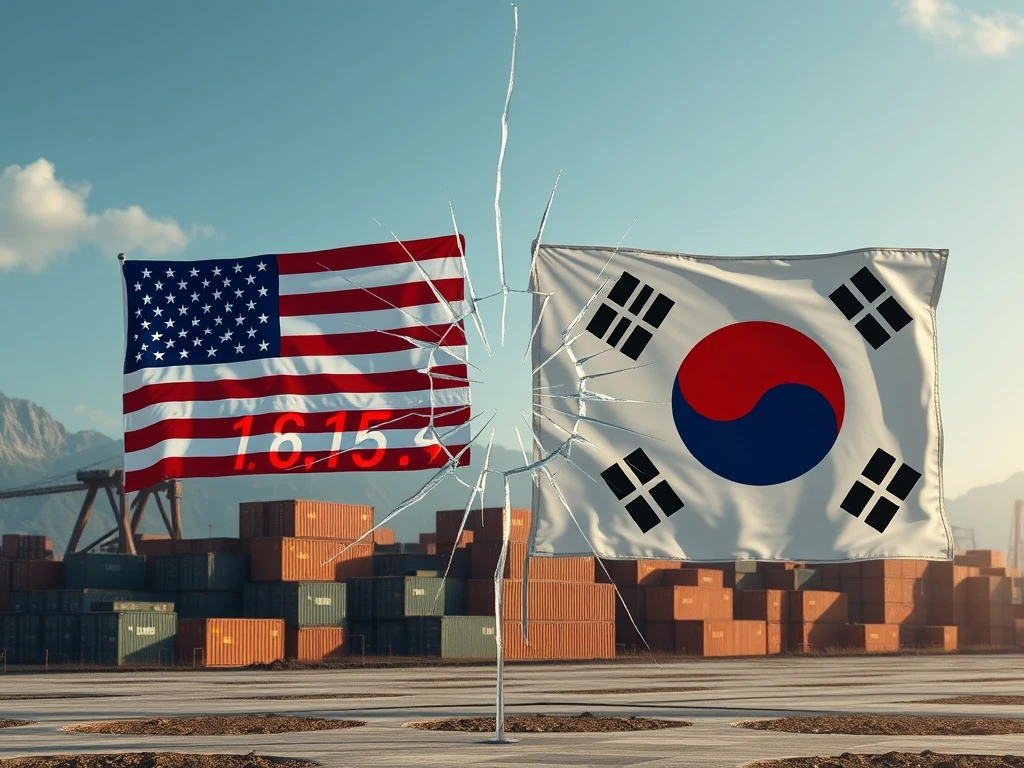
WASHINGTON, D.C., March 15, 2025 – In a move that sent shockwaves through global markets, former President Donald Trump announced his intention to impose 25% tariffs on South Korean goods, citing significant delays in bilateral trade negotiations. This dramatic escalation threatens to unravel the carefully constructed economic partnership between the United States and its key Asian ally, potentially triggering retaliatory measures and disrupting supply chains across multiple industries.
Trump’s Tariff Announcement and Immediate Context
Former President Trump made his declaration during a campaign rally in Michigan yesterday evening. He specifically referenced what he called “unacceptable delays” in renegotiating terms of the United States-Korea Free Trade Agreement (KORUS FTA). Consequently, this announcement represents the most significant trade policy statement from the Trump campaign during the current election cycle. The proposed tariffs would mark a substantial increase from current levels, which average between 2-3% for most Korean imports under existing agreements.
Market reactions were swift and negative. The South Korean won immediately fell 1.8% against the US dollar in Asian trading. Additionally, shares of major Korean exporters like Samsung Electronics and Hyundai Motor dropped by 3-5% in early trading. Meanwhile, US companies with significant Korean supply chains, particularly in the automotive and electronics sectors, saw their stock prices decline on fears of increased costs and potential disruptions.
Historical Background of US-South Korea Trade Relations
The United States and South Korea have maintained a complex trade relationship for decades. The original KORUS FTA took effect in 2012 after five years of negotiations. However, the Trump administration renegotiated the agreement in 2018, resulting in modified terms for automotive trade and agricultural exports. These modifications included extending US tariffs on Korean trucks until 2041 and increasing Korean quotas for US automobile imports.
Since the 2018 revisions, bilateral trade has grown substantially. According to US Census Bureau data, two-way goods trade reached $168 billion in 2023. South Korea represents America’s sixth-largest goods trading partner. Major US exports to Korea include machinery, aircraft, and agricultural products. Conversely, Korea primarily exports vehicles, machinery, and electrical equipment to the United States.
Expert Analysis of the Tariff Threat
Trade policy experts express deep concern about the potential consequences. Dr. Eleanor Vance, former US Trade Representative negotiator, explains, “A 25% tariff on Korean goods would violate existing trade agreement commitments. Such action would likely trigger immediate dispute settlement proceedings under the KORUS agreement and potentially at the World Trade Organization.” She further notes that South Korea would have legitimate grounds for proportional retaliation under international trade rules.
Industry analysts highlight specific sectors that would face immediate impact. The automotive industry represents the most significant concern, with Hyundai and Kia accounting for nearly 9% of the US market. Electronics manufacturing would also face severe disruption, given Korea’s dominant position in semiconductor and display panel production. These components are essential for numerous American technology products.
Potential Economic Impacts and Market Reactions
The proposed tariffs would affect numerous sectors of both economies. A 25% tariff on Korean vehicles could increase prices for popular models by $4,000 to $8,000. This price increase would likely reduce sales and potentially lead to job losses in US dealership networks. Furthermore, American manufacturers relying on Korean components would face increased production costs, potentially making their products less competitive globally.
Supply chain experts warn of broader implications. “Korean companies provide critical inputs for everything from smartphones to electric vehicles,” notes supply chain analyst Marcus Chen. “Disrupting these flows could delay product launches, increase consumer prices, and force costly reconfiguration of manufacturing networks that have developed over thirty years.”
The following table illustrates key trade statistics between the US and South Korea:
| Category | 2023 Value (USD) | Primary Products |
|---|---|---|
| US Exports to Korea | $82.4 billion | Machinery, Aircraft, Agricultural |
| US Imports from Korea | $85.6 billion | Vehicles, Semiconductors, Machinery |
| Trade Balance | -$3.2 billion deficit | Favorable to Korea |
Political and Diplomatic Implications
The timing of this announcement carries significant political weight. With the 2024 presidential election approaching, trade policy has emerged as a central campaign issue. The Trump campaign appears to be returning to the “America First” trade policies that characterized his previous administration. Meanwhile, the Biden administration has maintained the renegotiated KORUS agreement while pursuing additional cooperation through the Indo-Pacific Economic Framework.
Diplomatic relations between Washington and Seoul remain strong despite trade tensions. The two countries maintain a crucial military alliance, with approximately 28,500 US troops stationed in South Korea. Security analysts emphasize that economic disputes rarely affect security cooperation between the two nations. However, prolonged trade conflicts could create diplomatic friction that adversaries might exploit in the region.
Comparative Analysis with Previous Trade Actions
This announcement follows a pattern from the Trump administration’s first term. In 2018, the administration imposed 25% tariffs on steel imports and 10% tariffs on aluminum imports from most countries, including South Korea. However, Korea received exemptions from these tariffs after agreeing to quota limitations. The current proposal appears broader in scope, potentially affecting a wider range of products beyond metals.
Previous tariff actions provide insight into potential outcomes. The Section 301 tariffs on Chinese goods resulted in:
- Price increases for affected products averaging 20-25%
- Supply chain diversification away from China to Southeast Asia
- Retaliatory tariffs on US agricultural exports
- Limited manufacturing return to the United States
Similar patterns might emerge if tariffs on Korean goods become reality. However, Korea’s position as a treaty ally and security partner creates different dynamics than the US-China relationship.
Industry-Specific Consequences and Preparedness
Different sectors face varying levels of exposure to potential tariffs. The automotive industry has the highest visibility, but other industries would experience significant impacts:
Electronics and Semiconductors: Korea supplies approximately 40% of the world’s memory chips. Tariffs on these components would increase costs for virtually all electronic device manufacturers. Companies like Apple, Dell, and HP would face immediate pressure on margins.
Chemical and Industrial Products: Korea is a major producer of advanced chemicals, batteries, and industrial materials. These inputs are essential for numerous manufacturing processes. Tariffs would increase production costs across multiple industries simultaneously.
Consumer Goods: From smartphones to home appliances, Korean brands hold significant market share. Price increases would likely reduce consumer demand, affecting both Korean manufacturers and US retailers.
Many companies began diversifying their supply chains following previous trade tensions. However, complete diversification away from Korean suppliers remains challenging due to their technological leadership in several sectors. The specialized nature of Korean manufacturing creates significant barriers to rapid substitution.
Legal and Regulatory Framework Considerations
The implementation of these tariffs would face numerous legal hurdles. Under US trade law, the president possesses broad authority to adjust tariffs for national security reasons or to address trade imbalances. However, existing trade agreements create binding commitments that cannot be unilaterally altered without specific justifications.
The KORUS agreement includes detailed dispute settlement procedures. South Korea would almost certainly initiate these procedures if tariffs were implemented. Additionally, the World Trade Organization provides another venue for challenging what would likely be viewed as protectionist measures inconsistent with international trade rules.
Legal experts note that previous tariff actions faced numerous court challenges. While courts have generally deferred to executive authority on trade matters, the scale and targeting of these proposed tariffs might prompt more rigorous judicial scrutiny, particularly regarding their consistency with existing trade agreements ratified by Congress.
Conclusion
President Trump’s announcement of 25% tariffs on South Korean goods represents a significant escalation in trade policy rhetoric with potentially far-reaching consequences. While campaign statements do not always translate into implemented policy, the mere proposal has already affected financial markets and business planning. The United States and South Korea have built a deep economic partnership over decades, with integrated supply chains benefiting both nations. Disrupting this relationship through substantial tariffs would create economic costs for American consumers and businesses while testing an important diplomatic alliance. As the political campaign progresses, trade policy will remain a critical issue with direct implications for global economic stability and international relations.
FAQs
Q1: What specific goods would be affected by the proposed 25% tariffs?
A1: While President Trump did not specify particular products, trade analysts expect tariffs would primarily target major Korean exports to the US: automobiles and auto parts, electronics (especially semiconductors and displays), machinery, and certain chemical products. The exact product list would be determined through regulatory processes if the policy is implemented.
Q2: How would these tariffs differ from previous US tariffs on Korean goods?
A2: Previous tariffs under the Trump administration focused primarily on steel and aluminum, with Korea receiving exemptions after accepting quotas. The current proposal appears broader, potentially affecting a wider range of manufactured goods at significantly higher rates (25% versus previous 10-25% on limited products).
Q3: Can South Korea retaliate against these tariffs legally?
A3: Yes, under both the KORUS agreement and World Trade Organization rules, South Korea could impose proportional retaliatory tariffs on US exports if it successfully argues that US tariffs violate trade agreements. Retaliation would likely target politically sensitive US exports like agricultural products, aircraft, or machinery.
Q4: How quickly could these tariffs be implemented if proposed?
A4: Implementation would require regulatory procedures including public notice, comment periods, and hearings—a process typically taking 4-8 months. However, certain emergency authorities could potentially accelerate implementation, particularly if justified by national security concerns.
Q5: What would be the impact on US consumers and businesses?
A5: Consumers would face higher prices for Korean-made products including vehicles, electronics, and appliances. Businesses relying on Korean components would experience increased production costs, potentially leading to reduced competitiveness, lower profits, or job cuts in affected industries.
Q6: How might this affect the broader US trade relationship with Asia?
A6: Tariffs on South Korea could signal a broader shift toward protectionism, potentially affecting trade with other Asian partners. Allies like Japan and Taiwan might become concerned about similar treatment, while competitors like China might exploit divisions between the US and its allies to strengthen their regional economic position.
Related News
- Ethereum Whale’s Astounding $248M Gemini Deposit After 9-Year Dormancy Unlocks 32x Profit
- Ripple Saudi Arabia Partnership: A Visionary Leap as Kingdom’s Fintech Ambition Ignites
- Altcoin Season Index Climbs to 29: A Crucial Signal for Crypto Market Dynamics