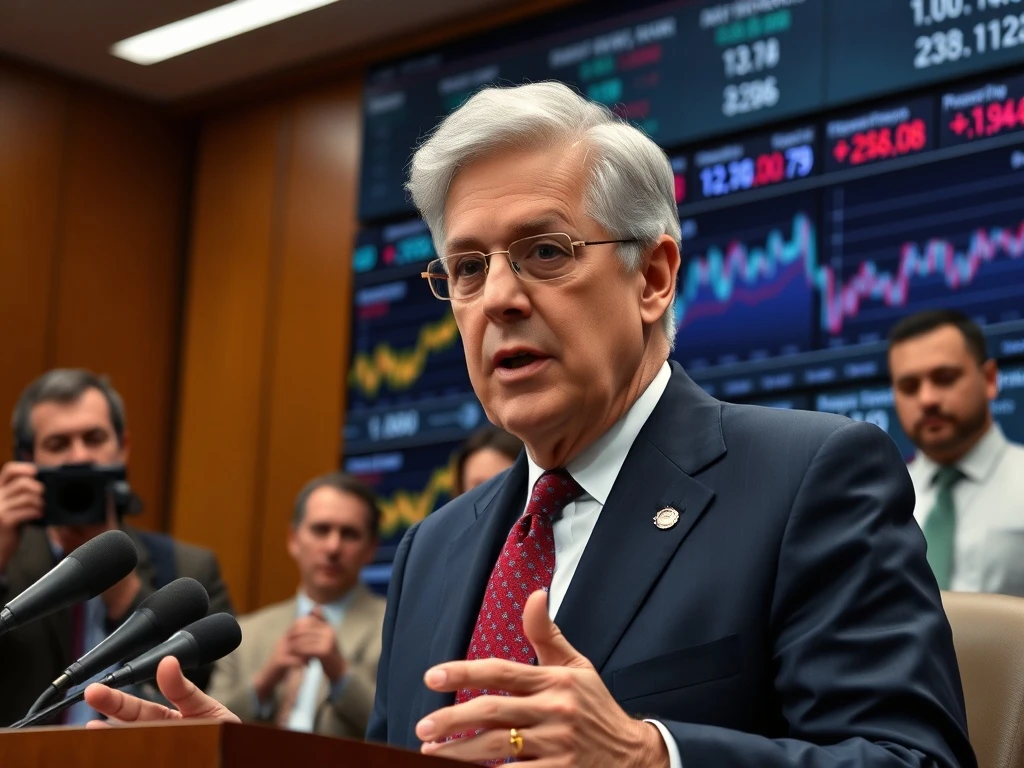
WASHINGTON, D.C. – March 2025: Federal Reserve Chair Jerome Powell delivered a sobering message to financial markets and policymakers today, stating unequivocally that inflation has not yet reached the central bank’s 2% target despite significant progress over the past three years. This declaration comes at a critical juncture for global economic stability and monetary policy direction.
Understanding Powell’s Inflation Target Assessment
Federal Reserve Chair Jerome Powell emphasized during his quarterly testimony before Congress that while inflation metrics have declined substantially from their 2022-2023 peaks, the current readings remain above the Federal Open Market Committee’s established 2% target. The central bank uses the Personal Consumption Expenditures (PCE) price index as its primary inflation gauge, which currently stands at approximately 2.4% according to the latest Bureau of Economic Analysis data.
This persistent gap between actual inflation and the target rate represents a significant challenge for monetary policymakers. The Federal Reserve has maintained its benchmark interest rate within a restrictive range of 4.25-4.50% since late 2024, reflecting continued concerns about price stability. Powell noted that service sector inflation, particularly in housing and healthcare, continues to demonstrate concerning stickiness despite goods inflation normalization.
The Historical Context of Inflation Targeting
The Federal Reserve formally adopted its 2% inflation target in January 2012 under then-Chair Ben Bernanke, establishing a clear framework for price stability objectives. This target represents what economists call “symmetrical inflation targeting,” meaning the Fed aims for inflation to average 2% over time, allowing for temporary deviations in both directions. However, the post-pandemic period has tested this framework severely.
Between 2021 and 2023, inflation surged to levels not seen since the early 1980s, peaking at 7.1% for the PCE index in June 2022. The Federal Reserve responded with the most aggressive tightening cycle in four decades, raising the federal funds rate from near-zero to its current restrictive level. While this policy succeeded in cooling inflation from its peak, the journey back to the 2% target has proven more challenging than many economists anticipated.
Expert Analysis: The Last Mile Problem
Economists frequently describe the final phase of inflation reduction as “the last mile problem,” drawing parallels to telecommunications infrastructure challenges. Dr. Michelle Gonzalez, former Federal Reserve economist and current director of the Peterson Institute for International Economics, explains this phenomenon: “The initial disinflation from peak levels responds relatively predictably to monetary tightening. However, the final descent to target often encounters structural resistance from wage-price spirals, supply chain rigidities, and inflationary expectations becoming embedded in economic behavior.”
Recent labor market data supports this analysis. The March 2025 employment report showed wage growth at 4.1% annually, substantially above the 3-3.5% range most economists consider compatible with 2% inflation. Service sector businesses continue to report significant labor cost pressures, particularly in healthcare, education, and hospitality industries where automation opportunities remain limited.
Global Implications and Comparative Analysis
The Federal Reserve’s inflation challenge mirrors similar struggles at other major central banks worldwide. The European Central Bank continues to grapple with inflation readings around 2.6%, while the Bank of England faces even more persistent price pressures at approximately 3.2%. This global synchronization of inflation persistence suggests structural factors beyond domestic monetary policy may be at play.
Several key factors contribute to this international phenomenon:
- Demographic shifts creating labor market tightness across developed economies
- Geopolitical fragmentation disrupting previously efficient global supply chains
- Climate transition costs embedding themselves in energy and food prices
- Housing shortages in major urban centers driving shelter inflation
These structural elements create what economists call “inflation persistence,” making the final descent to target particularly challenging for monetary policymakers who primarily influence demand-side factors through interest rate adjustments.
Market Reactions and Forward Guidance
Financial markets responded immediately to Powell’s remarks, with Treasury yields rising across the curve as traders priced in a higher probability of maintained restrictive policy. The two-year Treasury note yield increased by 12 basis points to 4.35%, while equity markets experienced sector-specific volatility. Interest-rate-sensitive sectors like real estate and technology underperformed, while energy and materials stocks showed relative strength.
Powell’s forward guidance contained several important elements for market participants:
| Policy Element | Current Stance | Market Implication |
|---|---|---|
| Interest Rate Path | On hold until confidence in 2% target | Delayed rate cut expectations |
| Balance Sheet Reduction | Continuing at current pace | Gradual liquidity withdrawal |
| Data Dependence | Heightened focus on inflation metrics | Increased volatility around data releases |
The Federal Reserve Chair emphasized that future policy decisions would remain “data-dependent,” with particular attention to monthly inflation reports, labor market conditions, and inflation expectations surveys. This approach represents a continuation of the framework established during the post-pandemic normalization period, prioritizing observable economic outcomes over calendar-based guidance.
The Role of Inflation Expectations
Perhaps the most critical element in Powell’s assessment concerns inflation expectations. The University of Michigan’s Survey of Consumers shows one-year inflation expectations at 3.1%, while the five-year outlook stands at 2.8%. These figures remain elevated compared to the pre-pandemic average of approximately 2.3-2.5%. When businesses and consumers expect higher future inflation, they frequently adjust pricing and wage demands accordingly, creating a self-fulfilling prophecy.
Federal Reserve research indicates that well-anchored inflation expectations represent the cornerstone of effective monetary policy. When the public trusts the central bank to maintain price stability, temporary price shocks have limited second-round effects. Powell’s emphasis on the inflation target reflects this understanding, signaling the Fed’s commitment to restoring that credibility even at the cost of extended restrictive policy.
Economic Impact and Sector Analysis
The persistence of above-target inflation creates distinct economic consequences across different sectors. Consumer discretionary spending faces continued pressure from reduced purchasing power, particularly affecting lower-income households. Meanwhile, businesses confront margin compression as they balance input cost increases against consumer price sensitivity.
Several sectors demonstrate particular vulnerability to the current inflation environment:
- Housing: Mortgage rates near 7% continue to constrain affordability
- Automotive: Elevated financing costs suppress vehicle demand
- Retail: Consumers trade down to value-oriented alternatives
- Manufacturing: Input cost volatility complicates production planning
Conversely, some sectors benefit from the current environment. Financial institutions experience improved net interest margins, while commodity producers benefit from elevated prices. Healthcare and essential services demonstrate relative resilience due to inelastic demand characteristics.
Conclusion
Federal Reserve Chair Jerome Powell’s clear statement that inflation has not yet reached the central bank’s 2% target establishes important parameters for monetary policy in 2025. This assessment reflects both measurable economic data and strategic policy considerations regarding inflation expectations and credibility. The path forward requires careful balance between maintaining restrictive policy to complete the disinflation process while avoiding unnecessary economic damage. As markets adjust to this reality, investors and policymakers alike must recognize that the final phase of inflation normalization may prove more protracted than initially anticipated, demanding patience and data-responsive flexibility from all economic participants.
FAQs
Q1: What specific inflation metric does the Federal Reserve target?
The Federal Reserve primarily targets the Personal Consumption Expenditures (PCE) price index, aiming for 2% inflation over the longer run. This index receives preference over the Consumer Price Index (CPI) because it better accounts for consumer substitution between goods and services.
Q2: How far is current inflation from the Fed’s target?
Based on the latest available data, the PCE index stands at approximately 2.4%, representing a 0.4 percentage point gap from the 2% target. This gap has narrowed significantly from the 5.1 percentage point difference at the inflation peak in 2022.
Q3: What factors make the “last mile” of inflation reduction particularly challenging?
Service sector inflation demonstrates greater persistence due to labor-intensive production, limited automation potential, and strong demand. Housing costs also show slow responsiveness to monetary policy, while inflation expectations can become embedded in economic behavior.
Q4: How does above-target inflation affect Federal Reserve interest rate decisions?
Sustained above-target inflation typically delays interest rate reductions and may necessitate maintaining restrictive policy for extended periods. The Fed prioritizes price stability as its primary mandate, making inflation outcomes the dominant factor in rate decisions.
Q5: What would signal that inflation is sustainably returning to target?
The Federal Reserve looks for multiple months of core PCE inflation at or below 2%, accompanied by moderating wage growth and stable inflation expectations. Broad-based improvement across goods and services sectors provides greater confidence than temporary improvements in specific categories.
Related News
- SEC Tokenized Securities Guidance: Landmark 2025 Rules Transform Digital Asset Regulation
- XRP Secures Decisive Victory as Federal Court Dismisses Major Class-Action Lawsuit
- Coinbase Listing Roadmap Sparks Excitement with HYPE Token Addition