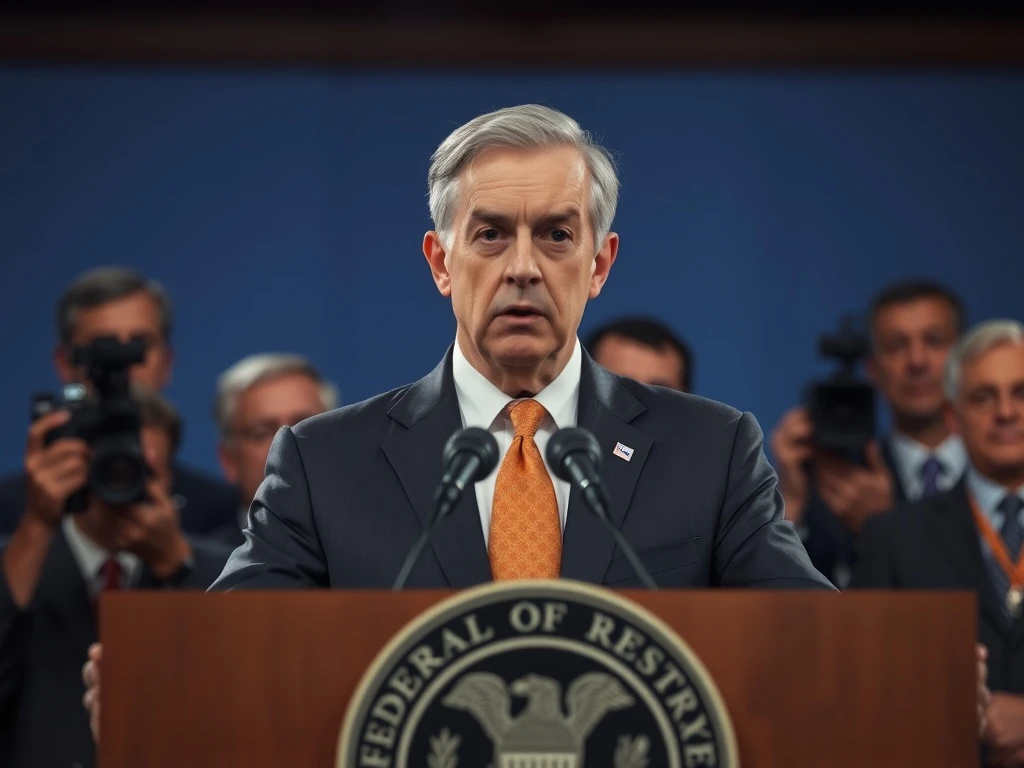
WASHINGTON, D.C. – Federal Reserve Chair Jerome Powell delivered a stark warning this week, asserting the central bank would fundamentally lose its credibility if it were to lose its hard-won independence. His remarks, made during a carefully monitored press conference, follow escalating concerns about political pressures and a confirmed federal investigation into the chair’s conduct. This development raises profound questions about the stability of the world’s most influential financial institution at a critical economic juncture.
Federal Reserve Independence Faces Unprecedented Scrutiny
Chair Powell addressed reporters directly, stating he does not believe the Federal Reserve will actually lose its operational autonomy. However, his explicit linkage of independence to institutional credibility marks a significant rhetorical escalation. Historically, the Fed’s ability to set interest rates and manage monetary policy without direct political interference has been a cornerstone of U.S. economic policy. Consequently, any threat to this arrangement sends shockwaves through global markets.
This statement follows revelations that U.S. federal prosecutors have launched an inquiry into Powell. While specific details remain confidential, sources confirm the investigation relates to communications and potential conflicts of interest. The Justice Department has not commented publicly, but the mere existence of a probe introduces substantial uncertainty. Market analysts immediately noted increased volatility in bond futures as investors processed the implications.
The Historical Foundation of Central Bank Autonomy
To understand the gravity of Powell’s warning, one must examine the Fed’s historical evolution. Congress established the Federal Reserve System in 1913 to provide a stable financial framework. Crucially, later amendments, particularly after the inflationary crises of the 1970s, cemented its independent status. This structure deliberately insulates monetary policy decisions from short-term political cycles.
Economists universally agree that independent central banks better control inflation. For instance, a 2023 study by the Brookings Institution analyzed 50 years of global data. It found that countries with independent central banks averaged inflation rates 3-5 percentage points lower than those without. The table below illustrates key benefits of central bank independence:
| Benefit | Economic Impact |
|---|---|
| Long-term Price Stability | Anchors inflation expectations, enabling sustainable growth. |
| Credible Policy Signaling | Markets trust forward guidance, reducing volatility. |
| Insulation from Political Pressure | Allows unpopular but necessary rate hikes to curb inflation. |
| International Confidence | Strengthens the dollar’s reserve currency status. |
Former Fed Chair Paul Volcker famously leveraged this independence in the early 1980s. He raised interest rates dramatically to break the back of double-digit inflation, despite causing a severe recession. That painful but necessary decision, made possible by Fed autonomy, laid the foundation for decades of economic expansion.
Expert Analysis on the Current Threat Environment
Dr. Sarah Jensen, a former Fed economist now at the Peterson Institute, provided context. “Chair Powell’s statement is not hypothetical,” she explained. “It’s a direct response to a tangible risk. The Fed’s power derives entirely from market belief in its impartiality and long-term focus. If actors believe policy is politically directed, that belief evaporates overnight.”
Jensen further noted that credibility operates like a bank account. “The Fed spends credibility to guide markets through crises—like the pandemic or bank failures. An investigation, especially one with unclear scope, forces the institution to defend itself rather than focus on its dual mandate of price stability and maximum employment.”
Immediate Market Reactions and Global Ripples
Financial markets reacted with notable caution following Powell’s remarks and news of the investigation. The yield on the 10-year Treasury note exhibited unusual intraday swings. Meanwhile, the VIX volatility index, often called the “fear gauge,” spiked by 15% in the subsequent trading session. International observers also expressed concern.
Christine Lagarde, President of the European Central Bank, referenced the situation indirectly in a Frankfurt speech. “The institutional integrity of major central banks is a global public good,” she stated. “We monitor developments that could affect cross-border financial stability.” Her comments underscore how Fed independence is not merely a domestic U.S. issue but a pillar of the international financial system.
The potential impacts are multifaceted and severe:
- Monetary Policy Uncertainty: Markets may discount future Fed guidance, making inflation control harder.
- Currency Volatility: The U.S. dollar could face pressure if institutional trust erodes.
- Political Polarization: The Fed could become a partisan battleground, damaging its technocratic reputation.
- Investor Retreat: Long-term institutional investors might seek assets in jurisdictions with more predictable policy frameworks.
Legal and Political Dimensions of the Federal Probe
The investigation by federal prosecutors remains shrouded in typical Justice Department secrecy. Legal experts suggest several potential foci, all relating to the boundary between independent policy and permissible external communication. One area of scrutiny could be private meetings with market participants. Another might involve communications with administration officials during sensitive policy periods.
Constitutional scholar Michael Torres from Georgetown University Law Center outlined the stakes. “The Federal Reserve Act grants independence, but it exists within a constitutional system of checks and balances,” Torres said. “An investigation tests that balance. It must be thorough enough to ensure accountability yet circumspect enough to avoid being perceived as a political weapon that itself undermines independence.”
Congressional response has split along partisan lines. Key Senate Banking Committee members issued contrasting statements. This division highlights the fragile political consensus that has historically protected the Fed from overt manipulation. The coming weeks will likely see intense oversight hearings, placing Powell and the concept of independence under a glaring public spotlight.
Conclusion
Federal Reserve Chair Jerome Powell’s stark warning about credibility and independence arrives at a precarious moment for the global economy. The central bank continues its battle against inflation while navigating the aftermath of regional banking stress. An investigation, regardless of its ultimate findings, introduces a dangerous variable: doubt. The Federal Reserve’s effectiveness hinges entirely on the belief that its decisions are data-driven, not politically motivated. Powell’s public statement serves as both a defense of this principle and a reminder of its fragility. The coming months will critically test whether the institutional guardrails protecting Federal Reserve independence can withstand simultaneous legal and political pressures.
FAQs
Q1: What did Jerome Powell actually say about Federal Reserve independence?
Chair Powell stated explicitly that the Federal Reserve would lose its credibility if it lost its operational independence. He made this comment while affirming his belief that such a loss of independence will not occur.
Q2: Why is Federal Reserve independence considered so important?
Independence allows the Fed to make politically difficult but economically necessary decisions, like raising interest rates to fight inflation, without short-term electoral pressure. This leads to greater long-term price stability and economic growth.
Q3: What is the federal investigation into Jerome Powell about?
While full details are not public, confirmed reports indicate U.S. federal prosecutors are investigating the chair. The inquiry likely focuses on communications and adherence to ethics guidelines, though its precise scope remains confidential.
Q4: How have financial markets reacted to this news?
Markets have shown increased volatility, particularly in Treasury bonds. The situation has introduced uncertainty about future monetary policy, causing investors to demand higher risk premiums.
Q5: Has a Fed Chair ever been investigated before?
While Fed officials have faced scrutiny, a formal federal investigation of a sitting Chair is exceptionally rare. It represents an unprecedented challenge to the institution’s norm of insulated operation.
Related News
- SEC Tokenized Securities Guidance: Landmark 2025 Rules Transform Digital Asset Regulation
- XRP Secures Decisive Victory as Federal Court Dismisses Major Class-Action Lawsuit
- Coinbase Listing Roadmap Sparks Excitement with HYPE Token Addition