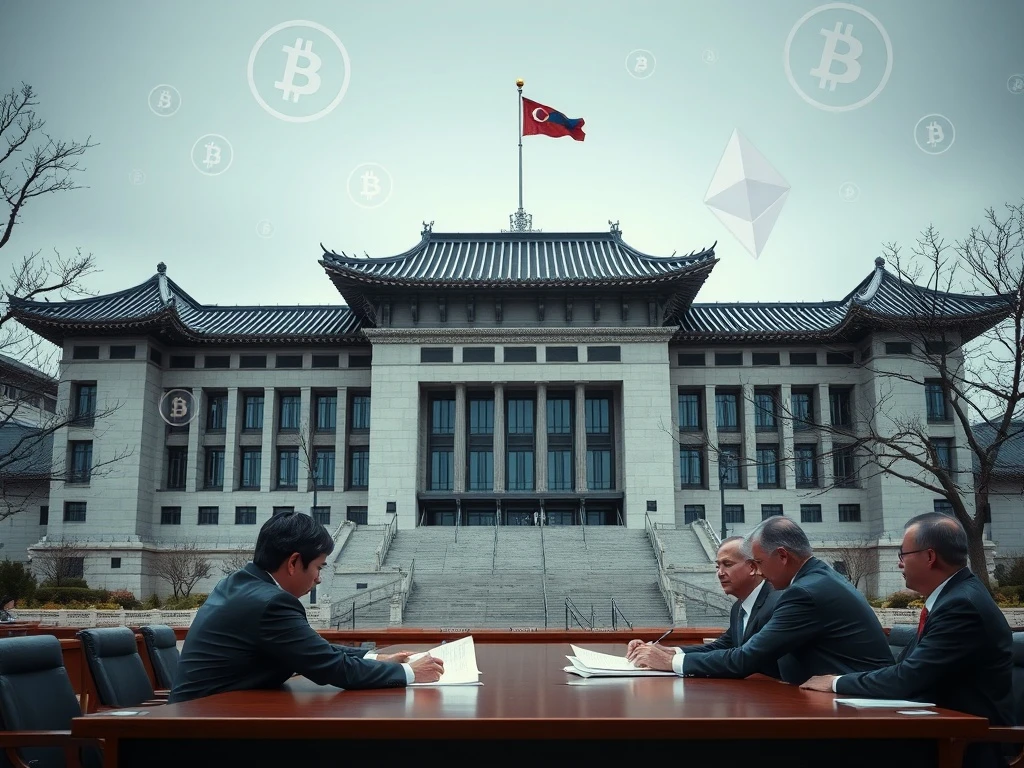
SEOUL, South Korea – A significant political clash has emerged in South Korea’s cryptocurrency landscape as the ruling People Power Party publicly opposes the Financial Services Commission’s proposed stake limit for major shareholders of digital asset exchanges. This regulatory confrontation, reported by Edaily in early 2025, reveals deep divisions within South Korea’s approach to governing its substantial cryptocurrency market, which ranks among the world’s most active and technologically advanced.
South Korea’s Crypto Regulation Faces Political Opposition
The Financial Services Commission’s legislative push to impose ownership restrictions on cryptocurrency exchange stakeholders has encountered substantial resistance from within the government itself. Representative Kim Sang-hoon, a prominent member of the National Assembly’s Political Affairs Committee, leads this opposition as chairman of the PPP’s special committee on stock and digital asset value-up. His arguments center on timing and potential economic consequences rather than principle.
Kim contends that implementing such regulations now creates problematic precedents. He specifically argues that management responsibility lines would become blurred under the proposed framework. Furthermore, he warns about potential capital flight from South Korea’s cryptocurrency sector. This concern stems from the nation’s position as a global leader in cryptocurrency adoption and trading volume.
Historical Context of South Korea’s Digital Asset Regulation
South Korea’s cryptocurrency journey began over a decade ago with minimal regulatory oversight. The market developed organically until 2017 when trading volumes skyrocketed, prompting initial government responses. Since then, regulatory approaches have evolved through several distinct phases:
- 2017-2018: Initial regulatory responses to cryptocurrency trading boom
- 2020: Implementation of real-name trading accounts and anti-money laundering measures
- 2021: Passage of the Specific Financial Information Act providing legal framework
- 2023-2024: Development of comprehensive exchange licensing requirements
- 2025: Current debate over ownership and stake limitations
Representative Kim emphasizes this historical progression in his criticism. He argues that ownership rules should have been established during the market’s formative years. Implementing them now, according to his perspective, represents regulatory overreach that could destabilize established market structures.
Expert Perspectives on Exchange Ownership Regulations
Financial regulation experts globally monitor South Korea’s approach as a potential model for other nations. Professor Lee Min-woo of Seoul National University’s Business School notes, “Exchange ownership regulations represent a complex balancing act. While concentrated ownership raises governance concerns, sudden restrictions can create market instability.” This perspective highlights the technical challenges facing regulators worldwide.
International comparisons reveal diverse approaches to exchange governance. Japan employs strict licensing requirements without specific ownership caps. Meanwhile, Singapore focuses on anti-money laundering compliance rather than ownership structures. The United States employs a state-by-state approach with varying requirements. South Korea’s proposed stake limit would therefore represent a distinctive regulatory innovation with uncertain consequences.
Economic Implications of the Proposed Stake Limit
The potential economic impacts of the FSC’s proposal extend beyond cryptocurrency exchanges themselves. South Korea’s technology sector, particularly blockchain development companies, could experience secondary effects. These companies often maintain close relationships with trading platforms through investment and partnership arrangements.
| Area of Impact | Potential Positive Effects | Potential Negative Effects |
|---|---|---|
| Market Competition | Increased exchange diversity | Reduced investment in existing platforms |
| Investor Protection | Improved governance structures | Capital flight to less regulated markets |
| Innovation Pace | More distributed development | Reduced risk-taking by major players |
| International Position | Enhanced regulatory reputation | Competitive disadvantage versus other markets |
Financial analysts note that South Korea’s cryptocurrency market represents significant economic activity. The nation’s major exchanges process billions in daily trading volume. Consequently, regulatory changes could influence broader financial stability. This concern particularly applies to retail investors who dominate South Korea’s cryptocurrency trading landscape.
The Political Dynamics of Cryptocurrency Regulation
Representative Kim’s criticism extends beyond technical arguments to political dimensions. He suggests the FSC pursues regulations not included in its original proposals. Furthermore, he references “unseen forces from above” influencing the commission’s current direction. This language indicates complex bureaucratic and political dynamics shaping cryptocurrency policy.
The People Power Party’s opposition reflects evolving political considerations surrounding digital assets. Cryptocurrency ownership has become widespread among younger South Korean demographics. These groups represent important electoral constituencies. Additionally, the party’s “value-up” committee specifically addresses digital asset appreciation as an economic priority.
This political dimension introduces additional complexity to regulatory discussions. Policy decisions must balance financial stability concerns with economic growth objectives. They must also consider technological innovation and international competitiveness. South Korea’s position as a technological leader adds urgency to these deliberations.
Comparative International Regulatory Approaches
Global cryptocurrency regulation remains fragmented despite increasing coordination efforts. The European Union’s Markets in Crypto-Assets (MiCA) framework establishes comprehensive rules without specific ownership limits. Meanwhile, Hong Kong has implemented licensing regimes focusing on investor protection rather than ownership structures.
These international examples provide context for South Korea’s regulatory debate. Nations with established frameworks generally avoid direct ownership restrictions. Instead, they emphasize transparency, consumer protection, and anti-money laundering compliance. This comparative perspective informs both sides of South Korea’s current policy discussion.
Technical Implementation Challenges
Practical implementation of stake limitations presents numerous technical challenges. Regulators must define which entities qualify as “major shareholders” with precision. They must also establish monitoring mechanisms for compliance verification. Additionally, they need to create appropriate transition periods for existing ownership structures.
These implementation details significantly influence regulatory effectiveness. Poorly designed rules could create unintended loopholes or compliance burdens. They might also encourage regulatory arbitrage where companies restructure to avoid restrictions. Such outcomes could undermine the policy’s original objectives while creating market distortions.
Financial technology experts emphasize the importance of regulatory clarity. Ambiguous rules create uncertainty that discourages investment and innovation. Clear guidelines, conversely, enable companies to plan and adapt effectively. This principle applies particularly to rapidly evolving sectors like cryptocurrency and blockchain technology.
Conclusion
The debate over South Korea’s crypto regulation, specifically the FSC’s proposed stake limit for exchange shareholders, reveals fundamental tensions in governing emerging financial technologies. The People Power Party’s opposition highlights concerns about timing, economic impact, and regulatory consistency. This political development ensures continued discussion rather than immediate implementation of ownership restrictions. South Korea’s approach will likely influence global cryptocurrency regulation as other nations observe its outcomes. The resolution of this debate will significantly shape the future of digital asset trading in one of the world’s most active cryptocurrency markets.
FAQs
Q1: What specific stake limit is the FSC proposing for crypto exchanges in South Korea?
The Financial Services Commission has not publicly specified exact percentage limits in its current proposal. The debate centers on the principle of imposing ownership restrictions rather than specific numerical thresholds.
Q2: Why does Representative Kim Sang-hoon oppose the stake limit proposal?
Kim argues the regulation would blur management responsibility lines and potentially cause capital flight. He believes ownership rules should have been implemented when South Korea’s cryptocurrency market first formed over a decade ago.
Q3: How might this regulatory debate affect ordinary cryptocurrency investors in South Korea?
Investors could experience increased market volatility during the debate period. The outcome might influence exchange stability, fee structures, and available trading options depending on final regulations.
Q4: What is the timeline for resolving this regulatory disagreement?
No specific timeline exists, but such debates typically involve multiple rounds of discussion, potential revisions, and legislative processes that could extend for several months.
Q5: How does South Korea’s approach compare to other major cryptocurrency markets?
South Korea has generally taken a more proactive regulatory approach than many nations. The current debate about ownership restrictions represents a more interventionist direction than seen in markets like Japan or Singapore.
Related News
- Bitcoin Price Plummets Below $88,000: Market Analysis Reveals Critical Support Levels
- Crypto Futures Liquidations Reveal Stark $176M Reality as Bitcoin Longs Face Brutal Squeeze
- Bitcoin Bull Case: Arthur Hayes Reveals Crucial Federal Reserve Balance Sheet Connection