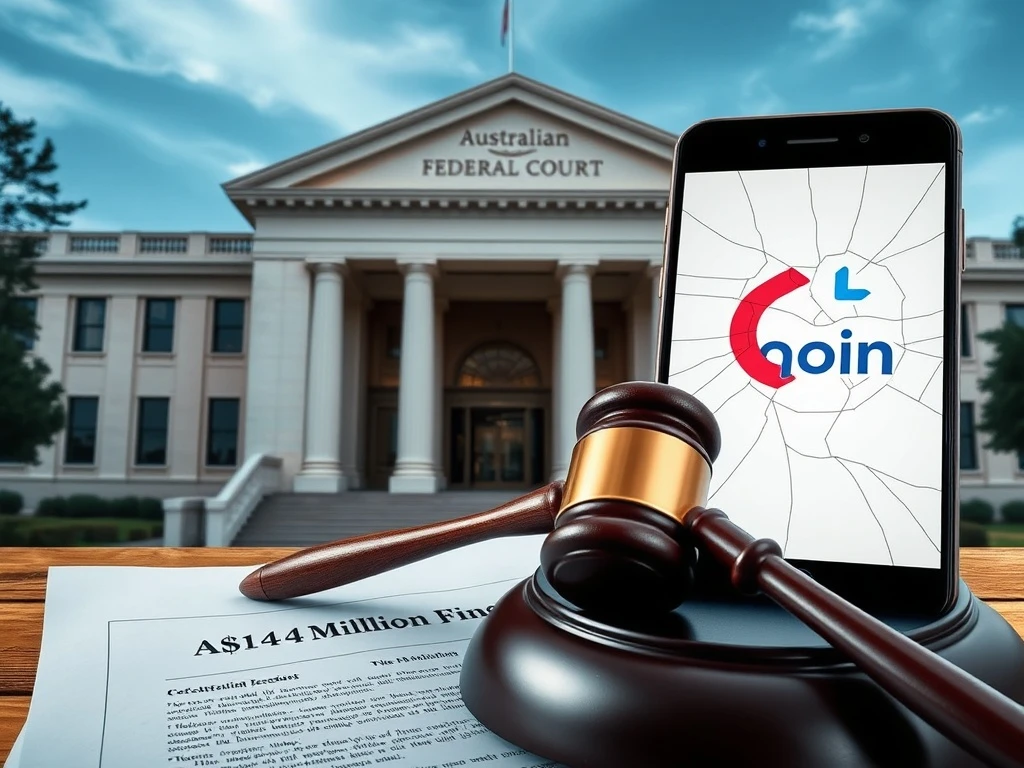
In a landmark enforcement action that sends a stark warning to the digital asset industry, the Australian Federal Court has slammed BPS Financial Pty Ltd with a crushing A$14 million ($9.9 million USD) penalty for systematically misleading consumers about its Qoin cryptocurrency wallet. This decisive ruling, delivered in Sydney, Australia, on [Date of Ruling], underscores regulators’ growing intolerance for deceptive practices in the rapidly evolving crypto sector.
BPS Financial Fine Exposes Systemic Deception
The court found that BPS Financial, the operator behind the Qoin wallet and token, engaged in false, misleading, and deceptive conduct. Specifically, the Australian Securities and Investments Commission (ASIC) successfully argued that BPS made several unsubstantiated claims to attract users. For instance, the company falsely advertised that a vast network of merchants accepted Qoin for everyday transactions. Furthermore, BPS misleadingly promoted the wallet’s liquidity, suggesting users could easily exchange Qoin for Australian dollars or other cryptocurrencies through independent exchanges. In reality, the court determined these claims were exaggerated or entirely fabricated, trapping consumers in an illiquid ecosystem. Consequently, this case represents one of the most significant financial penalties levied against a crypto business in Australian history.
The Regulatory Landscape for Crypto in Australia
This enforcement action did not occur in a vacuum. It is part of a broader, aggressive regulatory clampdown by Australian authorities aiming to protect consumers and establish clear rules for the digital finance space. Over the past three years, ASIC and the Australian Competition and Consumer Commission (ACCC) have significantly increased their scrutiny of crypto asset providers. They have focused particularly on advertising standards, licensing requirements, and the accuracy of product disclosures. The judgment against BPS Financial directly aligns with this strategic priority, demonstrating that regulators will use their full legal powers to hold companies accountable. Moreover, this action follows global trends, with authorities in the United States, United Kingdom, and European Union also taking stronger stances against misleading crypto promotions.
Expert Analysis: A Watershed Moment for Consumer Protection
Financial regulation experts view this ruling as a critical precedent. “This isn’t just a fine; it’s a statement of intent,” explains Dr. Sarah Chen, a senior lecturer in Fintech Law at the University of Melbourne. “The court’s decision clearly signals that crypto businesses must adhere to the same fundamental standards of honesty and transparency as traditional financial services. The size of the penalty is designed to deter other operators from making grandiose, unverified claims about utility and liquidity.” Chen further notes that the case hinged on classic consumer protection principles applied to a novel technology, proving that existing legal frameworks can be effectively adapted. The ruling also empowers consumers who may have suffered losses, potentially opening the door for class-action compensation proceedings.
Impact on the Qoin Ecosystem and Its Users
The immediate aftermath of the ruling has created significant uncertainty for existing Qoin wallet holders. The court’s findings validate long-standing complaints from users who reported difficulty spending their tokens or converting them to fiat currency. With the operator’s credibility severely damaged and facing a massive financial penalty, the future viability of the Qoin project is now in serious doubt. Industry analysts suggest the ecosystem could collapse, leaving token holders with worthless digital assets. This scenario highlights a critical risk in the crypto space: the dependency on a single entity’s solvency and integrity. The table below summarizes the core misleading claims and the court’s findings:
| Claim Made by BPS Financial | Court Finding |
|---|---|
| Qoin accepted by a large, growing network of merchants | Merchant network was limited and overstated |
| Qoin could be easily exchanged for AUD or other crypto | Liquidity was severely restricted; exchanges were not independent |
| The wallet provided a registered, compliant financial product | Representations regarding regulatory status were misleading |
Key Lessons for Crypto Investors and Operators
This case offers crucial takeaways for all market participants. For consumers, it reinforces the imperative of conducting extreme due diligence. Investors must look beyond marketing hype and verify key claims independently:
- Verify Liquidity: Check trading volumes on multiple independent exchanges, not just the one promoted by the issuer.
- Scrutinize Utility Claims: Research the actual number and quality of merchants that accept a token, rather than relying on advertised lists.
- Understand Regulatory Status: Confirm if the product is licensed by relevant authorities like ASIC or merely making vague claims about compliance.
For crypto businesses, the message is unequivocal: regulatory compliance is non-negotiable. Marketing materials must be accurate, balanced, and not omit important risk information. Proactive engagement with regulators, rather than evasion, is becoming the only sustainable path forward. The era of ‘wild west’ advertising in cryptocurrency is conclusively ending, replaced by a framework demanding accountability and transparency.
Conclusion
The A$14 million fine against BPS Financial for false advertising marks a pivotal moment in Australia’s approach to cryptocurrency regulation. This decisive action by the Federal Court, driven by ASIC’s enforcement, establishes a powerful deterrent against deceptive marketing practices within the crypto wallet and token sector. It underscores that consumer protection laws apply with full force to digital assets, regardless of their technological novelty. Ultimately, while this ruling brings justice for misled Qoin users, its broader legacy will be a cleaner, more trustworthy, and more mature digital asset market for all Australian participants.
FAQs
Q1: What exactly did BPS Financial do wrong?
The Australian Federal Court found BPS made false and misleading claims about its Qoin wallet, primarily regarding the size of its merchant network and the ease of converting Qoin tokens to cash or other cryptocurrencies.
Q2: Can affected Qoin wallet users get their money back?
The court fine is paid to the government, not directly to consumers. However, the ruling strengthens the legal position for users to seek compensation through separate civil actions or potential class-action lawsuits.
Q3: Does this mean all crypto wallets in Australia are now under scrutiny?
Yes, the action signals ASIC’s heightened focus on the sector. All crypto wallet operators and token issuers are now on notice to ensure their advertising and disclosures are accurate and compliant with Australian law.
Q4: How does this compare to other crypto-related fines globally?
While larger fines have been issued in the U.S., this A$14 million penalty is among the largest specifically for false advertising in the crypto space within the Asia-Pacific region, setting a strong regional precedent.
Q5: What should I do if I invested in a project based on similar promises?
Document all promotional materials and communications. Report your concerns to ASIC or the ACCC, and consider seeking independent legal advice to understand your options for recourse.
Related News
- ALPHA Token Faces Stark Investment Warning from Major South Korean Exchanges Coinone and Korbit
- Bitcoin Seizure Hack: South Korean Prosecutors Lose $28.8M in Stunning 14-Minute Breach
- WisdomTree’s Strategic Expansion: Tokenized Funds Revolutionize RWA Access on Solana