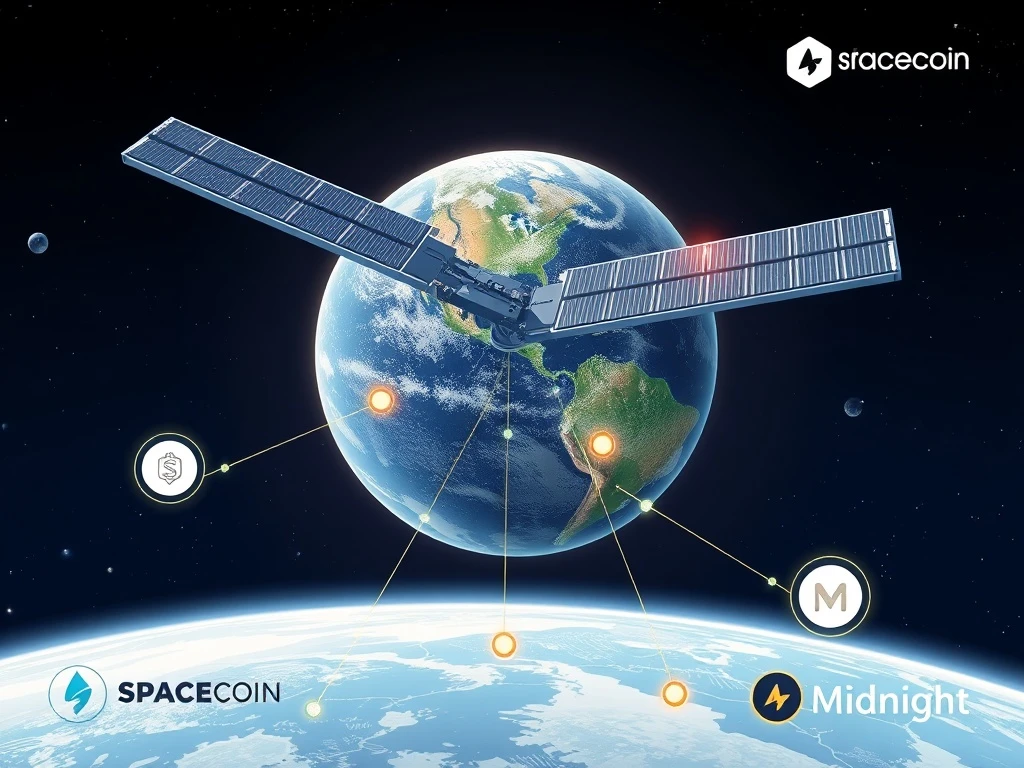
In a groundbreaking development for decentralized communication, SpaceCoin (SPACE) announced today its strategic partnership with Midnight, the privacy-focused blockchain platform spearheaded by Cardano founder Charles Hoskinson, to develop satellite-based privacy messaging technology that could redefine secure global communication. This collaboration, announced on March 15, 2025, represents a significant convergence of satellite infrastructure and advanced cryptographic privacy solutions, potentially creating the world’s first truly decentralized, server-independent messaging system. The partnership emerges during a period of increasing global concern about digital surveillance and centralized control over communication channels, positioning both projects at the forefront of the privacy technology movement.
SpaceCoin and Midnight Forge Satellite Privacy Alliance
The SpaceCoin and Midnight partnership initiates a comprehensive joint review process to develop privacy messaging technology leveraging satellite infrastructure. SpaceCoin, originally conceived as a decentralized satellite internet project, brings essential orbital infrastructure to the collaboration. Meanwhile, Midnight contributes its sophisticated zero-knowledge proof (ZKP) technology, developed under Charles Hoskinson’s leadership. The initial priority involves implementing a peer-to-peer messaging application that completely bypasses traditional centralized servers. Consequently, this approach fundamentally alters how secure communications might operate globally. The technical teams from both organizations will conduct extensive feasibility studies throughout 2025, with prototype development scheduled for early 2026.
Historically, satellite communication systems have faced significant privacy limitations despite their global reach. Traditional systems often route data through ground stations controlled by governments or corporations, creating potential surveillance vulnerabilities. SpaceCoin’s decentralized satellite network architecture addresses these concerns by distributing control across multiple independent nodes. Simultaneously, Midnight’s privacy-focused blockchain provides the cryptographic framework necessary for secure verification without data exposure. This dual-layered approach represents a novel solution to longstanding privacy challenges in satellite communications.
The Technical Architecture Behind the Partnership
The collaboration explores several innovative technical approaches. First, the system will utilize Midnight’s zero-knowledge proof technology to enable users to verify their authorization to communicate without revealing sensitive information. This means identities, locations, and message metadata remain concealed while maintaining network security. Second, SpaceCoin’s satellite infrastructure provides the physical layer for data transmission, creating a truly decentralized network backbone. Third, the peer-to-peer architecture eliminates single points of failure and control, enhancing both resilience and privacy. Finally, the system incorporates blockchain-based verification mechanisms to ensure message integrity without compromising confidentiality.
Zero-Knowledge Proofs Transform Satellite Communication
Midnight’s zero-knowledge proof technology represents the cryptographic cornerstone of this partnership. ZKPs enable one party to prove to another that a statement is true without revealing any information beyond the validity of the statement itself. In practical terms, this technology allows users to demonstrate they have permission to use the messaging network without exposing their identity, location, or other sensitive data. The implementation involves sophisticated cryptographic protocols that balance computational efficiency with robust privacy guarantees. Furthermore, this approach addresses growing concerns about metadata collection, which often reveals more about communication patterns than message content itself.
The evolution of zero-knowledge technology within blockchain ecosystems has accelerated significantly since 2020. Midnight’s implementation builds upon years of research and development within the broader Cardano ecosystem. Unlike earlier ZKP systems that required substantial computational resources, Midnight’s optimized protocols demonstrate remarkable efficiency gains. These advancements make satellite-based implementation technically feasible despite bandwidth and latency constraints. The technology also incorporates adaptive verification mechanisms that adjust security parameters based on network conditions and threat models.
| Technology | Centralization | Privacy Level | Infrastructure |
|---|---|---|---|
| Traditional Encrypted Messaging | Centralized Servers | Medium | Terrestrial Internet |
| Blockchain-Based Messaging | Partially Decentralized | Medium-High | Mixed Infrastructure |
| SpaceCoin-Midnight System | Fully Decentralized | High | Satellite Network |
Real-World Applications and Implications
The potential applications for this technology extend far beyond conventional messaging. Journalists operating in restrictive environments could communicate securely without relying on potentially compromised internet infrastructure. Humanitarian organizations could coordinate in disaster zones where terrestrial networks have failed. Financial institutions could establish secure backup communication channels. Additionally, the technology enables truly private Internet of Things (IoT) communications for sensitive industrial and governmental applications. The system’s design inherently resists censorship and surveillance, providing unprecedented protection for vulnerable communities worldwide.
Decentralized Satellite Networks Redefine Connectivity
SpaceCoin’s satellite infrastructure provides the physical foundation for this privacy-focused messaging system. Unlike traditional satellite networks operated by single entities, SpaceCoin employs a decentralized model where multiple independent satellites form a mesh network. This architecture offers several distinct advantages. First, it eliminates single points of control that could compromise privacy or enable censorship. Second, the distributed nature enhances resilience against technical failures or targeted attacks. Third, the network can potentially scale more efficiently as additional participants deploy compatible satellites. Finally, the decentralized approach aligns with the broader blockchain philosophy of distributed trust and verification.
The satellite technology itself incorporates several innovative features. Low-earth orbit (LEO) satellites provide lower latency than traditional geostationary systems. Advanced antenna technology enables efficient peer-to-peer connections between ground stations and satellites. The network implements sophisticated routing algorithms that optimize for both performance and privacy. Additionally, the system incorporates blockchain-based consensus mechanisms for network management and coordination. These technical elements combine to create a robust infrastructure capable of supporting privacy-focused applications at global scale.
- Decentralized Control: No single entity controls the entire satellite network
- Enhanced Privacy: Built-in cryptographic protection at infrastructure level
- Global Coverage: Satellite-based system reaches remote and restricted regions
- Censorship Resistance: Distributed architecture prevents single-point blocking
- Redundancy: Multiple satellites ensure continuous service availability
The Broader Context of Privacy Technology Evolution
This partnership emerges within a rapidly evolving landscape of privacy technologies. Governments worldwide have increasingly sought expanded surveillance capabilities, while simultaneously, technological advancements have enabled more sophisticated privacy protections. The European Union’s Digital Services Act and various national data protection regulations have created both challenges and opportunities for privacy-focused technologies. Meanwhile, consumer awareness about digital privacy has grown substantially, driving demand for more secure communication options. The SpaceCoin-Midnight collaboration represents a direct response to these converging trends, offering a technological solution that addresses multiple privacy concerns simultaneously.
Industry experts have noted the significance of this partnership within the broader blockchain ecosystem. Dr. Elena Rodriguez, a cryptography researcher at Stanford University, commented, “The integration of zero-knowledge proofs with satellite infrastructure represents a novel approach to decentralized communication. While technically challenging, the potential privacy benefits could be substantial if implemented correctly.” Similarly, Michael Chen, a satellite communications analyst, observed, “Decentralized satellite networks could disrupt traditional models of orbital infrastructure ownership and control. The privacy implications are particularly interesting given current geopolitical tensions around communication sovereignty.”
Implementation Timeline and Development Roadmap
The partnership follows a structured development timeline. The initial joint review phase, currently underway, will conclude in Q3 2025. This phase involves technical feasibility studies, regulatory analysis, and architectural planning. Following successful completion, prototype development will commence in Q4 2025, focusing on core messaging functionality and basic satellite integration. Testing phases throughout 2026 will evaluate performance, security, and usability across various scenarios. Assuming successful testing, limited deployment could begin in late 2026, with broader availability targeted for 2027. The development process incorporates regular security audits and peer review to ensure robust implementation of privacy features.
Potential Challenges and Considerations
Despite the promising potential, several challenges merit consideration. Regulatory compliance represents a significant consideration, as satellite communications face strict governmental oversight in most jurisdictions. The technical complexity of integrating advanced cryptography with satellite systems presents engineering challenges, particularly regarding latency and bandwidth optimization. Additionally, the economic model for sustaining decentralized satellite infrastructure requires careful design to ensure long-term viability. Security considerations extend beyond cryptography to include physical satellite protection and ground station security. Finally, user adoption depends on balancing privacy protections with practical usability considerations.
The partnership addresses these challenges through several strategic approaches. Regulatory engagement initiatives seek to demonstrate how the technology can comply with legitimate law enforcement needs while protecting privacy. Technical optimization focuses on efficient implementation of cryptographic protocols suitable for constrained environments. Economic models explore token-based incentives for network participation and maintenance. Security protocols incorporate multiple layers of protection across physical, network, and application levels. User experience design prioritizes intuitive interfaces that abstract complex cryptographic operations from end users.
Conclusion
The SpaceCoin and Midnight partnership represents a significant advancement in privacy technology, combining decentralized satellite infrastructure with sophisticated zero-knowledge proofs to create potentially unbreakable privacy messaging. This collaboration addresses growing global concerns about digital surveillance while leveraging cutting-edge blockchain and satellite technologies. The development timeline suggests practical implementations could emerge within the next two years, potentially transforming how secure communications operate worldwide. As privacy becomes increasingly precious in the digital age, innovations like satellite-based privacy messaging offer promising pathways toward more secure and autonomous communication systems. The SpaceCoin-Midnight initiative stands as a noteworthy development in the ongoing evolution of privacy-preserving technologies.
FAQs
Q1: What exactly does the SpaceCoin and Midnight partnership aim to create?
The partnership aims to develop a satellite-based privacy messaging system that uses zero-knowledge proofs to enable secure communication without centralized servers, protecting user identities and locations.
Q2: How does zero-knowledge proof technology protect privacy in this system?
Zero-knowledge proofs allow users to verify their authorization to communicate without revealing any personal information, ensuring that identities, locations, and metadata remain completely private while maintaining network security.
Q3: When can users expect to access this privacy messaging technology?
Following the current joint review phase, prototype development begins in late 2025, with testing throughout 2026 and potential limited deployment by late 2026 or early 2027, assuming successful development and regulatory compliance.
Q4: How does satellite infrastructure improve upon traditional internet-based messaging?
Satellite infrastructure provides global coverage including remote areas, eliminates reliance on terrestrial internet infrastructure that might be compromised or censored, and enables truly decentralized network architecture without single points of control.
Q5: What are the main challenges facing this satellite privacy messaging development?
Key challenges include regulatory compliance across multiple jurisdictions, technical integration of advanced cryptography with satellite systems, economic sustainability of decentralized infrastructure, comprehensive security implementation, and achieving practical usability for widespread adoption.
Related News
- Ledger’s Revolutionary Tezos Expansion: Etherlink Integration and Native Staking Transform Crypto Security
- Coinone Delisting Watchlist Drama: Trust Wallet Token Faces Extended Regulatory Scrutiny in South Korea
- BTC Perpetual Futures Long/Short Ratio Reveals Critical Market Sentiment Shift Across Major Exchanges