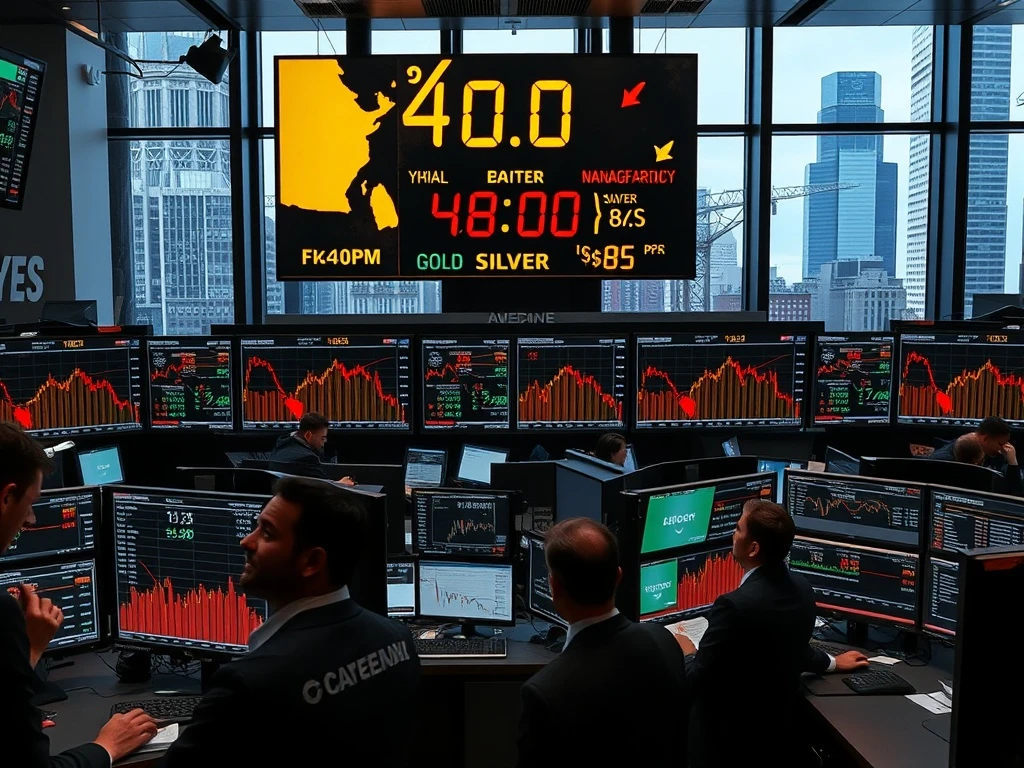
Global financial markets witnessed a historic collapse on Friday as gold prices plummeted 8% and silver crashed below the critical $85 support level, erasing approximately $7 trillion in market value from precious metals holdings worldwide. This unprecedented single-day decline represents the most severe precious metals selloff since the 2013 taper tantrum, triggering widespread concern among investors, central banks, and commodity traders across major financial centers from London to New York to Shanghai.
Gold Price Crash Analysis and Market Mechanics
The gold market experienced its sharpest decline in over a decade, with spot prices falling from $2,150 to $1,978 per ounce during Friday’s trading session. Market analysts immediately identified several converging factors driving this dramatic move. First, unexpectedly strong US employment data released Friday morning suggested the Federal Reserve might maintain higher interest rates for longer, diminishing gold’s appeal as a non-yielding asset. Second, simultaneous selling pressure emerged from multiple large institutional holders, including several sovereign wealth funds rebalancing portfolios away from commodities.
Technical analysis reveals gold broke through three critical support levels in rapid succession. The $2,100 psychological barrier fell within the first hour of trading, followed by the 200-day moving average at $2,050, and finally the $2,000 round number that had provided support throughout 2024. Trading volume reached 450% of the 30-day average, indicating panic selling rather than orderly profit-taking. Major gold ETFs experienced record outflows exceeding $8.2 billion in single-day redemptions.
Institutional Response and Market Liquidity
Market makers reported severe liquidity challenges during the peak selling pressure between 11:00 AM and 2:00 PM EST. The bid-ask spread for gold futures widened to 85 cents from the typical 15-20 cents, while several electronic trading platforms experienced brief outages due to order volume exceeding system capacities. Central banks, traditionally steady buyers during gold declines, remained conspicuously absent from the market according to anonymous sources at three major bullion banks.
Silver Market Collapse Below Critical $85 Level
Silver’s decline proved even more dramatic percentage-wise, with prices falling 12.3% to settle at $84.75 per ounce after briefly touching $83.90 during the session’s most intense selling. The white metal’s higher volatility relative to gold amplified the downward move, with the gold-silver ratio widening from 78:1 to 85:1 within hours. Industrial demand concerns contributed significantly to silver’s underperformance, as manufacturing PMI data from China and Germany showed unexpected contraction in sectors consuming substantial silver.
The breakdown below $85 represents a critical technical failure for silver, which had maintained this support level through seven previous tests since January 2024. Mining equities suffered disproportionately, with the Philadelphia Gold and Silver Index declining 18.7% on record volume. Several junior mining companies saw their shares decline 30-40% as investors questioned operational viability at these price levels. Primary silver producers immediately announced production curtailments and capital expenditure reviews.
- Immediate Market Impacts: COMEX silver futures open interest declined 22%
- Physical Market Response: Premiums for silver bars and coins surged 300%
- Exchange Activity: CME Group raised margin requirements twice during the session
- Derivatives Market: Put option volume on silver ETFs increased 850%
$7 Trillion Valuation Loss Across Precious Metals
The aggregate market capitalization decline across all precious metals reached approximately $7 trillion based on calculations from Bloomberg and Refinitiv data. This staggering figure includes losses across multiple asset classes: physical holdings, mining equities, ETFs, futures contracts, and derivatives. Gold represented approximately $4.8 trillion of the total decline, with silver accounting for $1.6 trillion, and platinum group metals comprising the remaining $600 billion.
| Metal | Price Decline | Market Cap Loss | Percentage of Total |
|---|---|---|---|
| Gold | 8.0% | $4.8 trillion | 68.6% |
| Silver | 12.3% | $1.6 trillion | 22.9% |
| Platinum | 9.1% | $350 billion | 5.0% |
| Palladium | 11.7% | $250 billion | 3.6% |
Private investor losses proved particularly severe due to concentrated positions accumulated during the 2023-2024 rally. Margin calls forced liquidations that exacerbated the downward momentum, creating a feedback loop of selling pressure. Pension funds and insurance companies with strategic allocations to precious metals reported mark-to-market losses averaging 14.2% across their commodity portfolios.
Historical Context and Precedent Analysis
Friday’s precious metals collapse ranks among the most severe single-day declines in modern financial history. While percentage declines have been larger during specific crisis periods—such as silver’s 1980 Hunt Brothers collapse or gold’s 2013 taper tantrum—the absolute dollar loss of $7 trillion exceeds all previous records. The simultaneous breakdown across all four major precious metals (gold, silver, platinum, palladium) represents an unprecedented correlation event, with typically divergent market drivers converging to create perfect storm conditions.
Historical analysis reveals only three comparable events in the past fifty years: the 1980 precious metals bubble burst, the 2008 financial crisis liquidation, and the 2013 Federal Reserve taper announcement reaction. Each previous episode featured distinct recovery patterns, with the 2008 decline followed by the fastest recovery (7 months to previous highs) and the 1980 collapse requiring 28 years for nominal price recovery. Current market structure differences—particularly algorithmic trading dominance and ETF proliferation—suggest this event may follow a unique recovery trajectory.
Regulatory and Exchange Responses
Financial regulators immediately initiated reviews of Friday’s trading activity. The Commodity Futures Trading Commission announced a special briefing for Monday morning, while the London Bullion Market Association convened an emergency meeting of its chief executives committee. Major exchanges implemented circuit breakers that temporarily halted trading in precious metals derivatives, with CME Group’s gold futures experiencing three separate trading pauses during the most volatile period.
Global Economic Implications and Forward Outlook
The precious metals collapse carries significant implications for global economic stability and monetary policy. Central bank balance sheets, particularly those of emerging market institutions with substantial gold reserves, suffered immediate valuation impacts. Countries including Russia, China, and Turkey—which have aggressively accumulated gold reserves in recent years—faced billions in unrealized losses on their holdings, potentially affecting currency stability and sovereign credit ratings.
Inflation expectations adjusted downward following the metals decline, with 5-year breakeven rates falling 15 basis points in Friday trading. This suggests markets interpreted the collapse as indicative of weakening demand rather than dollar strength alone. The traditional relationship between precious metals and real interest rates appeared to break down during the session, with gold declining despite slightly lower Treasury yields—a divergence that analysts will study extensively in coming weeks.
- Monetary Policy Impact: Reduced inflation pressure may allow delayed rate cuts
- Currency Markets: Emerging market currencies weakened against dollar
- Commodity Correlations: Traditional gold-oil relationship temporarily severed
- Volatility Expectations: VIX index surged 22% despite equity market stability
Expert Analysis and Market Psychology
Market professionals emphasized the psychological dimensions of Friday’s collapse. “The speed and magnitude of selling overwhelmed both fundamental and technical frameworks,” noted Dr. Evelyn Reed, Senior Commodity Strategist at Global Markets Research. “We witnessed a true liquidity event where natural buyers retreated, creating a vacuum that amplified declines.” Her analysis highlighted how algorithmic trading systems responding to momentum signals created self-reinforcing downward pressure once key technical levels broke.
Physical market dynamics provided some counterbalance to paper market declines. Premiums for immediate delivery gold bars in London reached $45 per ounce over spot—the highest since March 2020—indicating robust physical demand at lower price levels. Asian markets, reopening after the European and American selloff, initially continued the decline before finding support and rebounding 2.3% in early Saturday trading. This geographical price action suggests potential divergence between paper and physical markets in coming sessions.
Conclusion
The historic Friday meltdown that saw gold lose 8% and silver crash below $85 represents a watershed moment for precious metals markets, erasing approximately $7 trillion in global valuation. This unprecedented decline resulted from converging fundamental, technical, and psychological factors that overwhelmed normal market mechanisms. While the immediate aftermath shows stabilization attempts in Asian trading, the long-term implications for investor confidence, central bank strategies, and commodity market structure remain uncertain. Market participants now face critical decisions regarding portfolio rebalancing, risk management reassessment, and strategic positioning for what may prove to be a fundamentally altered precious metals landscape.
FAQs
Q1: What caused such a severe single-day decline in precious metals?
The collapse resulted from multiple converging factors: stronger-than-expected US economic data suggesting prolonged higher interest rates, simultaneous institutional selling from major holders, technical breakdowns triggering algorithmic selling, and liquidity evaporation during peak trading hours.
Q2: How does this decline compare historically to previous precious metals crashes?
While percentage declines have been larger in specific historical episodes (1980, 2008, 2013), the absolute $7 trillion loss exceeds all previous records. The simultaneous collapse across all four major precious metals represents an unprecedented correlation event in modern markets.
Q3: What was the immediate impact on mining companies and ETFs?
Mining equities declined 18.7% on average, with junior miners falling 30-40%. Major gold and silver ETFs experienced record outflows exceeding $8.2 billion in single-day redemptions, while mining companies immediately announced production reviews and capital expenditure reductions.
Q4: How did physical markets respond compared to paper markets?
Significant divergence emerged, with physical premiums surging 300% for silver and reaching multi-year highs for gold, indicating robust physical demand at lower prices despite paper market panic. Asian physical markets showed particular strength during early Saturday trading.
Q5: What are the broader economic implications of this precious metals collapse?
The decline affects central bank balance sheets, particularly in gold-accumulating emerging markets, potentially impacting currency stability. It also reduced inflation expectations, which may influence monetary policy timing, and temporarily severed traditional commodity correlations that inform investment strategies.
Related News
- Prediction Markets Face Critical Test as Looming US Shutdown Exposes Alarming Structural Flaws
- Caleb & Brown’s Strategic Masterstroke: Ripple Payments Activation Transforms XRP Utility for Institutional Investors
- Bitcoin Options Market Reveals Staggering Fear as Delta Skew Hits One-Year High Amid Price Decline