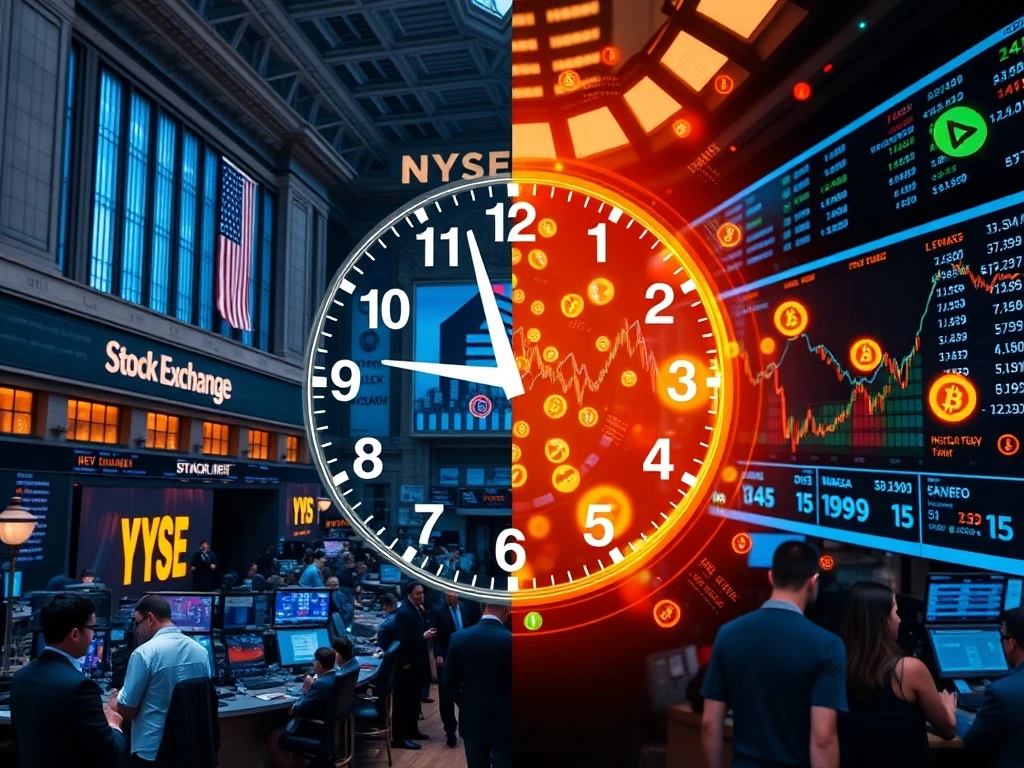
NEW YORK, March 2025 – The persistent liquidity challenges facing tokenized stocks might find their solution in an unexpected place: extended trading hours for traditional exchanges. According to ONDO Finance CEO Ian de Bode, implementing 24-hour trading on the New York Stock Exchange and Nasdaq could fundamentally resolve the weekend liquidity droughts that currently plague tokenized securities. This proposal emerges as financial markets increasingly intersect, revealing significant structural mismatches between traditional finance’s operating hours and cryptocurrency’s continuous trading cycle.
The Tokenized Stock Liquidity Conundrum
Tokenized stocks represent traditional equities converted into digital tokens on blockchain networks. Consequently, these assets bridge two distinct financial worlds with incompatible operating schedules. Traditional stock markets typically operate Monday through Friday, generally from 9:30 AM to 4:00 PM Eastern Time. Meanwhile, cryptocurrency and decentralized finance markets function continuously, 24 hours a day, seven days a week. This scheduling conflict creates what industry experts call “the weekend liquidity gap.”
During traditional market closures, liquidity for tokenized stocks often evaporates. Market makers face substantial challenges when hedging positions without access to underlying reference markets. Additionally, price discovery becomes fragmented, potentially leading to significant premiums or discounts versus traditional share prices. The table below illustrates the current trading schedule mismatch:
| Market Type | Trading Hours | Days of Operation | Liquidity Profile |
|---|---|---|---|
| Traditional Stock Exchanges (NYSE/Nasdaq) | 9:30 AM – 4:00 PM ET | Monday – Friday | High during hours, zero after hours |
| Cryptocurrency Exchanges | 24/7 | Every day | Continuous but variable |
| Tokenized Stock Markets | 24/7 | Every day | Thin during traditional market closures |
De Bode emphasized this structural issue in recent comments to CoinDesk. He specifically noted that while cryptocurrency and DeFi markets operate around the clock, traditional financial markets remain limited to weekday trading. This limitation causes liquidity for tokenized stocks to become extremely thin over weekends. Furthermore, this time mismatch complicates hedging strategies for market makers who provide liquidity across both ecosystems.
Historical Context of Extended Trading Hours
The concept of extended trading hours is not entirely new to traditional finance. In fact, after-hours trading has existed for decades through electronic communication networks. However, these sessions typically feature:
- Lower liquidity compared to regular hours
- Higher volatility due to reduced participation
- Wider bid-ask spreads increasing trading costs
- Limited accessibility for retail investors
Major Asian markets like Tokyo and Hong Kong have experimented with extended hours for specific products. European markets have similarly explored after-hours trading mechanisms. The technological infrastructure for 24-hour operations already exists within traditional finance. Investment banks and institutional traders routinely manage global portfolios across time zones. Settlement systems like T+1 now enable faster transaction processing. Therefore, the primary barriers to 24-hour trading are regulatory and operational rather than technological.
The Global Precedent for Continuous Trading
Several financial markets already demonstrate the feasibility of extended operations. Forex markets famously operate 24 hours daily during weekdays. Cryptocurrency exchanges have proven the technical viability of continuous trading systems. Even traditional commodities like gold and oil feature extended electronic trading sessions. The success of these markets provides a blueprint for how equity exchanges might implement similar systems.
Market structure experts point to several potential benefits of extended trading hours:
- Improved price discovery through continuous information incorporation
- Enhanced global accessibility for international investors
- Reduced overnight gap risk for portfolio managers
- Better alignment with corporate news release schedules
However, significant challenges remain. Exchange staffing, regulatory oversight, and market surveillance would require substantial adjustments. Clearing and settlement systems would need to operate continuously. Market participants would face increased operational costs. Despite these hurdles, the potential benefits for tokenized assets might justify the investment.
The Tokenization Revolution and Market Structure
Tokenization represents one of the most significant financial innovations of the decade. By converting traditional assets into blockchain-based tokens, this process enables:
- Fractional ownership of high-value assets
- Faster settlement through smart contracts
- Enhanced transparency via distributed ledgers
- Global accessibility beyond traditional geographic boundaries
Major financial institutions have increasingly embraced tokenization. BlackRock launched its BUIDL tokenized fund in 2024. JPMorgan executes billions in daily transactions on its Onyx blockchain. Franklin Templeton and WisdomTree have similarly introduced tokenized money market funds. This institutional adoption creates pressure for traditional market infrastructure to evolve accordingly.
The current market structure creates arbitrage opportunities between tokenized stocks and their traditional counterparts. During weekend closures, tokenized versions sometimes trade at significant premiums or discounts. This price divergence undermines the fundamental premise of tokenization as a faithful representation of underlying assets. Market makers struggle to maintain tight spreads without reliable hedging mechanisms. Consequently, liquidity providers often withdraw during periods of traditional market closure.
Regulatory Considerations and Implementation Timeline
Any transition to 24-hour trading would require extensive regulatory review. The Securities and Exchange Commission would need to approve rule changes for national exchanges. Self-regulatory organizations like FINRA would need to update surveillance protocols. International coordination would become essential for cross-border listings. Market participants anticipate a phased implementation approach rather than an immediate switch.
Potential implementation phases might include:
- Extended hours until 8:00 PM ET for all listed securities
- Weekend trading for major indices and ETFs
- Gradual expansion to individual equities based on liquidity
- Full 24-hour operations with appropriate safeguards
The Commodity Futures Trading Commission has already approved 24-hour trading for certain derivatives. This precedent suggests regulatory openness to extended hours where market demand exists. Exchange executives have quietly discussed extended operations for years. Technological advancements and competitive pressures from crypto markets might accelerate this timeline.
Impact on Market Participants and Financial Ecosystem
A transition to 24-hour trading would create winners and losers across the financial landscape. Retail investors might benefit from increased flexibility but face challenges monitoring continuous markets. Institutional investors would gain better risk management tools but incur higher operational costs. Market makers and liquidity providers would enjoy more consistent hedging opportunities despite increased capital requirements.
The table below summarizes potential impacts:
| Participant Group | Potential Benefits | Potential Challenges |
|---|---|---|
| Retail Investors | Flexible trading hours, global access | Information overload, increased volatility exposure |
| Institutional Investors | Better risk management, global portfolio alignment | Higher staffing costs, continuous monitoring needs |
| Market Makers | Improved hedging, reduced weekend risk | Increased capital requirements, complex systems |
| Exchanges | Increased volume, competitive positioning | Infrastructure costs, regulatory compliance |
| Tokenization Platforms | Enhanced liquidity, reduced arbitrage | Integration complexity, market structure changes |
Traditional financial media would need to adapt to continuous news cycles. Research analysts might issue updates outside traditional hours. Corporate investor relations departments would face pressure to time announcements appropriately. The entire financial ecosystem would gradually adjust to a world without market openings or closings.
Conclusion
The proposal for 24-hour trading on traditional exchanges represents a logical evolution toward integrated global markets. Tokenized stock liquidity challenges highlight structural incompatibilities between traditional and digital finance. As ONDO Finance CEO Ian de Bode correctly identified, aligning trading schedules would significantly benefit the growing tokenization industry. This alignment would reduce arbitrage opportunities, improve price discovery, and enhance market efficiency. While implementation challenges remain substantial, the direction of financial innovation clearly points toward greater integration and continuous operation. The weekend liquidity gap for tokenized stocks might soon become a historical footnote rather than a persistent market challenge.
FAQs
Q1: What are tokenized stocks?
Tokenized stocks are digital representations of traditional equities created on blockchain networks. They enable fractional ownership, faster settlement, and global accessibility while tracking the price of underlying securities.
Q2: Why does liquidity decrease for tokenized stocks on weekends?
Liquidity decreases because traditional reference markets close while tokenized versions continue trading. Market makers cannot effectively hedge their positions without access to underlying markets, causing them to withdraw liquidity.
Q3: How would 24-hour trading benefit traditional investors?
Traditional investors would gain flexibility to trade outside standard hours, better manage international portfolios, and respond to global events in real time. This could reduce overnight gap risk and improve price discovery.
Q4: What are the main barriers to implementing 24-hour trading?
Primary barriers include regulatory approval, exchange staffing, continuous clearing and settlement systems, market surveillance requirements, and participant operational costs. Technological infrastructure already supports extended hours.
Q5: How might 24-hour trading affect market volatility?
Initial volatility might increase during low-volume periods, but overall volatility could decrease as markets incorporate information continuously rather than in concentrated openings. Proper market structure design would be crucial for managing volatility.
Q6: Are other financial markets moving toward 24-hour operations?
Yes, cryptocurrency markets already operate 24/7, forex markets run nearly continuously, and commodities feature extended electronic trading. Several Asian exchanges have experimented with extended hours, creating precedents for equity markets.
Related News
- Bitcoin Plummets Below $80,000: Analyzing the Sudden Market Correction and 2025 Outlook
- Crypto Futures Liquidations Erupt: $269 Million Wiped Out in One Hour Amidst Market Turmoil
- Bitcoin Plunges Below $79,000: Analyzing the Sudden Market Correction