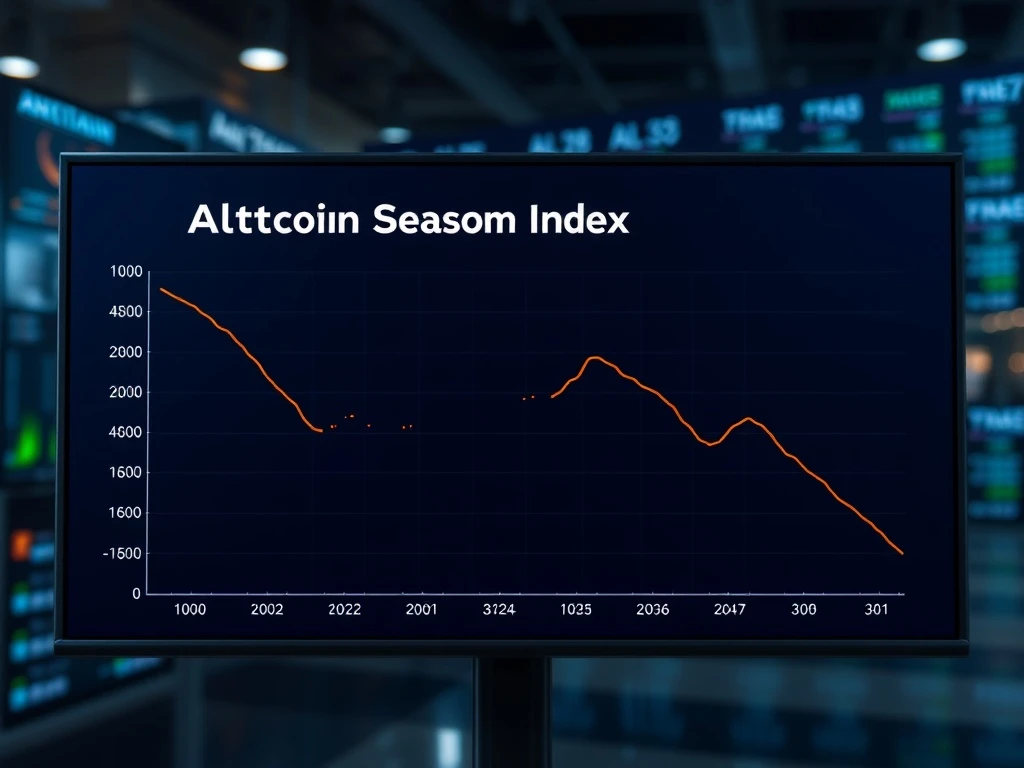
The cryptocurrency market’s pulse quickened today as a critical gauge flashed a stark warning. The Altcoin Season Index, a closely-watched metric from data platform CoinMarketCap, has plunged to a reading of 30. This significant two-point drop from yesterday solidifies a market environment firmly favoring Bitcoin over its smaller counterparts. For traders and long-term investors, this index movement provides a crucial, data-driven snapshot of current capital flows and risk sentiment.
Understanding the Altcoin Season Index Drop
CoinMarketCap’s Altcoin Season Index serves as a primary barometer for market cycle phases. The platform calculates this figure by comparing the 90-day price performance of the top 100 cryptocurrencies by market capitalization against Bitcoin’s performance. Analysts exclude stablecoins and wrapped tokens from this analysis to ensure clarity. A reading above 75 traditionally signals an ‘altcoin season,’ where a majority of altcoins outperform the market leader. Conversely, a reading below 75 indicates a ‘Bitcoin season.’ The current value of 30 sits far below this threshold, highlighting a pronounced period of Bitcoin dominance. This metric offers investors an objective framework beyond anecdotal observation.
The Mechanics Behind the Metric
The index’s calculation relies on a simple yet powerful comparative analysis. Data scientists track the rolling 90-day returns for each eligible asset in the top 100. They then compare each asset’s return directly to Bitcoin’s return over the identical period. The index represents the percentage of these altcoins that have managed to outperform Bitcoin. Therefore, a value of 30 means only 30% of the top altcoins have posted better returns than Bitcoin over the last quarter. This creates a clear, quantitative measure of relative strength. Market participants use this data to gauge risk appetite and sector rotation.
Historical Context of Market Cycles
Examining previous index readings reveals predictable cyclical patterns. The last major altcoin season, for instance, occurred in early 2021 when the index sustained readings above 75 for several months. During that period, capital rapidly flowed into smaller-cap projects, often generating exponential returns. However, these periods typically follow strong Bitcoin rallies and often precede broader market corrections. The current low reading mirrors phases seen in late 2019 and mid-2023, which were characterized by Bitcoin consolidation and altcoin underperformance. Understanding this history helps investors contextualize the present moment within longer-term trends.
Transition periods between seasons often see increased volatility. The index’s gradual decline from higher levels suggests a methodical shift in investor preference toward perceived safety and liquidity. Bitcoin, with its established network effect and institutional adoption, frequently becomes the asset of choice during uncertain macroeconomic climates. Consequently, the index acts as a sentiment indicator, reflecting collective market psychology. Analysts cross-reference this data with on-chain metrics and derivatives market activity to build a comprehensive outlook.
Implications for Crypto Investors
The low Altcoin Season Index reading carries direct consequences for portfolio strategy. Firstly, it suggests that momentum-based strategies focused on altcoins may currently underperform. Secondly, it highlights the importance of core Bitcoin exposure during certain market phases. Investors might interpret this data as a signal to reassess asset allocation. However, a low index also potentially identifies accumulation zones for high-conviction altcoin projects trading at a relative discount to Bitcoin. This creates a classic risk-reward scenario for different investor profiles.
- Risk Aversion: Capital tends to flow toward Bitcoin as a perceived safe-haven asset within crypto.
- Reduced Speculation: Lower index readings often correlate with decreased leverage and speculative trading in altcoins.
- Sector Rotation: The data may indicate capital is rotating out of altcoins and into Bitcoin or stablecoins.
- Long-Term Opportunity: Historically, severe altcoin underperformance has preceded major rallies in subsequent cycles.
Expert Analysis on Market Structure
Market analysts emphasize that a single metric never tells the full story. They recommend viewing the Altcoin Season Index alongside other indicators like Bitcoin dominance, total stablecoin supply, and exchange net flows. For example, a rising Bitcoin dominance percentage would corroborate the index’s message of Bitcoin strength. Furthermore, the specific altcoins that are outperforming—whether they are large-cap tokens like Ethereum or smaller projects—adds another layer of nuance. This current reading likely reflects broader macroeconomic headwinds, such as interest rate expectations, which disproportionately impact higher-risk assets.
The Path Forward for Altcoins
The critical question for the market is the catalyst for a potential index reversal. Historically, a sustained breakout in Bitcoin price above a key resistance level, followed by a period of consolidation, has often allowed capital to trickle into altcoins. This process, known as ‘altcoin rotation,’ can cause the index to climb rapidly. Other potential catalysts include major protocol upgrades, successful regulatory clarity for specific sectors like DeFi, or a surge in network usage for a leading smart contract platform. Monitoring developer activity and on-chain transaction growth can provide early signals of such a shift.
Nevertheless, the current low index reading underscores a market in a state of caution. It reflects a preference for liquidity and proven network security over experimental applications and narratives. This environment often separates projects with robust fundamentals from those reliant purely on speculation. For builders and developers, it can be a period focused on execution rather than marketing. The index, therefore, measures not just price, but the market’s current tolerance for innovation risk.
Conclusion
The Altcoin Season Index’s decline to 30 delivers a clear, data-centric message about the present cryptocurrency landscape. This reading firmly places the market in a Bitcoin season, characterized by the flagship asset’s relative outperformance. While this presents challenges for altcoin investors in the short term, it also aligns with historical cyclical behavior. Understanding this index and its implications allows for more informed, strategic decision-making. As always, prudent investors will combine this signal with a diverse set of on-chain and fundamental metrics to navigate the evolving market structure. The index remains a vital tool for quantifying the ever-shifting dynamics between Bitcoin and the broader altcoin universe.
FAQs
Q1: What does an Altcoin Season Index of 30 mean?
An index reading of 30 means that only 30% of the top 100 cryptocurrencies (excluding stablecoins) have outperformed Bitcoin over the past 90 days. This indicates a strong ‘Bitcoin season’ where capital and momentum are concentrated in the market leader.
Q2: How is the Altcoin Season Index calculated?
CoinMarketCap calculates the index by comparing the 90-day price performance of each coin in the top 100 by market cap against Bitcoin’s performance over the same period. The percentage of altcoins that outperform Bitcoin becomes the index value.
Q3: What is considered an ‘altcoin season’?
Analysts generally consider an ‘altcoin season’ to be in effect when the Altcoin Season Index sustains a reading above 75. This threshold indicates that at least 75% of top altcoins are outperforming Bitcoin, suggesting widespread capital rotation into smaller-cap assets.
Q4: Does a low index mean altcoins are a bad investment?
Not necessarily. A low index indicates current underperformance relative to Bitcoin, often during specific market cycles. Historically, periods of severe altcoin underperformance have created accumulation opportunities before subsequent rallies, making fundamental analysis crucial.
Q5: How often does the Altcoin Season Index update?
The index updates daily, reflecting the latest 90-day rolling performance data. This allows traders and investors to monitor the gradual strengthening or weakening of altcoin momentum against Bitcoin in near real-time.
Related News
- Bitcoin Plummets Below $78,000: Analyzing the Sudden Market Correction
- ZIL Surges Over 60% in Stunning Rally as Altcoins Defy Bitcoin Pause
- Bitcoin Soars: BTC Price Surges Above $79,000 Milestone, Signaling Strong Market Momentum