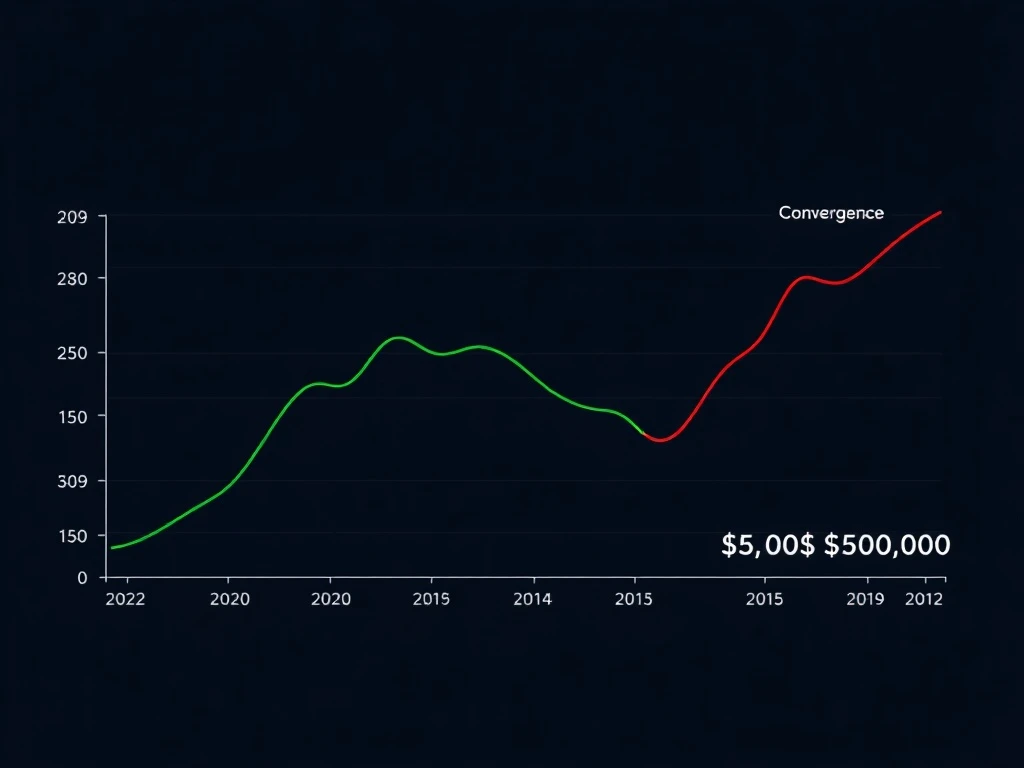
Bitcoin’s on-chain metrics reveal a critical convergence pattern that historically signals potential market bottoms, with current data showing the supply held at profit narrowing dramatically against loss-making supply. According to Glassnode analysis cited by CoinDesk, this phenomenon has preceded significant market reversals in previous cycles, suggesting the cryptocurrency market may be approaching a pivotal inflection point. The current convergence occurs as 11.1 million BTC remain profitable while 8.9 million BTC sit at losses, with the equilibrium price hovering around $60,000.
Understanding Bitcoin’s Profit/Loss Supply Convergence
On-chain analysis provides fundamental insights into Bitcoin’s market structure by examining wallet behavior and transaction patterns. The profit/loss supply metric tracks the portion of Bitcoin’s circulating supply held at profitable versus unprofitable positions based on acquisition prices. When these metrics converge, they indicate market participants face similar cost bases, reducing selling pressure from underwater positions. This convergence typically occurs during prolonged downturns when prices approach the average acquisition cost for many holders.
Glassnode’s data reveals specific historical precedents for this pattern. The analytics firm documented similar convergences in November 2022 following the FTX collapse, March 2020 during the COVID-19 market crash, January 2019 after the 2018 bear market, and during 2015’s accumulation phase. Each instance preceded significant price recoveries, though timing varied based on broader market conditions. The current narrowing gap between profitable and loss-making supply suggests market stress may be reaching exhaustion levels.
Historical Context and Market Cycle Analysis
Bitcoin markets demonstrate cyclical behavior with distinct phases of accumulation, expansion, distribution, and contraction. The profit/loss supply convergence typically marks late contraction phases when weak hands have largely exited positions. Historical data shows this metric serves as a reliable contrarian indicator, though not a precise timing tool. The 2015 convergence preceded a multi-year bull market, while the 2022 convergence aligned with Bitcoin’s recovery from $16,000 lows.
Market analysts emphasize several key factors surrounding current convergence patterns:
- Supply Distribution: Long-term holders currently control approximately 76% of circulating supply
- Realized Price: Bitcoin’s average acquisition cost sits near $60,000
- Holder Behavior: Exchange outflows suggest accumulation despite price pressure
- Macro Correlation: Traditional market conditions influence convergence timing
Expert Perspectives on Market Structure
Cryptocurrency analysts highlight the significance of supply-side metrics in assessing market health. Glassnode’s lead on-chain analyst previously noted that profit/loss convergence “often coincides with maximum pain points where capitulation gives way to accumulation.” This perspective aligns with behavioral finance principles where investor psychology shifts from fear to opportunity recognition. Independent researchers further observe that convergence periods typically see reduced exchange deposits, indicating decreased selling intent among remaining holders.
Traditional financial analysts drawing parallels to equity markets note similar patterns in stock accumulation during oversold conditions. However, they caution that cryptocurrency markets exhibit higher volatility and different fundamental drivers. The $60,000 equilibrium price represents a psychological and technical level where market forces may find temporary balance before establishing new directional momentum.
Technical and Fundamental Convergence Factors
Multiple analytical frameworks support the on-chain convergence thesis. Technical analysis shows Bitcoin testing long-term support levels while fundamental metrics indicate network health despite price declines. The hash rate remains near all-time highs, suggesting miner confidence in long-term viability. Network activity metrics show sustained utility beyond speculative trading, with daily active addresses maintaining consistent levels through market fluctuations.
Comparative analysis reveals distinctive aspects of the current convergence:
| Convergence Period | BTC Price Range | Market Context | Subsequent Performance |
|---|---|---|---|
| 2015 | $200-$300 | Post-Mt. Gox recovery | 20x increase over 2 years |
| January 2019 | $3,400-$3,800 | Post-2018 bear market | 3x increase in 6 months |
| March 2020 | $4,800-$5,200 | COVID-19 crash | 13x increase over 18 months |
| November 2022 | $16,000-$17,000 | Post-FTX collapse | 2x increase in 4 months |
This historical context provides framework for evaluating current market conditions. Each convergence occurred amid distinct macroeconomic environments with varying regulatory landscapes. The current convergence unfolds against evolving institutional adoption and regulatory clarity efforts globally.
Market Implications and Risk Considerations
The profit/loss supply convergence suggests potential bottom formation but doesn’t guarantee immediate reversal. Market participants should consider several risk factors including macroeconomic pressures, regulatory developments, and liquidity conditions. Historical patterns indicate convergence periods often experience heightened volatility as markets seek equilibrium. The $60,000 price level represents both technical support and psychological threshold where buyer and seller interests may align temporarily.
Investment professionals emphasize proper risk management during convergence periods. They recommend evaluating position sizing, time horizons, and portfolio diversification regardless of on-chain signals. While historical patterns provide context, each market cycle exhibits unique characteristics influenced by contemporary factors including institutional participation levels, derivative market development, and global adoption rates.
Institutional Perspective and Market Maturation
Institutional analysts note increased sophistication in cryptocurrency market analysis since previous convergence periods. The development of robust derivatives markets, regulated investment vehicles, and professional custody solutions has changed market dynamics. These developments may influence how convergence patterns manifest in current cycles. Institutional accumulation patterns during convergence periods differ from retail behavior, with longer time horizons and different capital allocation strategies.
Market structure analysis reveals evolving participant composition. The growing presence of long-term institutional holders may reduce volatility during convergence periods while extending accumulation phases. This structural shift could alter historical timing patterns while maintaining the fundamental significance of profit/loss supply metrics as market sentiment indicators.
Conclusion
Bitcoin’s on-chain profit/loss supply convergence signals a potential market bottom formation based on historical patterns and current data analysis. The narrowing gap between profitable and loss-making supply, with equilibrium near $60,000, suggests the market approaches a critical inflection point. While historical precedents indicate convergence often precedes significant recoveries, market participants should consider contemporary factors including macroeconomic conditions and regulatory developments. The Bitcoin market bottom signal from on-chain metrics provides valuable context for informed decision-making but requires integration with broader market analysis for comprehensive perspective.
FAQs
Q1: What does Bitcoin profit/loss supply convergence indicate?
This convergence indicates the portion of Bitcoin held at profitable prices approaches the portion held at losses, suggesting market stress may be reaching exhaustion levels and potentially signaling bottom formation based on historical patterns.
Q2: How reliable is this signal for timing market entries?
While historically significant, profit/loss convergence doesn’t provide precise timing signals. It indicates potential bottoming processes rather than exact reversal points, requiring confirmation from other technical and fundamental factors.
Q3: What price level would equalize profitable and loss-making supply?
According to Glassnode data, the equilibrium price where profitable and loss-making supplies would equalize is approximately $60,000, representing Bitcoin’s average acquisition cost across market participants.
Q4: How often has this convergence pattern occurred historically?
Documented instances include November 2022, March 2020, January 2019, and 2015. Each occurrence preceded significant price recoveries, though recovery timing and magnitude varied based on broader market conditions.
Q5: Does this convergence guarantee a market bottom?
No metric guarantees market bottoms. Convergence suggests potential bottom formation but requires confirmation through price action, volume patterns, and broader market fundamentals. Historical patterns provide context rather than certainty.
Related News
- Bitcoin Price Plummets Below $74,000: Market Analysis Reveals Critical Support Levels
- Bitcoin Soars: BTC Price Surges Past $75,000 Milestone in Historic Rally
- Bitcoin Price Plummets: BTC Falls Below Critical $74,000 Support Level