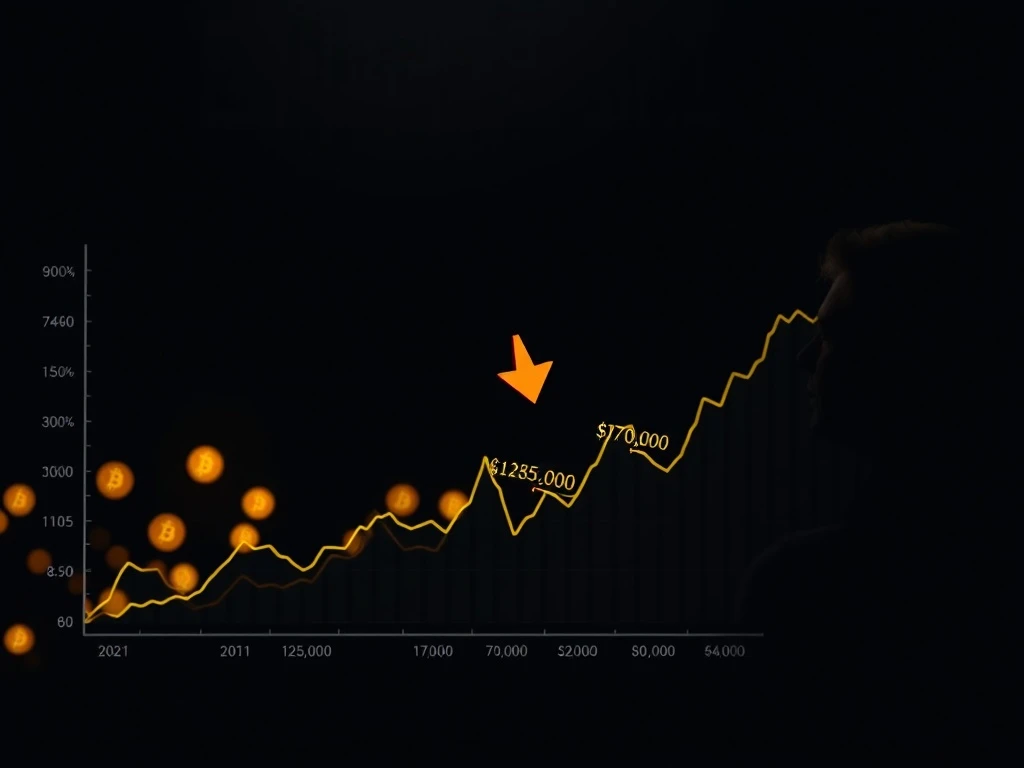
Prominent investor Michael Burry, whose legendary 2008 housing market prediction earned him fame in ‘The Big Short,’ now issues a stark warning about Bitcoin’s trajectory. According to recent reports from financial publication CoinDesk, Burry suggests the leading cryptocurrency could experience a dramatic downturn mirroring the devastating 2022 bear market. This analysis comes as Bitcoin trades around $70,000 in early 2025, following a significant retreat from its October 2024 peak near $126,000.
Michael Burry’s Bitcoin Crash Analysis and Historical Parallels
Michael Burry’s warning centers on concerning technical patterns he observes in Bitcoin’s recent price action. Specifically, he draws direct comparisons between current market conditions and the prolonged cryptocurrency winter that began in late 2021. During that previous downturn, Bitcoin’s value plummeted from approximately $35,000 to below $20,000, representing a loss exceeding 40% of its market capitalization. Burry’s analysis applies a similar percentage decline ratio to Bitcoin’s current price position. Consequently, this mathematical projection suggests Bitcoin could potentially fall toward the low $50,000 range if historical patterns repeat themselves. Market analysts note this warning carries particular weight given Burry’s established reputation for identifying major financial bubbles before they burst.
Understanding the 2022 Cryptocurrency Bear Market Context
The 2022 bear market provides essential context for evaluating Burry’s current prediction. That period represented one of cryptocurrency’s most severe contractions, driven by multiple converging factors. Major triggers included aggressive interest rate hikes by global central banks, which reduced investor appetite for speculative assets. Additionally, several high-profile cryptocurrency company collapses, including the Terra-Luna ecosystem and FTX exchange, created a crisis of confidence across the entire digital asset sector. Bitcoin’s price consequently entered a sustained downward trend for approximately eighteen months. Many retail investors experienced substantial losses during this phase, while institutional players reassessed their cryptocurrency exposure levels. Understanding this historical backdrop helps investors gauge the potential severity of Burry’s warning for the current market cycle.
Technical Analysis and Market Psychology Factors
Beyond simple percentage comparisons, several technical and psychological factors support the cautious outlook. Bitcoin recently failed to maintain momentum above key psychological resistance levels despite apparent institutional adoption progress. Market data shows declining trading volumes during rally attempts, suggesting weakening buyer conviction. Furthermore, the cryptocurrency fear and greed index has exhibited increased volatility, indicating unstable market sentiment. Seasoned traders recognize that extended periods of consolidation following rapid price increases often precede significant corrections. These technical observations, combined with macroeconomic uncertainty regarding inflation and monetary policy, create a complex risk environment for digital assets.
Expert Responses and Alternative Market Perspectives
Financial experts present diverse viewpoints regarding Burry’s Bitcoin crash prediction. Some analysts acknowledge the validity of historical pattern recognition while emphasizing fundamental differences between 2022 and 2025 market structures. Notably, Bitcoin now benefits from established regulatory frameworks in major economies and substantial institutional investment through approved exchange-traded funds. Other market observers highlight Bitcoin’s reduced volatility metrics compared to previous cycles, suggesting increased maturity. However, critics counter that these stabilizing factors might not prevent sharp corrections during broader financial market stress. Several prominent cryptocurrency researchers have published contrasting analyses projecting continued upward momentum based on adoption metrics and technological developments. This professional disagreement underscores the inherent uncertainty in cryptocurrency price forecasting.
Macroeconomic Influences on Cryptocurrency Valuation
Global economic conditions significantly influence Bitcoin’s price trajectory, potentially validating or negating Burry’s warning. Central bank policies regarding interest rates and quantitative tightening directly impact capital flows toward risk assets like cryptocurrencies. Geopolitical tensions and currency devaluation fears in various regions historically increase Bitcoin demand as a potential hedge. Conversely, strong traditional equity market performance often diverts investment away from alternative assets. Current economic indicators show mixed signals, with persistent inflation concerns balanced against technological productivity gains. Investors must monitor these macroeconomic variables closely, as they will likely determine whether Bitcoin experiences another severe downturn or navigates toward more stable valuation levels.
Risk Management Strategies for Cryptocurrency Investors
Prudent investors should consider several protective strategies in light of potential market volatility. Financial advisors universally recommend maintaining appropriate asset allocation percentages rather than overconcentrating in any single investment class. Dollar-cost averaging provides a disciplined approach to building cryptocurrency positions while mitigating timing risk. Setting clear stop-loss orders helps protect capital during unexpected market declines. Additionally, investors might consider hedging strategies using options or diversified portfolio construction. Education remains crucial; understanding blockchain technology fundamentals and market cycles enables more informed decision-making. Finally, maintaining a long-term perspective helps investors avoid panic selling during temporary price corrections, which historically have represented buying opportunities for patient market participants.
Conclusion
Michael Burry’s Bitcoin crash prediction warrants serious consideration from cryptocurrency market participants, given his demonstrated analytical acumen. His warning about a potential 2022-style decline to the $50,000 range stems from observable price pattern similarities and mathematical projections. However, investors must balance this cautious perspective against improved market fundamentals and institutional adoption since the previous bear market. Ultimately, cryptocurrency investing requires careful risk assessment, continuous education, and disciplined portfolio management. Whether Bitcoin experiences another severe downturn or continues its maturation as an asset class, informed investors who understand both historical patterns and evolving market dynamics will navigate future volatility most effectively.
FAQs
Q1: What specific price pattern does Michael Burry identify in Bitcoin’s recent movement?
Burry notes Bitcoin’s drop from $126,000 in October 2024 to approximately $70,000 resembles the pattern preceding the 2022 bear market, when BTC fell from $35,000 to below $20,000.
Q2: How does Burry calculate the potential $50,000 Bitcoin price target?
He applies the percentage decline ratio from the 2022 crash (roughly 40-50%) to Bitcoin’s current price level, projecting a similar proportional decrease could bring BTC to the low $50,000s.
Q3: What major differences exist between current market conditions and the 2022 cryptocurrency environment?
Key differences include Bitcoin ETF approvals, clearer regulatory frameworks, increased institutional participation, and generally reduced volatility metrics compared to the 2021-2022 period.
Q4: How reliable are historical pattern predictions for cryptocurrency markets?
While historical analysis provides valuable context, cryptocurrency markets evolve rapidly. Past patterns don’t guarantee future results due to changing adoption, regulation, and macroeconomic factors.
Q5: What should investors do in response to this type of market warning?
Investors should review their risk tolerance, ensure proper portfolio diversification, consider dollar-cost averaging strategies, and avoid making impulsive decisions based solely on any single prediction.
Related News
- Bitfinex BTC Margin Longs Surge to 2-Year High Amid Bitcoin’s Alarming Price Decline
- Ethereum Price Plummets Below 3 Million Won on Upbit, Marking a Critical 9-Month Low
- Bitcoin Plummets Below $68,000: Market Reacts to Sudden Price Correction