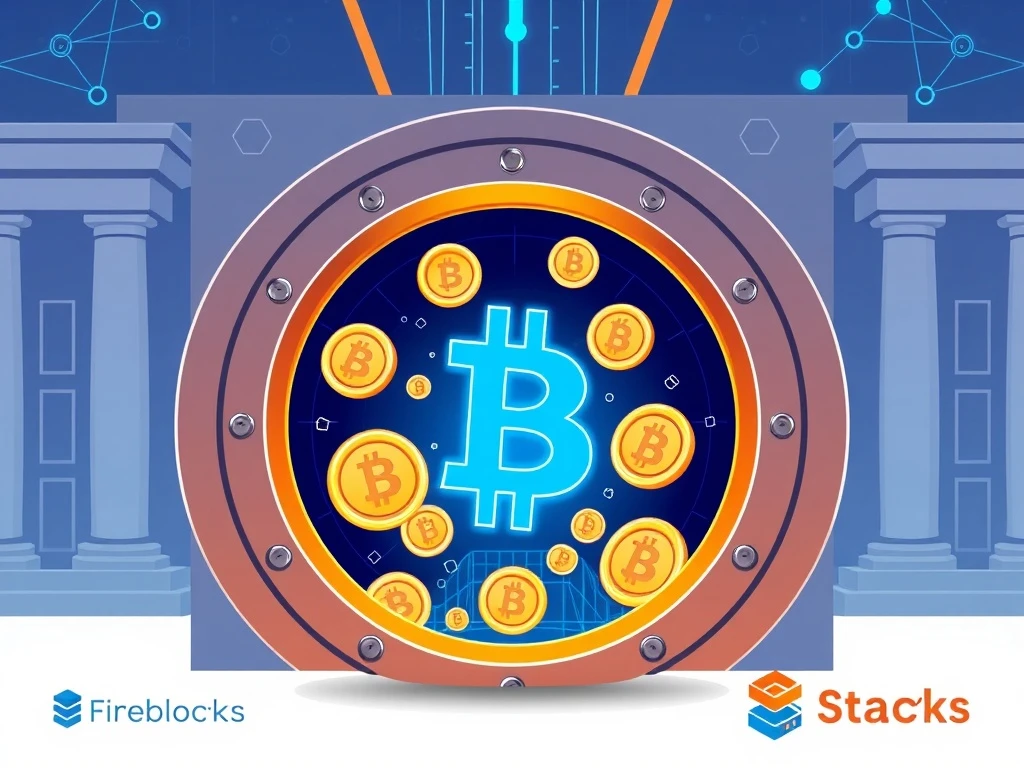
Institutional investors now have unprecedented access to Bitcoin-based decentralized finance through a groundbreaking collaboration between Fireblocks and Stacks, announced on March 15, 2025. This partnership fundamentally transforms how traditional financial institutions interact with Bitcoin’s $1.3 trillion ecosystem by enabling secure, compliant smart contract functionality on the world’s largest cryptocurrency network. Consequently, major financial players can finally participate in Bitcoin DeFi opportunities while maintaining enterprise-grade security standards.
Fireblocks and Stacks Transform Bitcoin’s DeFi Landscape
The Fireblocks-Stacks integration represents a pivotal moment for institutional cryptocurrency adoption. Fireblocks, the leading digital asset custody platform serving over 1,800 institutions, now provides direct access to Stacks’ Bitcoin layer-2 solution. This technical breakthrough enables institutions to deploy smart contracts that settle transactions on Bitcoin’s base layer while executing complex DeFi operations off-chain. Moreover, this collaboration addresses three critical institutional requirements: regulatory compliance, security assurance, and operational scalability.
Stacks brings unique technological advantages to this partnership. Specifically, its Proof-of-Transfer consensus mechanism enables smart contracts that inherit Bitcoin’s security while operating with greater flexibility. The Stacks blockchain processes transactions independently but periodically settles final states to Bitcoin’s immutable ledger. This architecture provides institutions with the audit trail necessary for compliance reporting while maintaining the performance required for sophisticated DeFi applications.
Technical Architecture and Security Framework
Fireblocks integrates Stacks through its proprietary MPC-CMP technology, which eliminates single points of failure in private key management. This multi-party computation approach distributes cryptographic key shares across multiple parties, requiring consensus for transaction authorization. Additionally, Fireblocks’ policy engine enables institutions to configure granular transaction controls, approval workflows, and compliance rules specifically for Bitcoin DeFi operations on Stacks.
The technical implementation follows a layered security model:
- Layer 1: Bitcoin’s proof-of-work provides ultimate settlement security
- Layer 2: Stacks’ Clarity smart contracts enable programmable logic
- Custody Layer: Fireblocks’ MPC technology secures private keys
- Policy Layer: Institutional controls govern transaction parameters
Institutional Bitcoin DeFi Use Cases and Applications
This collaboration unlocks numerous practical applications for institutional participants. Traditional finance entities can now engage with Bitcoin beyond simple holding strategies. For instance, asset managers can implement yield-generating strategies through Bitcoin-based lending protocols. Similarly, treasury departments can optimize corporate Bitcoin holdings through automated rebalancing and liquidity provision.
The partnership specifically enables several institutional-grade DeFi applications:
| Application | Description | Institutional Benefit |
|---|---|---|
| Bitcoin Lending | Secure collateralized lending using Bitcoin | Yield generation on idle assets |
| Automated Market Making | Liquidity provision for Bitcoin pairs | Fee income with controlled risk |
| Structured Products | Custom derivatives and options on Bitcoin | Risk management and hedging |
| Cross-chain Operations | Bitcoin interoperability with other chains | Portfolio diversification |
Furthermore, regulatory compliance receives particular attention in this implementation. Fireblocks’ transaction monitoring integrates with Stacks’ transparent blockchain data, providing institutions with comprehensive audit trails. This combination addresses concerns from financial regulators about DeFi’s transparency and anti-money laundering compliance.
Market Impact and Industry Implications
The institutional entry into Bitcoin DeFi could significantly impact cryptocurrency markets. Currently, Bitcoin represents approximately 52% of total cryptocurrency market capitalization but participates in less than 3% of DeFi total value locked. This disparity highlights the substantial growth potential that institutional participation might unlock. Analysts project that institutional Bitcoin DeFi could attract $50-100 billion in assets within 24 months of widespread adoption.
Industry experts recognize this development’s importance. Michael Shaulov, CEO of Fireblocks, stated in the announcement, “This integration bridges the gap between institutional security requirements and Bitcoin’s DeFi potential.” Similarly, Muneeb Ali, co-creator of Stacks, emphasized, “We’re bringing Bitcoin’s security to programmable finance in a way that meets institutional standards.” These statements reflect the partnership’s strategic significance for both companies and the broader cryptocurrency ecosystem.
Competitive Landscape and Differentiation
The Fireblocks-Stacks partnership enters a competitive institutional cryptocurrency infrastructure market. However, several factors differentiate this offering from alternatives. First, the solution leverages Bitcoin’s established security and network effects rather than building on newer, less-proven blockchains. Second, the integration addresses institutional pain points around custody and compliance that many DeFi platforms overlook. Third, the technical architecture provides a clear path for regulatory acceptance through its transparency and control mechanisms.
Comparatively, Ethereum-based institutional solutions face different challenges, including higher gas fees and regulatory uncertainty around proof-of-stake consensus. Meanwhile, alternative Bitcoin layer-2 solutions lack Fireblocks’ institutional custody infrastructure and compliance tooling. Therefore, this partnership creates a unique position in the market that combines Bitcoin’s security with institutional-grade operational controls.
Implementation Timeline and Adoption Roadmap
The integration follows a phased rollout strategy designed to ensure stability and security. Phase one, completed in Q1 2025, enables basic Stacks transaction capabilities through Fireblocks’ platform. Phase two, scheduled for Q2 2025, will introduce advanced DeFi functionality including automated yield strategies and cross-chain operations. Finally, phase three in Q3 2025 will incorporate regulatory reporting features and integration with traditional finance systems.
Early adopters include several prominent financial institutions already testing the platform. These institutions represent approximately $15 billion in potential Bitcoin DeFi allocation according to industry estimates. Their feedback will shape the platform’s development priorities and feature roadmap throughout 2025. Additionally, the partnership includes educational initiatives to help institutional clients understand Bitcoin DeFi risks and opportunities.
Conclusion
The Fireblocks and Stacks collaboration fundamentally transforms institutional access to Bitcoin DeFi opportunities. This partnership successfully bridges the gap between Bitcoin’s security and institutional compliance requirements through innovative technical architecture. Consequently, traditional financial institutions can now participate in decentralized finance while maintaining enterprise-grade security and regulatory compliance. The integration marks a significant milestone in cryptocurrency’s institutional adoption journey, potentially unlocking billions in capital for Bitcoin-based financial applications. As this technology matures, institutional Bitcoin DeFi may become a standard component of sophisticated digital asset strategies.
FAQs
Q1: What specific Bitcoin DeFi opportunities does this partnership enable?
This collaboration enables institutions to participate in Bitcoin lending, yield farming, liquidity provision, and structured products through secure smart contracts that settle on Bitcoin’s blockchain while executing on Stacks’ layer-2 solution.
Q2: How does Fireblocks ensure security for institutional Bitcoin DeFi operations?
Fireblocks utilizes multi-party computation technology that eliminates single points of failure, distributed key management, granular policy controls, and transaction monitoring integrated with Stacks’ transparent blockchain data for comprehensive security.
Q3: What makes Stacks different from other Bitcoin layer-2 solutions?
Stacks uses a unique Proof-of-Transfer consensus that inherits Bitcoin’s security while enabling smart contracts through its Clarity programming language, providing both security and programmability for institutional applications.
Q4: How does this integration address regulatory compliance concerns?
The solution provides comprehensive audit trails, transaction monitoring, policy controls, and transparency that help institutions meet anti-money laundering, know-your-customer, and financial reporting requirements for DeFi activities.
Q5: What types of institutions are most likely to adopt this technology first?
Asset managers, hedge funds, corporate treasuries, and regulated cryptocurrency exchanges represent likely early adopters, particularly those already holding Bitcoin allocations seeking yield generation and advanced financial applications.
Related News
- Bitcoin’s $70,000 Support Shatters—Unleashing a Fierce Crypto Market Debate
- Bitcoin Price Drop: Tech Rout Drags US Equities Lower as BTC Breaks Below $67K
- Bitcoin Price Plummets Below $67,000: Analyzing the Sudden Market Downturn