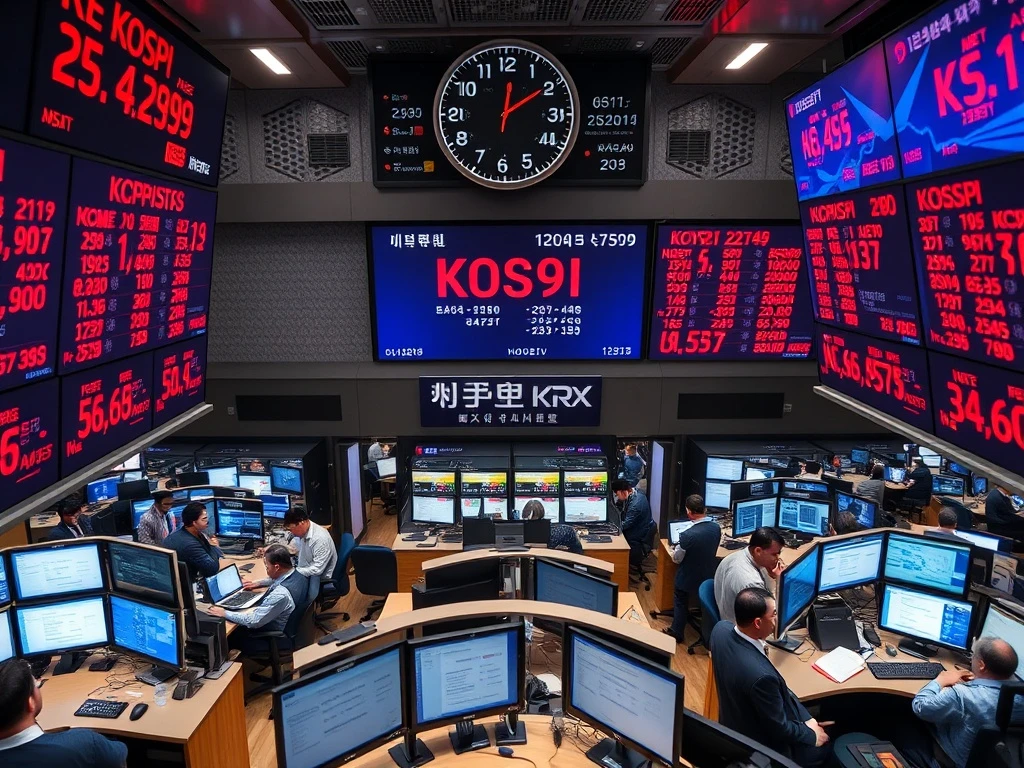
SEOUL, South Korea – The Korea Exchange (KRX) activated a sell-side sidecar for the KOSPI market on Thursday, marking the second such intervention this year and highlighting ongoing volatility in Asia’s fourth-largest economy. This crucial market mechanism temporarily restricts certain sell orders when the KOSPI 200 futures contract experiences rapid declines, providing breathing room during turbulent trading sessions. Market analysts immediately noted the activation’s significance, particularly as it follows similar interventions earlier in 2024, suggesting persistent concerns about market stability.
Understanding the KOSPI Sell-Side Sidecar Mechanism
The Korea Exchange’s sidecar functions as a targeted volatility control mechanism. Specifically, it triggers when the KOSPI 200 futures contract falls by more than 5% from the previous day’s closing price. Consequently, the system imposes a five-minute cooling-off period for specific sell orders. During this interval, market participants cannot execute sell orders below the current best bid price. This temporary pause aims to prevent cascading sell-offs that could destabilize the broader market.
Market regulators designed the sidecar as part of a comprehensive circuit breaker system. The Korea Exchange implemented these safeguards following the 2008 global financial crisis. Additionally, they refined the mechanisms after the 2010 Flash Crash in United States markets. The current system represents years of regulatory evolution. Financial authorities continuously monitor its effectiveness during periods of market stress.
Technical Specifications and Activation Criteria
The sidecar mechanism operates with precise technical parameters. First, it monitors KOSPI 200 futures contracts in real-time. Second, it calculates percentage declines from the reference price. Third, it automatically activates when thresholds breach predetermined levels. The system then communicates activation alerts to all trading participants through official KRX channels. Market data feeds immediately reflect the status change. Trading platforms must comply with order restrictions during the cooling period.
| Trigger Level | Action | Duration |
|---|---|---|
| ±5% from reference | Sell-side sidecar activation | 5 minutes |
| ±8% from reference | Market-wide trading halt | 15 minutes |
| ±15% from reference | Market-wide trading halt | Remainder of session |
Historical Context of Sidecar Activations in Korean Markets
This week’s activation represents the second sidecar trigger in 2024. Previously, the Korea Exchange activated the mechanism in February during global tech stock corrections. Historically, sidecar activations remain relatively rare events. The system triggered only three times during the entire 2023 calendar year. However, frequency increased during the COVID-19 pandemic volatility. Market data shows 11 activations occurred between 2020 and 2022.
Financial historians note several significant activation periods. The 2008 global crisis prompted multiple interventions. The 2011 European debt crisis triggered several sidecar events. More recently, geopolitical tensions affected activation frequency. Each episode provides valuable data for regulatory refinements. The Korea Exchange reviews all activations during quarterly risk committee meetings.
Comparative Analysis with Global Markets
South Korea’s approach aligns with international best practices. The United States employs similar mechanisms through SEC Rule 48. Japan implements price bands on the Tokyo Stock Exchange. Hong Kong uses dynamic circuit breakers. However, the Korean system features unique characteristics. Its five-minute duration differs from other markets. The focus on futures contracts represents a specific design choice. This comparative analysis helps understand regulatory philosophies across jurisdictions.
Immediate Market Impact and Trading Reactions
Thursday’s sidecar activation immediately affected trading dynamics. The KOSPI index declined 2.3% during the morning session. Trading volume surged 40% above the 30-day average. Institutional investors adjusted their strategies accordingly. Retail investors received automated alerts from brokerage platforms. Market makers modified their quoting behavior. Derivatives trading experienced temporary dislocations.
Several key sectors demonstrated particular sensitivity. Technology stocks showed amplified volatility. Semiconductor companies experienced above-average declines. Financial institutions adjusted their risk models. Foreign investors monitored the situation closely. Trading algorithms adapted to the new constraints. Market participants generally accepted the mechanism as necessary for stability.
- Technology Sector: Samsung Electronics declined 3.2%
- Financial Sector: KB Financial Group fell 1.8%
- Automotive Sector: Hyundai Motor dropped 2.1%
- Foreign Investment: Net selling reached $420 million
- Trading Volume: Increased to 850 million shares
Regulatory Perspective and Exchange Communications
The Korea Exchange issued an official statement following the activation. The communication emphasized the mechanism’s preventive nature. Regulators highlighted their continuous market monitoring. The Financial Services Commission (FSC) supported the exchange’s decision. Both institutions reiterated their commitment to market stability. They confirmed adequate liquidity conditions throughout the session.
Market surveillance teams operated at enhanced levels. The exchange monitored for potential market abuse. Algorithmic trading received particular scrutiny. Regulatory officials conducted real-time analysis of order flows. They verified compliance with all trading restrictions. Post-activation reviews began immediately following market close.
Expert Analysis and Financial Commentary
Financial analysts provided immediate assessments following the activation. Professor Kim Jae-won from Seoul National University noted, “The sidecar mechanism functions as designed during volatility episodes. However, its effectiveness depends on broader market confidence.” Institutional traders emphasized the importance of predictable regulatory responses. They appreciated the transparency in activation criteria.
Market strategists identified several contributing factors. Global interest rate uncertainties influenced investor sentiment. Currency fluctuations affected foreign investment flows. Sector-specific concerns amplified the declines. Technical indicators suggested oversold conditions. These combined elements created the volatility environment triggering the sidecar.
Investor Implications and Portfolio Management Considerations
The sidecar activation carries important implications for various investor categories. Institutional managers must adjust their execution algorithms. Retail investors should understand the mechanism’s purpose. Long-term investors might view activations as potential buying opportunities. Short-term traders need contingency plans for restricted periods.
Portfolio managers recommend several strategic adjustments. First, maintain appropriate cash positions during volatile periods. Second, diversify across sectors less sensitive to Korean market volatility. Third, implement hedging strategies using available derivatives. Fourth, monitor Korea Exchange announcements for potential interventions. Fifth, review historical activation patterns for strategic insights.
Technological Infrastructure and System Reliability
The Korea Exchange maintains robust technological systems supporting sidecar operations. Trading platforms automatically enforce restrictions. Surveillance systems detect threshold breaches within milliseconds. Communication networks disseminate alerts simultaneously. Backup systems ensure continuity during critical periods. Regular stress tests verify system capacity.
Technology teams conducted comprehensive reviews following Thursday’s activation. They verified all system components performed as designed. Data integrity checks confirmed accurate transaction recording. Network latency measurements remained within acceptable parameters. System logs documented the entire activation sequence. These verifications ensure confidence in future activations.
Future Regulatory Developments and Market Evolution
The Korea Exchange continuously evaluates its market safeguards. International regulatory cooperation informs potential improvements. Technological advancements enable more sophisticated mechanisms. The exchange considers several enhancement areas. Dynamic threshold adjustments represent one possibility. Sector-specific triggers might offer more targeted interventions. Machine learning applications could improve prediction capabilities.
Market participants anticipate ongoing regulatory evolution. The Financial Services Commission regularly reviews circuit breaker effectiveness. International benchmarking studies compare various approaches. Academic research contributes to evidence-based improvements. Industry consultations ensure practical implementation. These collaborative efforts aim to balance market efficiency with necessary stability measures.
Conclusion
The Korea Exchange’s activation of the KOSPI sell-side sidecar represents a carefully designed response to market volatility. This second activation in 2024 demonstrates the mechanism’s ongoing relevance in modern financial markets. The system provides temporary breathing space during rapid declines while maintaining overall market functioning. Investors should understand both the technical operation and strategic implications of these interventions. As global markets evolve, such safeguards will continue playing crucial roles in maintaining stability and confidence. The Korea Exchange’s approach offers valuable insights into balancing market efficiency with necessary protective measures during turbulent periods.
FAQs
Q1: What exactly triggers a sell-side sidecar on the Korea Exchange?
The sidecar activates when the KOSPI 200 futures contract declines by more than 5% from the previous day’s closing price. This triggers a five-minute cooling period restricting certain sell orders.
Q2: How often does the Korea Exchange activate sidecar mechanisms?
Activations remain relatively rare, with only two occurrences in 2024 so far and three during all of 2023. Frequency increases during periods of significant market volatility.
Q3: Can investors still trade during a sidecar activation?
Yes, trading continues during sidecar activations with specific restrictions. Sell orders cannot execute below the current best bid price, but other trading activities proceed normally.
Q4: How does Korea’s sidecar compare to circuit breakers in other markets?
While similar in purpose to mechanisms in the US and Japan, Korea’s system uniquely focuses on futures contracts and implements a standardized five-minute duration for cooling periods.
Q5: What should investors do when a sidecar activates?
Investors should avoid panic selling, review their investment theses, and consider whether volatility presents strategic opportunities. Monitoring official Korea Exchange communications provides important guidance.
Related News
- Galaxy Digital’s Bold $200M Share Buyback Signals Renewed Confidence as Crypto Stock Rebounds
- Bitcoin Difficulty Plummets 11.16%: Stunning Network Adjustment Echoes China’s 2021 Mining Exodus
- Bitcoin-Backed Loans: Strike’s Strategic Margin Call Extension Shields Borrowers Amid Intensifying Volatility