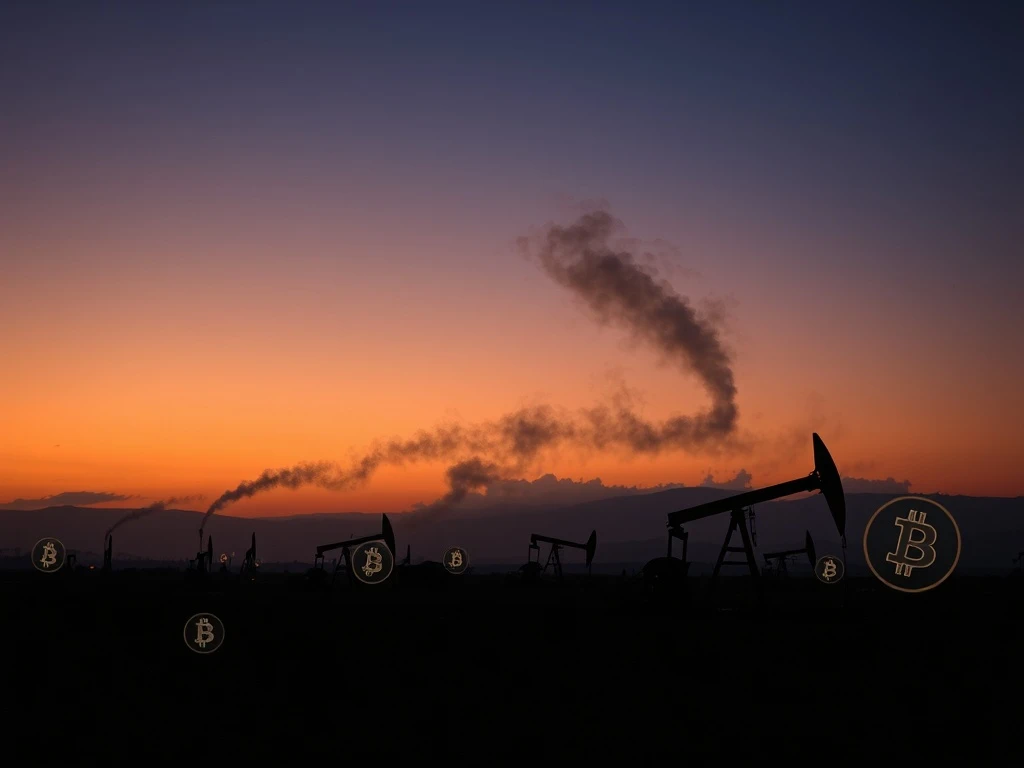
CARACAS, VENEZUELA — Analysts monitoring Venezuela’s economic landscape now predict a remarkable development: the country’s emerging oil industry resurgence may directly precede a substantial Bitcoin mining boom powered by previously wasted flared gas. This potential convergence of traditional energy recovery and cryptocurrency infrastructure represents a significant economic opportunity for the sanctioned nation. Furthermore, this development could reshape global conversations about energy utilization in digital asset creation.
Venezuela Bitcoin Mining Potential from Flared Gas
Energy analysts and cryptocurrency researchers have identified Venezuela’s substantial gas flaring as a potential resource for Bitcoin mining operations. Gas flaring refers to the burning of natural gas associated with oil extraction. This practice typically occurs when infrastructure for capturing, processing, or transporting the gas remains unavailable. The World Bank’s Global Gas Flaring Reduction Partnership estimates that Venezuela flares billions of cubic meters of gas annually. Consequently, this wasted energy represents both an environmental concern and a substantial untapped economic asset.
Recent technological advancements now enable the conversion of this flared gas into electricity on-site. Mobile Bitcoin mining containers can utilize this electricity directly at oil fields. This process creates a circular economic model. First, oil production generates associated gas. Second, that gas powers generators. Third, those generators run Bitcoin mining hardware. Finally, the mined Bitcoin generates revenue, potentially funding further oil infrastructure development. This model has gained traction in other oil-producing regions, including the Permian Basin in the United States.
The Resurgence of Venezuela’s Oil Industry
Venezuela’s oil production has shown measurable recovery since 2023. The United States Treasury Department issued General License 44 in October 2023. This license temporarily authorized transactions involving Venezuela’s oil and gas sector. Although this license faced non-renewal in April 2024, the six-month period allowed for increased production and foreign investment discussions. Major international oil companies, including Chevron and Repsol, maintained or expanded their operations under specific authorizations.
The country’s crude output reportedly surpassed 900,000 barrels per day in early 2025. This represents a significant increase from the 2020 low of approximately 400,000 barrels per day. This production rebound directly correlates with increased associated gas volumes. Historically, Venezuela has lacked sufficient gas processing and pipeline infrastructure. Therefore, a substantial portion of this associated gas gets flared. The table below illustrates Venezuela’s recent oil production trajectory and its implied gas flaring volume.
| Year | Estimated Oil Production (barrels/day) | Estimated Gas Flared (million cubic feet/day) |
|---|---|---|
| 2020 | ~400,000 | ~300 |
| 2022 | ~700,000 | ~525 |
| 2024 | ~850,000 | ~640 |
| 2025 Projection | ~900,000+ | ~675+ |
This resurgence creates a foundational condition for flared-gas utilization projects. Increased oil activity means more consistent gas flow. Consistent gas flow provides reliable fuel for power generation. Reliable power generation enables viable Bitcoin mining operations.
Expert Analysis on Economic and Technical Feasibility
Dr. Elena Marquez, an energy economist at the Central University of Venezuela, provided context on the technical requirements. “The concept is technically sound,” Marquez stated. “Modular gas-to-power systems paired with containerized mining rigs can be deployed within months. The primary challenges are not technological but rather logistical and regulatory.” She emphasized that such projects require clear legal frameworks for cryptocurrency and secure off-take agreements for the digital assets produced.
International blockchain energy consultant Mark Thielen published a 2024 report analyzing flare-gas Bitcoin mining. His findings indicate that a single standard mining container using flared gas can reduce CO2-equivalent emissions by approximately 6,000 tons per year compared to continuous flaring. This reduction occurs because methane, the primary component of natural gas, has a much higher global warming potential than CO2 when vented unburned. Flaring converts methane to CO2, and using the gas for productive work adds economic value to that process.
Regulatory Landscape and Cryptocurrency History
Venezuela possesses a complex history with cryptocurrency. The government launched the petro (PTR) cryptocurrency in 2018. This oil-backed digital currency aimed to circumvent international financial sanctions. The project faced significant criticism and limited international adoption. However, it established a regulatory precedent and some institutional knowledge within the country. The National Superintendency of Cryptoassets (SUNACRIP) was created to oversee all crypto-related activities.
In 2020, reports emerged of informal Bitcoin mining operations using subsidized electricity. The government subsequently increased electricity tariffs for high-consumption users, indirectly targeting mining. The current regulatory environment remains in flux. Key considerations for any large-scale flared-gas mining initiative include:
- Legal Status: The formal legality of Bitcoin mining for commercial export.
- Taxation: How revenue from mined Bitcoin would be taxed.
- Repatriation: Mechanisms for converting Bitcoin to hard currency.
- Partnership Models: Joint ventures between state oil company PDVSA and private mining firms.
Analysts suggest that a clear regulatory framework could attract foreign technology and capital partners. These partners would provide the modular mining infrastructure in exchange for a share of the Bitcoin yield.
Global Precedents and Comparative Advantages
Venezuela’s potential entry into flare-gas Bitcoin mining follows a path tested in other jurisdictions. Companies like Crusoe Energy Systems in the United States and Upstream Data in Canada have pioneered this model. They deploy digital flare mitigation systems that convert gas into electricity for modular data centers. These projects demonstrate the economic and environmental logic. Venezuela’s comparative advantages for such projects are notable:
- Abundant Feedstock: High, consistent volumes of flared gas in concentrated geographic areas.
- Energy Cost: The effective fuel cost is near-zero, as the gas is otherwise wasted.
- Climate: Warm climates reduce cooling costs for mining equipment, a major operational expense.
- Existing Infrastructure: Oil fields have basic road and security infrastructure.
However, significant disadvantages exist. Political instability and sanctions create investment risk. The lack of reliable internet connectivity in remote oil fields presents a technical hurdle. Furthermore, the volatility of Bitcoin’s price affects project economics. A sustained price downturn could render operations unprofitable despite low energy costs.
The Impact on Global Bitcoin Mining Geography
The Bitcoin network’s hashrate, its total computational power, has historically migrated toward regions with the cheapest sustainable energy. China’s 2021 mining ban triggered a migration to the United States, Kazakhstan, and Russia. Analysts like Alex Brammer of Luxor Mining note that “stranded energy” assets, including flared gas, represent the next frontier for mining location diversification. “Venezuela has some of the largest stranded gas assets in the world,” Brammer commented. “If even a fraction were harnessed, it could meaningfully contribute to global hashrate.”
This geographic shift supports network decentralization and security. It also aligns with growing emphasis on Environmental, Social, and Governance (ESG) criteria within the cryptocurrency industry. Using wasted methane for productive computation can improve the perceived environmental footprint of Bitcoin mining. Several Bitcoin mining companies now publicly report their use of flare gas to mitigate emissions.
Potential Economic Impacts for Venezuela
A successful flared-gas Bitcoin mining sector could generate multiple economic benefits for Venezuela. First, it would create a new export commodity—digital Bitcoin—that is easier to transact under complex sanctions regimes than physical oil. Second, it would generate high-tech employment and transfer technical skills. Third, it could provide a model for monetizing other stranded energy resources, such as remote hydroelectric or solar potential.
Revenue estimates vary widely based on Bitcoin’s price and the scale of deployment. A conservative analysis suggests that capturing 10% of Venezuela’s flared gas for mining could generate tens of millions of dollars in annual revenue. This revenue could fund further gas capture infrastructure, creating a positive feedback loop. Ultimately, reduced flaring would also help Venezuela meet its commitments under the Global Methane Pledge, potentially improving its international standing.
Conclusion
The resurgence of Venezuela’s oil industry creates a tangible opportunity for a parallel flared-gas Bitcoin mining boom. This potential development rests on a convergence of factors: increasing oil production, abundant wasted gas, proven modular technology, and a global cryptocurrency market seeking sustainable energy sources. While significant regulatory and logistical hurdles remain, the economic and environmental logic is compelling. Analysts will closely monitor whether Venezuela can translate its oil industry recovery into a innovative digital asset strategy, potentially creating a new model for resource-rich nations worldwide. The success of such Venezuela Bitcoin mining initiatives could demonstrate how legacy energy industries and digital frontier technologies can intersect for mutual benefit.
FAQs
Q1: What is flared gas, and why is it used in Bitcoin mining?
A1: Flared gas is natural gas burned off during oil extraction when capture infrastructure is lacking. Bitcoin mining can use this otherwise-wasted gas to generate electricity, turning an environmental liability into a productive asset and revenue source.
Q2: Is Bitcoin mining currently legal in Venezuela?
A2: The legal status is complex. The government has a history of engaging with cryptocurrency through the petro, and a regulatory body (SUNACRIP) exists. However, large-scale commercial Bitcoin mining for export operates in a gray area without explicit, stable legislation.
Q3: How does using flared gas for mining help the environment?
A3: It reduces methane emissions. Methane vented directly is a potent greenhouse gas. Flaring converts it to less-potent CO2. Using the gas for productive work (mining) adds economic value to that combustion process, incentivizing gas capture over venting.
Q4: What are the main challenges for starting flared-gas Bitcoin mining in Venezuela?
A4: Key challenges include regulatory uncertainty, international sanctions complicating equipment imports and Bitcoin sales, security risks in remote oil fields, and the need for reliable internet connectivity for mining operations.
Q5: Could this model work in other oil-producing countries?
A5: Yes, the model is already operational in the United States, Canada, and the Middle East. Any region with significant gas flaring and a permissive regulatory environment can potentially adopt flared-gas Bitcoin mining to monetize wasted energy.
Related News
- USDT Minted: Tether Treasury’s Monumental 1,000 Million Issuance Shakes Crypto Liquidity
- BlackRock Bitcoin Deposit: Monumental $270M Move to Coinbase Prime Signals Institutional Confidence
- Strategy Q4 Loss: Staggering $17.4 Billion Hit Reveals Bitcoin’s Brutal Correction