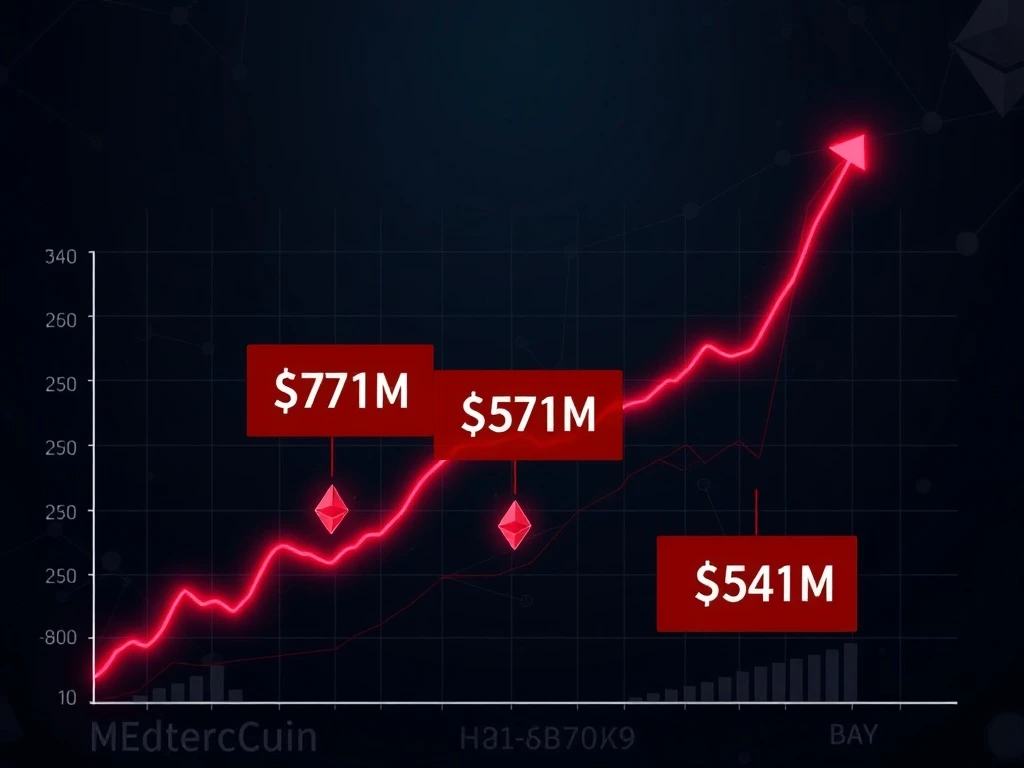
On-chain analytics firm Lookonchain has identified three critical liquidation zones that now threaten approximately $1.76 billion worth of Ethereum (ETH). This significant market risk, identified in March 2025, stems from large, leveraged positions held by prominent entities and anonymous whales. Consequently, these zones represent potential flashpoints for cascading sell pressure if the ETH price declines into specific ranges. Market participants are closely monitoring these levels for their potential impact on overall crypto market stability.
Understanding the $1.76 Billion Ethereum Liquidation Threat
Liquidation in cryptocurrency markets occurs when a leveraged position is automatically closed by a protocol or exchange. This happens because the collateral value falls below a required maintenance threshold. Forced liquidations can trigger rapid, automated selling. This selling often exacerbates price declines in a volatile feedback loop. The identification of precise price zones where this may happen provides crucial risk data for traders and analysts.
Lookonchain’s analysis, a respected source for on-chain intelligence, pinpoints the exact ETH price brackets and the entities involved. The total value at risk underscores the interconnected nature of decentralized finance (DeFi) and centralized lending. Notably, the health of these large positions can influence broader market sentiment and liquidity.
Breaking Down the Three Major Liquidation Zones
The data reveals three distinct clusters of risk, each tied to different price levels and holders. The following table summarizes the primary threat zones:
| Entity / Group | ETH at Risk | USD Value at Risk | Liquidation Price Range |
|---|---|---|---|
| Trend Research | 356,150 ETH | $671 Million | $1,562 – $1,698 |
| Joseph Lubin & 2 Whales | 293,302 ETH | $553 Million | $1,329 – $1,368 |
| 7 Siblings | 286,733 ETH | $541 Million | $1,029 – $1,075 |
Firstly, the highest zone involves Trend Research. This entity faces potential liquidation of 356,150 ETH if prices fall between $1,562 and $1,698. Secondly, a group containing Ethereum co-founder Joseph Lubin and two anonymous whales holds 293,302 ETH at risk in a lower band. Finally, the entity known as “7 Siblings” has exposure for 286,733 ETH at the lowest identified price range. These zones act like defensive lines in the market; a breach could trigger significant automated sell orders.
The Mechanics and Market Impact of Cascading Liquidations
The primary concern with concentrated liquidation zones is the potential for a cascade. For example, if ETH price drops into the $1,562–$1,698 range, Trend Research’s position could start liquidating. This forced selling would add downward pressure on the price. Subsequently, this pressure could push the price into the next lower zone, triggering Joseph Lubin and the whales’ positions. This domino effect could theoretically continue to the lowest zone.
Such an event would not only impact ETH’s price but also increase volatility across the crypto market. Historically, large liquidations have coincided with sharp market downturns and periods of illiquidity. Analysts use this on-chain data to model worst-case scenarios and assess systemic risk within the DeFi ecosystem. Monitoring tools and dashboards now commonly track these aggregate liquidation levels across major platforms.
Contextualizing the Risk in the 2025 Crypto Landscape
The crypto market in 2025 operates with increased institutional participation and more sophisticated financial instruments. Leveraged products, including perpetual swaps and margin lending, are widely available. Therefore, liquidation risks are a fundamental part of market structure. However, the scale of the risk identified here is notable. $1.76 billion represents a substantial portion of daily trading volume on many exchanges.
Regulatory developments over recent years have also shaped how exchanges and DeFi protocols manage liquidations. Many platforms have implemented circuit breakers or more gradual liquidation engines to mitigate market impact. Despite these safeguards, the concentration of risk in specific hands remains a point of vulnerability. Market educators consistently warn traders about the dangers of over-leverage, especially for large positions.
Expert Perspectives on On-Chain Risk Analysis
On-chain analytics has evolved into a critical discipline for risk assessment. Firms like Lookonchain, Glassnode, and CryptoQuant track wallet movements, exchange flows, and derivative metrics. Their data provides a transparent, albeit pseudonymous, view of market leverage. Experts argue that this transparency is a double-edged sword. While it allows for pre-emptive risk management, it can also lead to targeted trading strategies that exploit known liquidation clusters.
“The market often tests these liquidation zones,” explains a veteran market analyst who prefers anonymity. “Large players may intentionally push price toward these levels to trigger stop-losses and liquidations, acquiring assets at a discount. It’s a high-stakes game of chess played with blockchain data.” This behavior underscores the importance of robust risk management strategies for all market participants, from retail traders to institutional whales.
Historical Precedents and Risk Mitigation Strategies
The crypto market has witnessed several major liquidation events. The May 2021 crash and the LUNA/UST collapse in 2022 serve as stark reminders. During these events, billions in positions were liquidated within days, leading to extreme volatility and protocol insolvencies. Learning from history, many lenders now require higher collateral ratios. Additionally, traders increasingly use decentralized options or hedging strategies to protect against downside risk.
For the entities named in the report, risk mitigation could involve several actions. They might add more collateral to their positions to raise the liquidation price. Alternatively, they could gradually unwind or hedge their leverage through derivatives. The public nature of this data may prompt pre-emptive moves to avoid becoming a target. The market will watch for any large transfers of ETH into or out of the identified wallets as a signal of changing risk posture.
Conclusion
The identification of three major Ethereum liquidation zones threatening $1.76 billion highlights a significant latent risk in the cryptocurrency market. The concentrated positions held by Trend Research, Joseph Lubin, associated whales, and 7 Siblings create specific price levels that could act as accelerants for a downturn. While on-chain transparency allows for this advanced warning, it also introduces complex market dynamics. Ultimately, understanding these Ethereum liquidation risks is crucial for anyone involved in crypto trading, investing, or ecosystem analysis as the market continues to mature in 2025 and beyond.
FAQs
Q1: What is a liquidation zone in cryptocurrency?
A liquidation zone is a specific price range where a large volume of leveraged long positions would be automatically closed (liquidated) due to insufficient collateral, potentially causing cascading sell pressure.
Q2: Who is at risk according to the Lookonchain report?
The report identifies three groups: Trend Research (356,150 ETH at risk), Ethereum co-founder Joseph Lubin and two anonymous whales (293,302 ETH at risk), and an entity called “7 Siblings” (286,733 ETH at risk).
Q3: Why are these liquidation zones a problem for the broader market?
If triggered, the forced selling from these large positions could create a domino effect, pushing the price down into the next liquidation zone and amplifying volatility, which could negatively impact all ETH holders and the wider crypto market.
Q4: How can traders protect themselves from liquidation risks?
Traders can use prudent risk management: avoiding excessive leverage, maintaining high collateral ratios, setting stop-loss orders carefully, and using hedging instruments like options to limit downside exposure.
Q5: Is on-chain data like this always accurate?
On-chain data is verifiable and transparent but requires interpretation. Analysts must correctly attribute wallets to entities and understand the specific terms of lending protocols. While highly reliable, it is not infallible and should be one part of a broader analysis.
Related News
- USDT Minted: Tether Treasury’s Monumental 1,000 Million Issuance Shakes Crypto Liquidity
- BlackRock Bitcoin Deposit: Monumental $270M Move to Coinbase Prime Signals Institutional Confidence
- Strategy Q4 Loss: Staggering $17.4 Billion Hit Reveals Bitcoin’s Brutal Correction