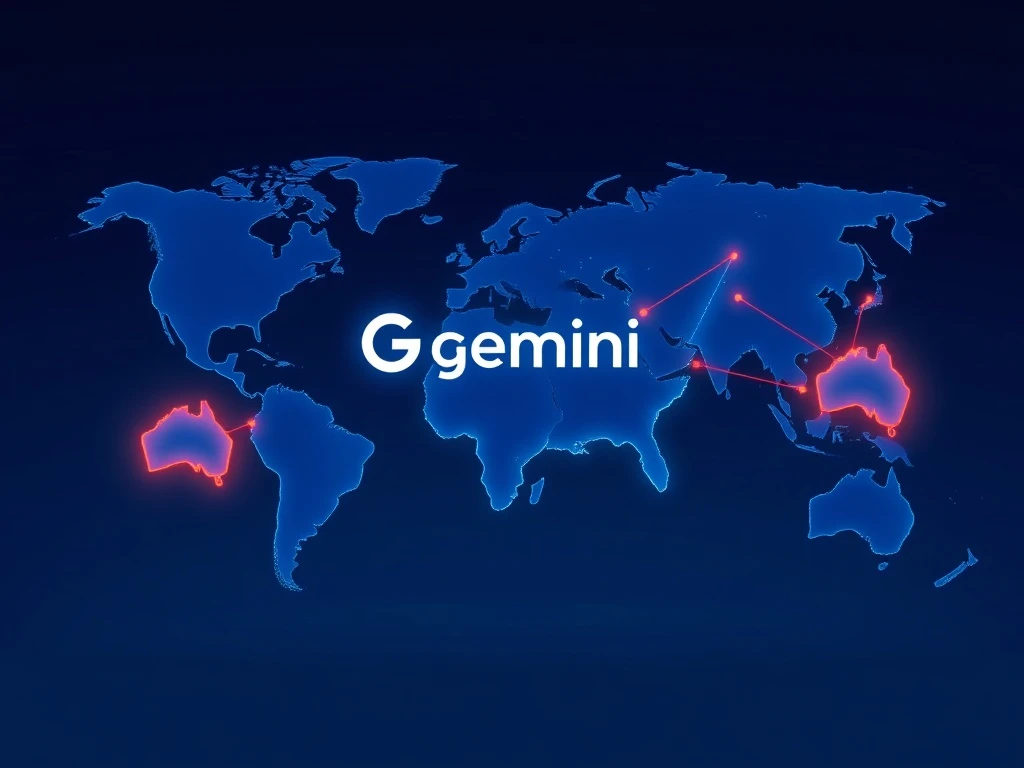
LONDON, UK – January 15, 2025 – Gemini Exchange, the prominent cryptocurrency platform founded by Cameron and Tyler Winklevoss, announced today its complete withdrawal from the United Kingdom, European Union, and Australian markets. Consequently, the company will redirect all operational resources toward consolidating its position in North America. This strategic decision marks one of the most significant geographic retractions in recent crypto exchange history, fundamentally altering competitive dynamics across three major economic regions.
Gemini Exchange Announces Major Market Exit Strategy
Gemini officially notified users in the affected regions this morning. The exchange will begin winding down services immediately, with a complete cessation scheduled for March 31, 2025. Users must withdraw all assets before this deadline. This move follows months of speculation about Gemini’s international strategy amid tightening global regulations. The exchange cited “evolving regulatory complexity” and a “strategic need for concentrated resources” as primary drivers. Industry analysts immediately recognized the announcement’s significance for the broader cryptocurrency landscape.
Furthermore, this decision represents a dramatic reversal from Gemini’s previous international expansion plans. The exchange had actively pursued licensing in multiple jurisdictions throughout 2023 and 2024. Market observers note the timing coincides with the final implementation phases of the European Union’s Markets in Crypto-Assets (MiCA) regulations. Similarly, the UK’s Financial Conduct Authority has recently finalized its crypto asset regime. Navigating these parallel, yet distinct, regulatory frameworks requires substantial legal and compliance investment.
Analyzing the Regulatory and Economic Drivers
The regulatory environment for cryptocurrency exchanges has intensified globally. In the European Union, MiCA establishes comprehensive rules for crypto-asset service providers. These rules mandate strict capital requirements, custody standards, and consumer protection measures. Compliance costs for operating across 27 member states are substantial. The United Kingdom is developing its own bespoke regulatory framework post-Brexit. Australia’s Treasury has also proposed stringent new licensing rules for digital asset platforms.
Conversely, the United States regulatory landscape, while complex, is becoming more defined for established players. Gemini holds a New York Trust Charter (a BitLicense) and operates in numerous states with money transmitter licenses. The company has invested heavily in its U.S. compliance infrastructure. Focusing solely on this mature regulatory framework allows for operational efficiency. The economic calculation is clear: serving a single, massive market with unified compliance protocols may yield better returns than managing multiple fragmented regimes.
Expert Analysis on Market Consolidation Trends
Financial technology experts see this as part of a broader industry trend. “We are witnessing a phase of strategic consolidation in crypto,” notes Dr. Anya Sharma, a fintech regulation professor at the London School of Economics. “The era of unfettered global expansion is over. Exchanges now face a cost-benefit analysis for each jurisdiction. For Gemini, the calculus likely showed that defending and growing its U.S. market share against domestic competitors like Coinbase and Kraken required undivided attention and capital.”
Data supports this strategic shift. North America remains the world’s largest cryptocurrency market by trading volume and institutional investment. The potential for spot Bitcoin ETF growth and expanding blockchain integration in traditional finance is concentrated there. By exiting competitive, lower-margin, and regulatory-heavy markets, Gemini can reallocate hundreds of millions in annual operational spending. This capital can fund technology development, security enhancements, and aggressive U.S. marketing campaigns.
Immediate Impact on Users and the Crypto Ecosystem
The immediate impact falls directly on Gemini’s customer base in the exiting regions. The exchange has outlined a clear transition process:
- Deposit Disabling: Immediate halt on all new deposits in GBP, EUR, and AUD.
- Trading Wind-Down: Gradual restriction of trading pairs over the next 30 days.
- Withdrawal Period: Full asset withdrawal support until the March 31 deadline.
- Account Closure: Automatic closure of inactive accounts with remaining balances after the deadline, subject to escheatment laws.
This creates urgent action for approximately 2 million affected users, according to industry estimates. Many must find alternative platforms, potentially incurring transfer fees and facing new KYC procedures. Competing exchanges, including Binance, Coinbase International, and local platforms, have already begun targeted marketing campaigns to capture this migrating user base. Market liquidity for certain crypto pairs may temporarily fragment in these regions.
The Ripple Effect on Competition and Innovation
Gemini’s withdrawal creates a vacuum in key markets, particularly for institutional and high-compliance retail clients. The exchange was known for its strong regulatory posture and insurance-backed custody. This exit may benefit other U.S.-based exchanges with international arms, like Coinbase, or European-focused platforms like Bitstamp. However, it also reduces competitive pressure, potentially leading to less favorable fee structures for users in the UK, EU, and Australia.
From an innovation perspective, the move signals that even well-capitalized players are prioritizing sustainability over growth-at-all-costs. This could influence venture capital investment, shifting focus toward startups targeting specific regulatory niches rather than aspiring to be global giants. The era of the “universal” crypto exchange may be narrowing, giving way to regionally specialized or product-specific platforms.
Strategic Refocus on the American Digital Asset Frontier
Gemini’s renewed American focus will manifest in several key areas. Company statements highlight a commitment to deepening institutional services, expanding its NFT and Gemini Earn products, and enhancing its core trading engine. The U.S. market is currently experiencing a wave of traditional finance adoption. Major banks and asset managers are exploring blockchain integration and digital asset custody. Gemini, with its New York trust charter, is uniquely positioned to serve this institutional wave.
The competitive battlefield in America is also shifting. The approval of multiple spot Bitcoin ETFs has changed the dynamics of retail access. Exchanges now compete not just with each other, but with traditional finance conduits. Gemini’s strategy likely involves leveraging its reputation for security and compliance to become the preferred partner for traditional institutions entering the space. This is a higher-margin, less saturated business than competing for retail traders in dozens of countries.
Comparative Table: Key Market Regulatory Landscapes (2025)
| Region | Primary Regulatory Framework | Key Challenge for Exchanges | Gemini’s Status |
|---|---|---|---|
| United States | State-by-State Money Transmission Laws, NYDFS BitLicense, Federal SEC/CFTC oversight | Fragmented but familiar; high compliance cost | Fully Licensed, Core Focus |
| European Union | Markets in Crypto-Assets (MiCA) Regulation | Uniform but complex; passporting across 27 states | Exiting Market |
| United Kingdom | FCA Crypto Asset Regime (Post-Brexit) | New, evolving standalone framework | Exiting Market |
| Australia | Treasury’s Proposed Licensing Reform | Pending legislation with strict custody rules | Exiting Market |
Conclusion
Gemini Exchange’s decision to exit the UK, EU, and Australian markets represents a pivotal moment in cryptocurrency industry maturation. This strategic retreat underscores the immense and growing cost of global regulatory compliance. By refocusing exclusively on America, Gemini bets that depth in the world’s most valuable market will outweigh breadth across multiple challenging jurisdictions. The move will test whether a “America-first” strategy can ensure long-term dominance against more globally diversified competitors. For users and observers worldwide, it serves as a clear indicator that the crypto industry’s growth phase is now inextricably linked to strategic regulatory navigation.
FAQs
Q1: What is the final date for Gemini users in the UK, EU, and Australia to withdraw their funds?
A1: The absolute deadline for all users in the exiting regions to withdraw their cryptocurrency and fiat balances is March 31, 2025. Gemini strongly recommends completing withdrawals well before this date.
Q2: Why did Gemini Exchange make this decision now?
A2: The decision coincides with the full implementation of stringent new regulations like the EU’s MiCA and final rules in the UK and Australia. The cost and complexity of maintaining full compliance across all these jurisdictions simultaneously, while competing in the core U.S. market, became prohibitive.
Q3: Can U.S.-based Gemini users be affected by this change?
A3: No, this change only affects users with accounts registered in the United Kingdom, European Union, and Australia. Services for users in the United States, Canada (where permitted), and other non-exiting regions will continue uninterrupted and may even expand.
Q4: What are the main alternatives for affected users?
A4: Users can transfer assets to other licensed exchanges operating in their region, such as Coinbase, Kraken, Bitstamp, or various regulated local platforms. They should compare fees, supported assets, and security features before choosing an alternative.
Q5: Does this signal financial trouble for Gemini?
A5: Not necessarily. Strategic retreat and focus are common in competitive industries. Analysts interpret this as a reallocation of resources rather than a sign of distress. The company is choosing to defend and grow its position in its most important market, the United States.
Related News
- Bitcoin’s Resilient Struggle: Technical Analysis Reveals Hidden Strength Beneath Key Averages
- Tether Makes Strategic Investment in Revolutionary USDT-Based Payments Network t-0
- Crypto-Backed Loans: Sberbank’s Bold Move to Revolutionize Corporate Finance in Russia