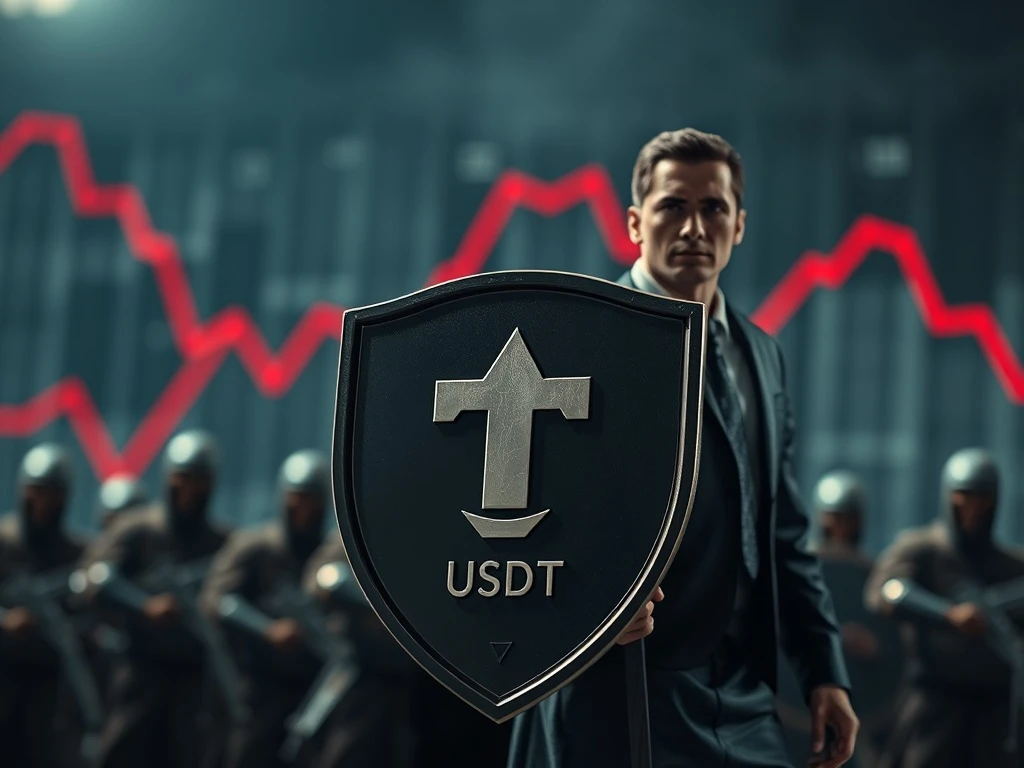
On November 26, 2024, amid a significant downturn across digital asset valuations, Tether CEO Paolo Ardoino captured market attention with a cryptic social media post. Ardoino shared a short, evocative video on his X account featuring an army marching with shields and swords, a move analysts quickly interpreted as a symbolic message of resilience to the cryptocurrency community. This event occurred during a sharp correction that saw Bitcoin’s price drop approximately 15% from its weekly high, pulling down the broader market cap by over $200 billion in a 48-hour period. The Tether CEO’s action provides a compelling case study in how industry leaders communicate during periods of extreme financial stress.
Tether CEO’s Cryptic Message and Market Context
Paolo Ardoino, who assumed the role of CEO at Tether in December 2023, posted the video without explicit commentary. The footage depicted a disciplined phalanx of soldiers advancing, their shields forming an unbroken wall. According to a report by the cryptocurrency news outlet U.Today, market observers and traders on social media platforms almost unanimously decoded the imagery as a metaphor for defense. Specifically, they viewed it as a statement about Tether’s preparedness to withstand selling pressure and maintain the peg of its USDT stablecoin. This visual communication strategy highlights a modern trend where crypto executives use symbolic, non-verbal cues to project confidence.
Furthermore, the timing was particularly significant. The video emerged as the global cryptocurrency market faced a multi-faceted challenge. Several key factors contributed to the sell-off:
- Macroeconomic Headwinds: Stronger-than-expected U.S. economic data renewed fears of prolonged higher interest rates.
- Exchange-Traded Fund (ETF) Outflows: U.S. spot Bitcoin ETFs experienced three consecutive days of net outflows totaling nearly $900 million.
- Leverage Unwinding: Data from analytics firms like CoinGlass showed over $1.5 billion in long positions were liquidated across derivatives exchanges.
In this volatile environment, the stability of major stablecoins like Tether’s USDT becomes paramount. Tether, with a market capitalization exceeding $110 billion, acts as a primary liquidity pillar and safe-haven asset within crypto trading pairs.
The Critical Role of Stablecoins in Market Corrections
During cryptocurrency market downturns, stablecoins transition from mere trading instruments to essential harbors of perceived safety. Their primary function is to maintain a 1:1 peg with a fiat currency, typically the U.S. dollar. When volatility spikes, traders rapidly convert volatile assets like Bitcoin and Ethereum into stablecoins to preserve capital value. This massive movement creates immense redemption pressure on the issuing company’s reserves. Tether’s operational history includes navigating several such stress tests, most notably during the 2018 bear market and the Terra/LUNA collapse of 2022.
Consequently, Ardoino’s video can be analyzed as a direct response to this underlying mechanics of market fear. The “shields” represent the company’s claimed robust reserves, while the “swords” symbolize its active mechanisms for defending the peg, such as minting and burning tokens and managing liquidity across exchanges. A breakdown in this defense, meaning a “de-peg” event where USDT trades significantly below $1.00, could trigger a cascading liquidity crisis. The following table contrasts key stability metrics for major stablecoins during the recent correction:
| Stablecoin | Issuer | Market Cap (Approx.) | Observed Trading Range (vs $1.00) | Primary Reserve Backing |
|---|---|---|---|---|
| USDT | Tether | $110B | $0.998 – $1.002 | U.S. Treasuries, Cash, Other |
| USDC | Circle | $32B | $0.999 – $1.001 | U.S. Treasuries, Cash |
| DAI | MakerDAO | $5B | $0.997 – $1.003 | Overcollateralized Crypto Assets |
As shown, Tether maintained its peg within a narrow band, a fact that likely underpinned the confident tone of Ardoino’s symbolic post. The company’s most recent attestation report, published by independent auditor BDO, claimed that over 90% of its reserves were held in “cash and cash equivalents,” primarily U.S. Treasury bills.
Expert Analysis on Executive Communication Strategies
Industry analysts note that Ardoino’s approach fits a pattern of strategic communication. Dr. Lena Schmidt, a financial sociologist at the Zurich Institute of Technology, published a 2024 paper on signaling theory in decentralized finance. “In the absence of traditional central bank assurances,” Schmidt explains, “crypto entities must construct their own narratives of stability. Symbolic acts, especially those invoking historical metaphors of strength and unity, serve as psychological anchors for a retail investor base prone to panic.” She contrasts this with the more direct, data-heavy communication style of Circle (issuer of USDC), suggesting different risk cultures within the stablecoin sector.
Moreover, the act of posting on X, rather than issuing a formal press release, targets the core demographic of crypto traders who consume information in real-time on social platforms. This method ensures rapid dissemination and community engagement, turning the CEO’s personal account into a de facto corporate communications channel during crises. However, this strategy also carries risk, as ambiguous symbolism can sometimes be misinterpreted, potentially amplifying uncertainty rather than quelling it.
Historical Precedents and Market Psychology
The cryptocurrency market has a rich history of symbolic gestures from its leaders during turbulent times. For instance, during the 2022 market collapse, key figures like Binance CEO Changpeng Zhao and MicroStrategy’s Michael Saylor made highly publicized purchases of Bitcoin, signaling their long-term conviction. Ardoino’s military metaphor, however, shifts the focus from offensive accumulation to defensive fortification. This aligns with Tether’s fundamental role as a stability provider rather than a speculative asset promoter.
Market psychology plays a crucial role in these events. A stablecoin’s peg is as much a function of collective belief as it is of technical reserves. If a critical mass of users believes the issuer cannot honor redemptions, a bank run can occur, breaking the peg regardless of the underlying accounting. Therefore, confidence-building measures are not merely publicity stunts; they are operational necessities. Ardoino’s video can thus be seen as a preemptive strike against doubt, aiming to solidify community trust before questions about Tether’s resilience could gain traction on social media forums.
Additionally, the response from the crypto community was swift and largely supportive. Major trading desks reported no unusual redemption requests for USDT following the post, and its market share among stablecoins actually increased slightly during the week, according to data from DeFiLlama. This suggests the intended message was effectively received. The event underscores how modern financial markets, especially those built on digital and social foundations, are influenced by narratives and signals that operate alongside raw financial data.
Conclusion
The Tether CEO’s decision to post a video of an army with shields and swords during a sharp market correction represents a sophisticated form of financial communication. Paolo Ardoino leveraged symbolic imagery to project strength and preparedness, directly addressing the community’s latent fears about stablecoin stability under pressure. This event highlights the intertwined nature of market mechanics, psychology, and narrative in the cryptocurrency ecosystem. While Tether’s actual resilience depends on the quality and liquidity of its reserves, the CEO’s defiant signal served as a timely reminder of the company’s central role in maintaining market infrastructure during periods of extreme volatility. As the digital asset class matures, the strategies its leaders use to manage confidence will remain a critical area of observation for participants and analysts alike.
FAQs
Q1: What did the Tether CEO’s video actually show?
The video posted by Paolo Ardoino showed a stylized clip of an ancient army marching in formation, carrying shields and swords. It was a symbolic piece of content without direct explanatory text.
Q2: Why is this video significant for the cryptocurrency market?
It is significant because it was posted during a major market downturn. Analysts interpret it as a signal from the world’s largest stablecoin issuer that it is prepared to defend its USDT peg against massive selling pressure, which is crucial for overall market liquidity.
Q3: Did Tether’s USDT lose its $1 peg during this market correction?
No. Available data from major cryptocurrency exchanges shows that USDT continued to trade within a very narrow range around $1.00 (typically between $0.998 and $1.002), demonstrating maintained stability throughout the period.
Q4: How does Tether supposedly “defend” its stablecoin peg?
Tether manages its peg through a combination of mechanisms: using its reserves to meet large redemption requests, arbitrage incentives for traders to buy USDT when it dips below $1, and managing the supply of tokens through minting (creating) and burning (destroying) processes in response to market demand.
Q5: Has Tether’s CEO used similar symbolic communication before?
Yes. Paolo Ardoino and other crypto executives frequently use metaphors and symbolic language on social media. For example, during past periods of stress, discussions of “fortresses” or “battle readiness” have been used to communicate operational strength and reserve security to the community.
Related News
- Brazil Prepares to Tax Cryptocurrency Flows: A Comprehensive Guide to the 2025 Regulatory Shift
- US Government Bitcoin Losses Approach $5 Billion: Strategic Holdings Tested by Market Volatility
- Bitcoin Price Analysis: Expert Reveals Why Current Market Pain Signals Maturation, Not Collapse