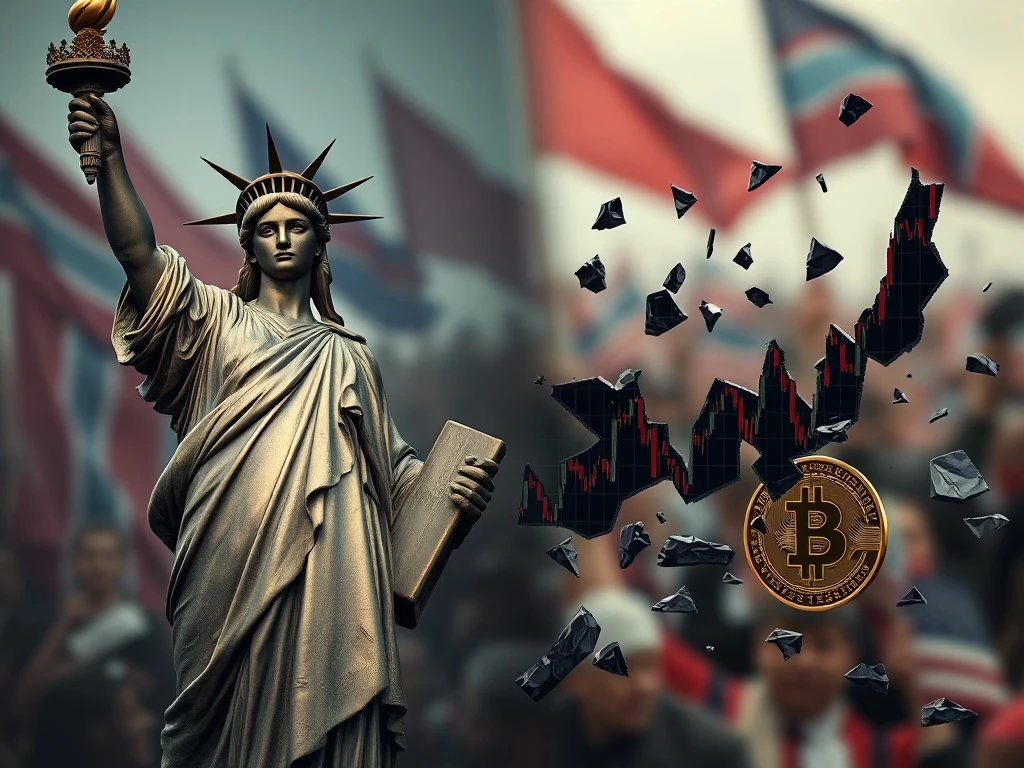
NEW YORK, March 2025 – Nobel Prize-winning economist Paul Krugman has issued a stark analysis of the latest Bitcoin downturn, arguing this Bitcoin crash represents a fundamental departure from previous cycles. According to his recent commentary, echoed in reports from U.Today, the digital asset’s historical resilience, rooted in libertarian ideology, is now fracturing under the weight of overt politicization. This shift, Krugman contends, creates a crisis of trust that may prevent the familiar recovery pattern, posing new and significant questions for the entire cryptocurrency market’s foundation.
Understanding the Unique Nature of This Bitcoin Crash
Historically, Bitcoin’s volatility has followed a recognizable pattern. Major price corrections, such as the 2018 bear market or the 2022 “crypto winter,” were typically followed by robust recoveries. Many analysts attributed this resilience to Bitcoin’s core value proposition as a decentralized, censorship-resistant store of value. Consequently, this narrative attracted a dedicated base of supporters who viewed the asset through a strong ideological lens. Their faith, according to Krugman’s thesis published on his blog, created a non-economic price floor. This floor was not based on cash flows or corporate earnings but on a shared belief system. However, the current market environment challenges that very premise. The professor from the City University of New York suggests the asset’s recent price ascent was fueled less by pure ideology and more by its adoption as a political symbol. Therefore, the current decline reflects a weakening of that symbolic power, not just a typical market correction.
The Politicization of Cryptocurrency and Its Market Impact
The integration of cryptocurrency politicization into mainstream political discourse marks a critical juncture. Over the past several years, digital assets have moved from niche online forums to the center of legislative debates and campaign rhetoric. Political figures have increasingly embraced or rejected Bitcoin based on partisan lines, framing it as a tool for financial freedom or a vector for illicit activity. This process has fundamentally altered the asset’s perception. Krugman’s analysis implies that when an asset’s value becomes tied to political fortunes, its market behavior changes. Specifically, its price becomes susceptible to political shifts, regulatory threats from opposing parties, and the erosion of bipartisan or apolitical appeal. For instance, the table below contrasts the drivers of past crashes with Krugman’s view of the current situation:
| Past Bitcoin Crashes (e.g., 2018, 2022) | Current Bitcoin Crash (2025 Analysis) |
|---|---|
| Driven by market cycles, leverage unwinding, or external macro shocks. | Driven by a crisis of trust in its politicized narrative. |
| The ideological ‘HODL’ base remained steadfast, providing buy-side support. | The ideological base is fragmented; trust in the political narrative is fading. |
| Recovery was fueled by renewed belief in Bitcoin’s original, anti-establishment promise. | Recovery is uncertain as the original promise is seen as co-opted by political agendas. |
This shift has tangible effects. Market data shows decreased buying activity from long-term holders during this dip compared to previous ones. Furthermore, trading volumes in politically neutral jurisdictions have shown different patterns than in regions where crypto is a hot-button issue. The asset’s correlation with certain political indices has increased, a novel and concerning trend for proponents of its role as “digital gold.”
Expert Perspectives on the Erosion of the Ideological Price Floor
Krugman’s viewpoint, while prominent, exists within a broader expert debate. Some blockchain analysts agree that the libertarian ideology that once provided a unified defense for Bitcoin’s price has diluted. They point to the community’s internal divisions on issues like regulation, environmental impact, and technological upgrades. Conversely, other economists argue that Bitcoin’s value drivers are maturing beyond simple narratives. They cite the growth of institutional adoption through ETFs, its fixed supply schedule, and its performance in countries with hyperinflation as more concrete fundamentals. However, even these proponents acknowledge that narrative and perception remain powerful short-term price forces. The key question Krugman raises is whether the politicized narrative has damaged the core ideological narrative beyond repair for a significant portion of its former base. Evidence from social sentiment analysis across platforms indicates a marked increase in discussions tying Bitcoin’s price directly to upcoming elections or regulatory comments, supporting the premise of a shift.
The Role of Trust and Narrative in Crypto Valuation
All financial assets rely on some degree of trust and shared narrative. For traditional equities, it’s trust in a company’s management and future profits. For government bonds, it’s trust in a state’s ability to repay its debt. For Bitcoin, since its inception, the primary narrative has been trust in a decentralized, algorithmic system free from government control. This narrative was its greatest strength and its most vulnerable point. Krugman’s argument centers on the idea that this trust has been redirected. Now, trust is placed in the ability of certain political movements to protect or promote the asset. This is inherently less stable than trust in mathematics and code. When political winds change, that trust can evaporate rapidly. The current BTC price floor is being tested not by miners’ costs or network hash rate, but by the conviction of a politically motivated holder base. If that conviction wavers, the historical support levels derived from ideological HODLing may not hold, potentially leading to a deeper and more prolonged downturn than those driven solely by macroeconomic factors.
Conclusion
Paul Krugman’s analysis of the current Bitcoin crash presents a compelling, if controversial, framework. He moves the discussion beyond technical charts and macroeconomic indicators to the psychological and ideological bedrock of cryptocurrency’s value. The core argument—that politicization has fundamentally altered the asset’s risk profile by undermining its unifying libertarian narrative—challenges a key tenet of Bitcoin’s historical resilience. Whether this thesis fully predicts the market’s future remains to be seen. Nonetheless, it highlights an undeniable evolution in the cryptocurrency landscape: Bitcoin is no longer just a technological experiment or an ideological statement. It is now a political football, and its price may increasingly reflect that volatile game. This development demands careful scrutiny from investors, regulators, and observers alike, as the rules for valuation and risk assessment are being rewritten in real time.
FAQs
Q1: What does Paul Krugman say is different about this Bitcoin crash?
Krugman argues this crash is driven by a “crisis of trust” in Bitcoin’s politicized narrative, unlike past crashes which were market-cycle events where the core libertarian ideology remained intact and fueled recoveries.
Q2: What is the “ideological price floor” for Bitcoin?
It refers to the theoretical price level supported by the unwavering belief of holders who value Bitcoin primarily for its decentralized, censorship-resistant properties, leading them to buy during dips regardless of short-term economics.
Q3: How has Bitcoin become politicized?
Bitcoin has become a prominent topic in political campaigns and legislative debates, with support or opposition often falling along partisan lines. It is framed as a symbol of financial freedom by some and a regulatory problem by others.
Q4: Do all experts agree with Krugman’s analysis?
No. While some analysts agree the ideological base has fragmented, others believe Bitcoin is developing more traditional fundamentals (like institutional adoption) that will support its value independently of political narratives.
Q5: What are the potential long-term impacts if Krugman’s view is correct?
If correct, Bitcoin could experience higher volatility tied to political events, struggle to find a stable valuation floor, and see its role as “digital gold” questioned due to its correlation with political rather than economic cycles.
Related News
- USDC Minted: Whale Alert Reveals Staggering 250 Million Stablecoin Injection
- Bitcoin Price Defies Gravity: BTC Reclaims $71,000 as Oversold RSI Sparks ‘Mathematical Limit’ Debate
- USDT Transfer Stuns Market: 400 Million Moves from HTX to Aave in Strategic Whale Maneuver