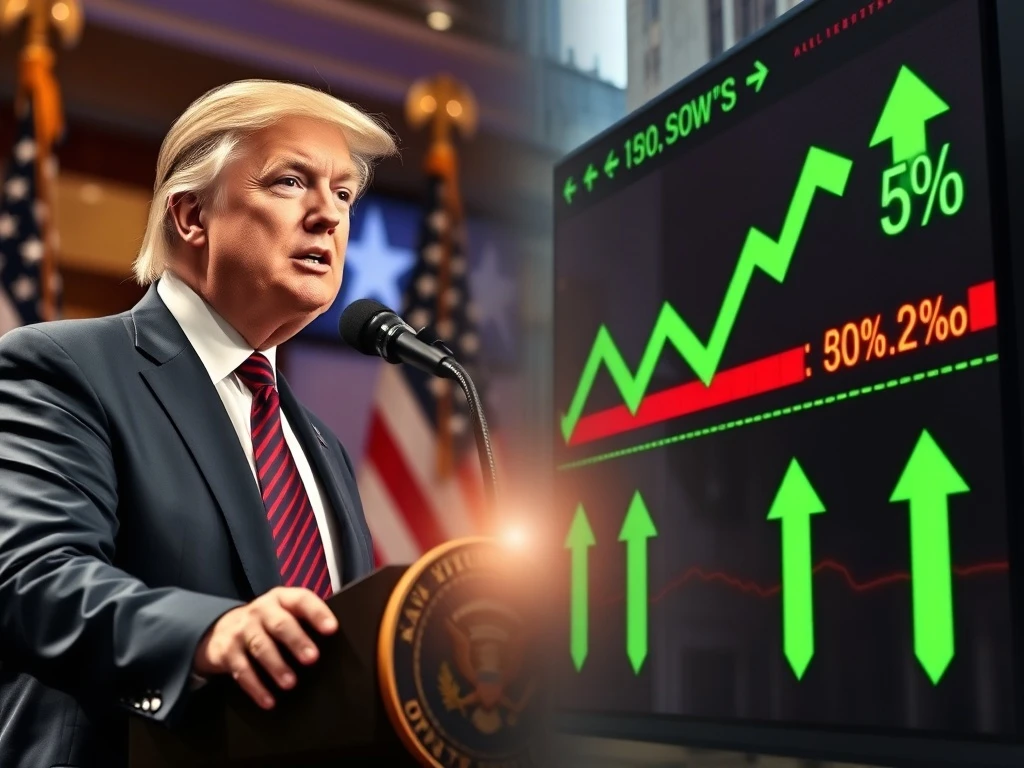
WASHINGTON, D.C. — November 2024: President Donald Trump recently made a striking economic prediction that has captured Wall Street’s attention, forecasting that the U.S. stock market will double from current levels by the conclusion of his presidential term. This bold statement immediately sparked widespread discussion among economists, investors, and policy analysts about its feasibility and potential implications for the American economy. Market observers now carefully examine historical precedents, current economic indicators, and policy directions that might influence this ambitious projection.
Trump’s Stock Market Prediction: Context and Immediate Reactions
President Trump delivered his market doubling prediction during a recent economic policy address. He specifically referenced current benchmark levels of major indices like the S&P 500 and Dow Jones Industrial Average. Financial analysts quickly calculated that achieving this forecast would require unprecedented annualized returns exceeding 15-20% over the remaining term period. Historically, such sustained growth rates have occurred only during exceptional economic expansions or recovery periods following major market corrections.
Market professionals responded with mixed reactions to the presidential forecast. Some portfolio managers noted that similar predictions from political figures often serve as aspirational targets rather than precise economic forecasts. Others pointed to the administration’s stated policy priorities, including potential tax reforms, regulatory adjustments, and trade policy developments. These factors could significantly influence corporate earnings and investor sentiment throughout the coming years.
Historical Presidential Market Performance Analysis
Examining historical data provides essential context for evaluating presidential market predictions. The table below illustrates stock market performance during various presidential administrations since 1950:
| President | Term Years | S&P 500 Total Return | Annualized Return |
|---|---|---|---|
| Bill Clinton | 1993-2000 | +210% | +15.3% |
| Barack Obama | 2009-2016 | +166% | +13.4% |
| Donald Trump | 2017-2020 | +67% | +13.7% |
| Ronald Reagan | 1981-1988 | +118% | +10.2% |
This historical analysis reveals that while substantial market gains have occurred during certain administrations, a 100% increase represents an exceptionally ambitious target. The Clinton administration achieved the highest modern-era returns, benefiting from the technology boom and favorable economic conditions. Current market valuations, interest rate environments, and global economic factors present different challenges and opportunities than previous periods of exceptional growth.
Economic Fundamentals Supporting Market Growth
Several economic factors could potentially support stronger market performance. Corporate earnings growth remains a fundamental driver of stock prices. Additionally, productivity improvements through technological adoption might accelerate economic expansion. Demographic trends, including workforce participation rates, also influence long-term growth potential. Policy initiatives focusing on infrastructure, energy independence, and manufacturing could stimulate specific market sectors.
Monetary policy decisions by the Federal Reserve will significantly impact market trajectories. Interest rate adjustments influence corporate borrowing costs and investor return expectations. Inflation management remains crucial for maintaining purchasing power and consumer confidence. Global economic conditions, particularly in major trading partners, affect export-oriented companies and multinational corporations.
Expert Perspectives on Market Doubling Scenarios
Financial economists and market strategists have offered diverse perspectives regarding the doubling prediction. Many emphasize that stock market performance depends on multiple interconnected factors rather than single policy initiatives. Several experts identified key considerations for evaluating the forecast’s plausibility:
- Earnings Growth Trajectory: Corporate profits must expand significantly to justify higher valuations
- Valuation Multiples: Current price-to-earnings ratios might limit near-term appreciation potential
- Interest Rate Environment: Monetary policy significantly influences equity risk premiums
- Geopolitical Stability: International relations affect global trade and investment flows
- Technological Innovation: Productivity breakthroughs can accelerate economic growth
Historical analysis shows that markets doubling within four-year periods typically require exceptional circumstances. The post-World War II economic boom, the technology revolution of the 1990s, and the recovery from the 2008 financial crisis each produced substantial gains. Current economic conditions differ markedly from these historical precedents, presenting both challenges and opportunities.
Potential Policy Impacts on Financial Markets
Administration policy directions could influence specific market sectors disproportionately. Proposed tax policies might affect corporate profitability and investor returns. Regulatory changes could alter operating environments for industries like energy, finance, and technology. Trade policy developments impact multinational corporations and supply chain dynamics. Infrastructure initiatives might benefit construction, materials, and engineering sectors.
Fiscal policy decisions regarding government spending and deficit management affect interest rates and economic growth. Healthcare policy changes influence pharmaceutical, insurance, and hospital stocks. Energy policy directions impact traditional and renewable energy companies. Technology policy regarding innovation, competition, and data privacy affects one of the market’s largest sectors. These interconnected policy areas collectively shape the investment landscape.
Comparative International Market Performance
Global market context provides additional perspective on the doubling prediction. Major international indices have demonstrated varying performance characteristics in recent years. Emerging markets sometimes achieve higher growth rates but with increased volatility. Developed markets typically offer more stability with moderate growth potential. The U.S. market has generally outperformed many international counterparts over the past decade, though past performance never guarantees future results.
Currency fluctuations significantly impact returns for international investors. Monetary policy divergence among central banks creates cross-border investment dynamics. Geopolitical developments influence capital flows between regions. Trade relationships affect multinational corporate earnings. These global interconnections mean U.S. market performance cannot be evaluated in isolation from worldwide economic conditions.
Conclusion
President Trump’s prediction that the U.S. stock market will double by the end of his term represents an exceptionally ambitious economic forecast. Historical analysis reveals that while substantial market gains have occurred during certain administrations, achieving 100% growth requires exceptional circumstances and sustained favorable conditions. Multiple factors including corporate earnings, monetary policy, geopolitical developments, and technological innovation will collectively determine market trajectories. Investors should maintain diversified portfolios while monitoring economic indicators and policy developments that might influence this Trump stock market prediction. The coming years will ultimately reveal whether this bold forecast aligns with actual market performance.
FAQs
Q1: What exactly did President Trump predict about the stock market?
President Trump predicted that the U.S. stock market would double from its current level by the end of his presidential term, implying approximately 100% growth over the remaining period.
Q2: Has any president previously seen the stock market double during their term?
Yes, President Bill Clinton oversaw a 210% total return in the S&P 500 during his eight-year administration, though this occurred over two terms rather than one.
Q3: What annual return would be needed to double the stock market in four years?
Achieving a 100% return in four years requires approximately 19% annualized returns, significantly above historical average market returns of about 10% annually.
Q4: What economic factors most influence stock market performance?
Corporate earnings growth, interest rates, inflation, economic expansion, geopolitical stability, and investor sentiment collectively influence market performance.
Q5: How should investors respond to presidential market predictions?
Investors should maintain diversified portfolios aligned with their risk tolerance and time horizon, considering that market predictions—from any source—carry uncertainty and should not override sound financial planning principles.
Related News
- Bithumb Bitcoin Error Triggers Alarming South Korean Probe Over 60 Trillion Won Payout
- Crypto Funding Soars: Firms Secure $258M in Pivotal Week for Blockchain Investment
- Arweave Block Production Halted: Critical 24-Hour Network Stall Sparks Concern