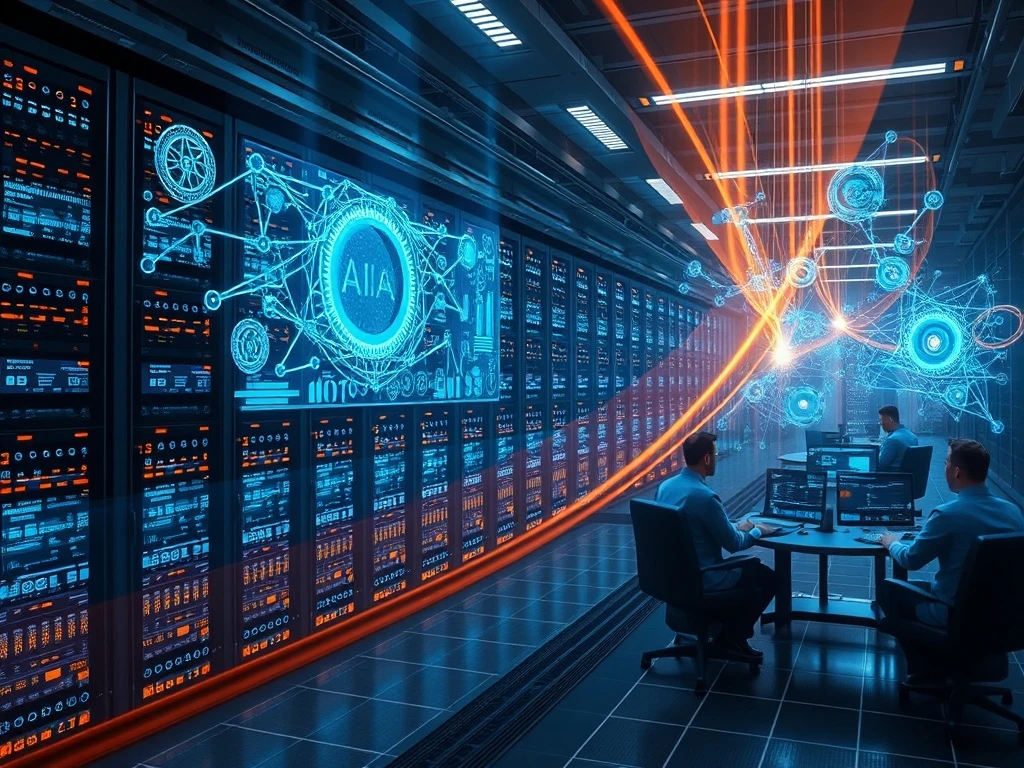
GLOBAL TECHNOLOGY LANDSCAPE, March 2025 – The integration of artificial intelligence and high-performance computing has entered an unprecedented acceleration phase, fundamentally transforming how researchers, corporations, and governments approach complex computational challenges. This convergence represents more than mere technological synergy; it marks a paradigm shift in computational capability that is already delivering tangible breakthroughs across scientific research, industrial design, and climate modeling. The fusion of AI’s pattern recognition with HPC’s raw processing power creates computational systems that exceed the sum of their parts, enabling solutions to problems previously considered intractable within practical timeframes.
The Acceleration of AI/HPC Integration in Modern Computation
Historically, artificial intelligence and high-performance computing developed along parallel but distinct technological trajectories. However, recent advancements have catalyzed their integration at an exponential rate. High-performance computing systems, traditionally optimized for linear scientific calculations, now incorporate specialized AI accelerators directly into their architecture. Conversely, modern AI training frameworks leverage distributed HPC clusters to process increasingly complex neural networks. This bidirectional integration creates a positive feedback loop where each technology enhances the other’s capabilities. For instance, AI algorithms now optimize HPC workload scheduling, while HPC resources accelerate AI model training by orders of magnitude.
The driving forces behind this accelerated integration are multifaceted. Firstly, the computational demands of large language models and generative AI systems have surpassed what conventional computing infrastructure can efficiently provide. Secondly, scientific domains like genomics, astrophysics, and materials science require both the pattern recognition of AI and the numerical precision of HPC. Thirdly, economic pressures demand more efficient computational resource utilization, pushing organizations toward integrated solutions. Major technology providers, including NVIDIA, AMD, and Intel, have consequently redesigned their hardware architectures specifically for this converged computational environment.
Technological Foundations Enabling Rapid Convergence
Several key technological developments have enabled the current acceleration in AI/HPC integration. Heterogeneous computing architectures now seamlessly combine CPUs, GPUs, and specialized AI processors within unified systems. Advanced interconnects like NVIDIA’s NVLink and AMD’s Infinity Fabric provide the high-bandwidth, low-latency communication necessary for synchronized AI-HPC workflows. Furthermore, software frameworks have evolved dramatically; platforms like PyTorch and TensorFlow now natively support distributed training across HPC clusters, while traditional HPC applications incorporate AI-assisted optimization modules.
The memory hierarchy represents another critical convergence point. High-bandwidth memory technologies, originally developed for HPC applications, now accelerate AI training by reducing data movement bottlenecks. Similarly, computational storage solutions allow AI models to process massive datasets without traditional I/O limitations. These hardware advancements coincide with software innovations in containerization and orchestration, enabling portable workflows that can leverage both AI and HPC resources interchangeably. The standardization of interfaces and APIs across previously separate ecosystems has been particularly crucial for this integration.
Real-World Applications and Immediate Impacts
The practical impacts of accelerated AI/HPC integration are already visible across multiple sectors. In pharmaceutical research, combined systems have reduced drug discovery timelines from years to months by using AI to identify candidate molecules and HPC to simulate their interactions. Climate scientists now employ integrated models that use AI to identify patterns in observational data while HPC runs detailed physical simulations of atmospheric dynamics. Automotive and aerospace engineers leverage these converged systems for generative design, where AI proposes optimized structures that HPC validates through rigorous physical simulation.
Financial institutions apply integrated AI/HPC systems for real-time risk analysis at previously impossible scales. Meanwhile, energy companies optimize complex extraction and distribution networks using AI-driven predictive models running on HPC infrastructure. The table below illustrates key sector applications:
| Industry Sector | AI Contribution | HPC Contribution | Integrated Benefit |
|---|---|---|---|
| Healthcare Research | Pattern recognition in medical imaging | Molecular dynamics simulation | Accelerated drug discovery pipeline |
| Climate Science | Anomaly detection in climate data | Global circulation modeling | Improved climate prediction accuracy |
| Manufacturing | Predictive maintenance algorithms | Computational fluid dynamics | Optimized production processes |
| Financial Services | Fraud detection models | Monte Carlo risk simulations | Real-time comprehensive risk assessment |
Architectural Evolution and System Design Principles
The architecture of integrated AI/HPC systems has evolved significantly from earlier approaches that merely connected separate components. Modern designs follow several key principles that enable true convergence. First, they implement unified memory spaces that allow both AI and HPC workloads to access data without costly transfers between discrete memory pools. Second, they employ adaptive resource scheduling that dynamically allocates computational elements based on workload characteristics. Third, they incorporate cross-stack optimization where compilers, libraries, and runtime systems coordinate across the entire software-hardware spectrum.
Several architectural patterns have emerged as particularly effective for AI/HPC integration:
- Tightly-coupled heterogeneous nodes combining different processor types with coherent memory
- Disaggregated composable infrastructure allowing dynamic reconfiguration for different workload types
- Hierarchical systems with specialized accelerators for specific computational patterns
- Edge-core-cloud continuum distributing different aspects of integrated workflows across computational tiers
These architectural approaches address the fundamental challenge that AI and HPC workloads often have opposing optimization requirements. AI training typically benefits from lower precision arithmetic and massive parallelism, while traditional HPC applications demand high numerical accuracy and complex communication patterns. Integrated architectures must therefore provide flexibility without compromising performance for either workload type.
Performance Metrics and Benchmarking Challenges
Measuring the performance of integrated AI/HPC systems presents unique challenges that traditional benchmarking approaches cannot adequately address. Conventional HPC benchmarks like HPL and HPCG measure floating-point performance and memory bandwidth but ignore AI-specific metrics. Conversely, AI benchmarks like MLPerf focus on training throughput and inference latency without considering scientific simulation requirements. The community has consequently developed new benchmarks that evaluate combined workflows, such as training an AI model on data generated by an HPC simulation.
Key performance indicators for integrated systems now include:
- Cross-workflow efficiency: How effectively the system transitions between AI and HPC computational patterns
- Data movement minimization: Reduction in data transfers between AI and HPC processing elements
- Energy efficiency per combined computation: Total useful work completed per unit of energy across mixed workloads
- Time to integrated solution: Reduction in overall time from problem formulation to validated result
These metrics reflect the reality that the value of integration lies not in peak performance of individual components but in the efficiency of complete computational pipelines. Early adopters report improvements of 3-10x in end-to-end workflow completion times compared to separated AI and HPC systems, with corresponding reductions in energy consumption and computational resource requirements.
Expert Perspectives on Integration Trajectories
Leading computational scientists emphasize that current integration represents only the beginning of a longer convergence trajectory. Dr. Maria Chen, Director of the Advanced Computing Research Institute, notes, “We’re transitioning from connected systems to truly unified computational fabrics where the distinction between AI and HPC becomes increasingly blurred at the architectural level.” This perspective aligns with hardware roadmaps showing increasingly specialized processing elements that can dynamically adapt to different computational patterns.
Industry analysts project continued acceleration through 2025-2030, driven by several factors. First, the demand for sustainable computing will push integration as a pathway to improved energy efficiency. Second, emerging applications in quantum-AI-HPC hybrids will require even tighter integration. Third, the democratization of these technologies through cloud services will make integrated capabilities accessible to smaller organizations and research groups. However, experts also caution about challenges including increased system complexity, specialized skill requirements, and the need for new programming models that abstract the underlying heterogeneity.
Software Ecosystem and Development Paradigms
The software landscape for integrated AI/HPC systems has undergone rapid evolution to support this convergence. Traditional boundaries between scientific computing libraries and machine learning frameworks have dissolved, with projects like JAX and Julia demonstrating how unified programming models can serve both domains. Container technologies, particularly those supporting GPU acceleration and high-performance networking, enable portable workflows across diverse infrastructure. Furthermore, workflow management systems have evolved to orchestrate complex pipelines that seamlessly combine AI training, inference, and simulation stages.
Several development paradigms have proven particularly effective for integrated applications:
- Differentiable programming allowing gradients to flow through combined AI-HPC computations
- Compositional frameworks where AI and HPC components interact through well-defined interfaces
- Domain-specific languages that abstract hardware heterogeneity while maintaining performance
- Interactive exploration environments supporting rapid iteration between AI analysis and simulation
These software approaches reduce the traditional barriers between AI and HPC development teams, fostering collaborative approaches to problem-solving. They also address the critical challenge of talent development, as they allow specialists in each domain to contribute without requiring deep expertise in the other. The resulting productivity gains amplify the hardware benefits of integration, creating compound improvements in overall computational capability.
Economic and Strategic Implications
The acceleration of AI/HPC integration carries significant economic implications for organizations across sectors. Organizations adopting integrated approaches report substantial reductions in time-to-solution for complex problems, directly translating to competitive advantages and accelerated innovation cycles. The efficiency gains also reduce computational costs, particularly important given the energy intensity of both AI training and large-scale simulation. Strategically, integration creates new capabilities that enable entirely new business models and research approaches previously impractical due to computational limitations.
National and regional initiatives increasingly recognize integrated AI/HPC infrastructure as critical strategic assets. Investment patterns show growing allocation to converged systems rather than separate AI and HPC deployments. This shift reflects the understanding that future economic competitiveness and scientific leadership will depend on mastery of integrated computational approaches. Consequently, workforce development programs now emphasize cross-disciplinary skills spanning both AI and HPC methodologies, preparing the next generation of computational scientists and engineers for this converged landscape.
Conclusion
The acceleration of AI/HPC integration represents one of the most significant computational trends of 2025, fundamentally reshaping how organizations approach complex problems across scientific, industrial, and societal domains. This convergence moves beyond simple co-location of technologies to create genuinely unified computational systems where artificial intelligence and high-performance computing enhance each other’s capabilities. The resulting systems deliver not only improved performance but entirely new approaches to problem-solving that leverage the complementary strengths of both paradigms. As this integration continues to accelerate through 2025 and beyond, it promises to unlock new frontiers in scientific discovery, technological innovation, and practical problem-solving that will define the next era of computational capability.
FAQs
Q1: What exactly does AI/HPC integration mean in practical terms?
AI/HPC integration refers to the architectural and software convergence that allows artificial intelligence workloads and high-performance computing simulations to run on shared infrastructure with minimal overhead. Practically, this means AI models can directly analyze simulation results as they’re generated, and simulations can use AI to guide their parameters, creating interactive computational loops rather than separate processing stages.
Q2: Why has this integration accelerated particularly in 2025?
Several converging factors drive the 2025 acceleration: the computational demands of foundation models have exceeded conventional AI infrastructure; scientific applications increasingly require both AI pattern recognition and HPC precision; hardware advances like unified memory architectures have removed technical barriers; and economic pressures demand more efficient computational resource utilization across organizations.
Q3: What are the main technical challenges in AI/HPC integration?
Key challenges include managing different numerical precision requirements between AI and HPC workloads, minimizing data movement between different processing elements, developing programming models that abstract this complexity, creating effective resource scheduling for mixed workloads, and establishing performance metrics that reflect integrated workflow efficiency rather than isolated component performance.
Q4: How does integration affect energy consumption compared to separate systems?
Properly implemented integration typically reduces total energy consumption by minimizing data movement between systems, improving overall resource utilization, and allowing dynamic power management based on workload characteristics. Early adopters report 20-40% energy reductions for equivalent computational work, though this varies significantly by application and implementation quality.
Q5: What skills are needed to develop applications for integrated AI/HPC systems?
Developers need cross-disciplinary understanding spanning traditional HPC concepts like parallel programming and numerical methods alongside AI fundamentals like neural network architectures and training methodologies. Familiarity with frameworks that bridge both domains, containerization for portable workflows, and performance analysis tools for heterogeneous systems has become increasingly valuable in this converged landscape.
Related News
- Bitcoin Soars: BTC Price Surges Past $77,000 Milestone in Major Market Rally
- Upbit ZIL Suspension: Critical Network Upgrade Halts Transactions Temporarily
- LD Capital Ethereum Mistake: Strategic Reversal After Costly Rally Bet Falters