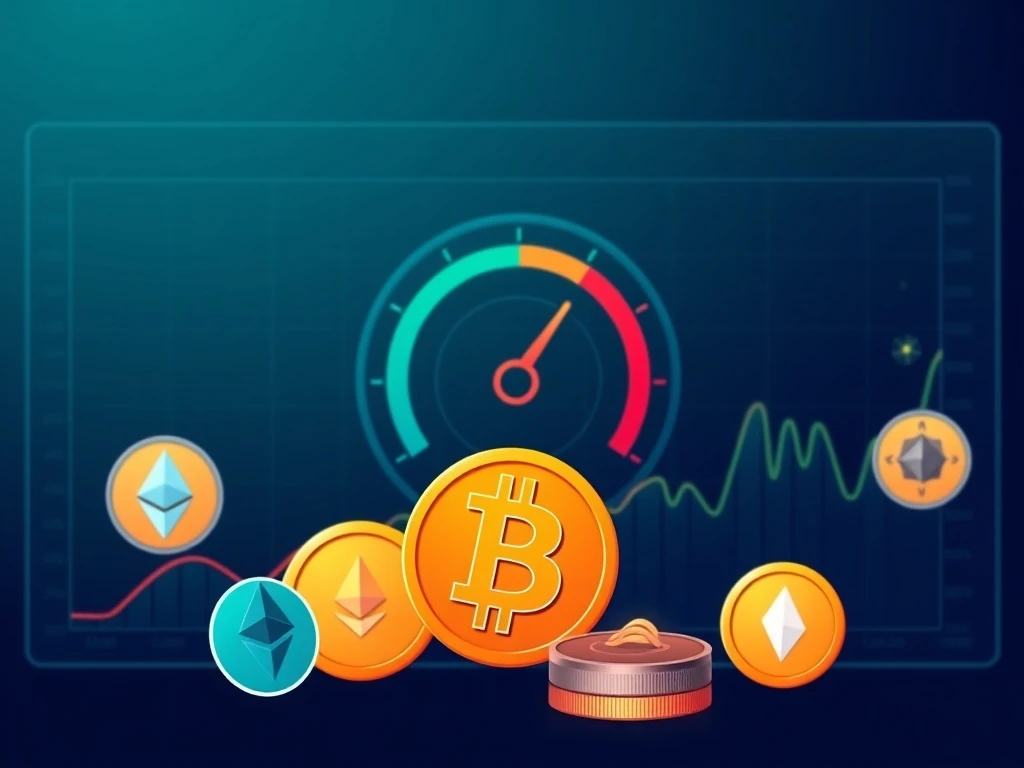
Global cryptocurrency markets, as of early 2025, continue to exhibit a clear preference for the original digital asset, with CoinMarketCap’s pivotal Altcoin Season Index registering a starkly low score of 27. This crucial metric, a barometer for market rotation, signals that Bitcoin remains the primary engine of capital flows, consequently dampening the performance prospects for alternative cryptocurrencies in the near term. The index’s current position, far from the 75 threshold needed to declare an ‘altcoin season,’ provides a data-driven snapshot of investor sentiment and risk appetite across the volatile digital asset landscape.
Decoding the Altcoin Season Index and Its Current Reading of 27
CoinMarketCap’s Altcoin Season Index functions as a quantitative tool for measuring market cycles. The platform calculates this figure by analyzing the 90-day price performance of the top 100 cryptocurrencies by market capitalization, deliberately excluding stablecoins and wrapped tokens. Subsequently, it compares each asset’s returns directly against Bitcoin’s performance over the identical period. A score of 100 would indicate that every single one of these top altcoins outperformed Bitcoin, while a score of 0 suggests universal underperformance. The current reading of 27 means that only a small fraction—approximately a quarter—of major altcoins have managed to surpass Bitcoin’s gains over the last three months.
Market analysts consistently monitor this index because it moves beyond simple price observation. It offers a structured, comparative framework. The 90-day window smooths out short-term volatility and noise, providing a more reliable medium-term trend. Historically, sustained periods where the index climbs above 75 have correlated with explosive, broad-based rallies in alternative cryptocurrencies. These periods often see capital rotate out of Bitcoin, perceived as a relative safe haven, and into higher-risk, higher-potential-reward altcoin projects. Conversely, a low index like 27 strongly suggests a ‘risk-off’ environment or a market phase where Bitcoin is absorbing the majority of incoming institutional and retail investment.
- Calculation Method: Compares 90-day performance of top 100 cryptos vs. Bitcoin.
- Exclusions: Stablecoins (USDT, USDC) and wrapped tokens (wBTC) are filtered out.
- Season Threshold: A sustained score above 75 officially signals an altcoin season.
- Current Implication: A score of 27 highlights pronounced Bitcoin dominance.
Historical Context and the Cycle of Crypto Market Leadership
Understanding the significance of a score of 27 requires examining past market cycles. For instance, during the major bull market of 2017, the index would have reached 100 for extended periods as assets like Ethereum, Ripple’s XRP, and Litecoin dramatically outpaced Bitcoin’s impressive gains. Similarly, in 2021, distinct altcoin seasons emerged, particularly in the summer and towards the year’s end, driven by the rise of decentralized finance (DeFi) and non-fungible token (NFT) ecosystems built primarily on alternative blockchains. These historical patterns establish a rhythm where Bitcoin leads initial bullish breakouts, followed by capital dispersion into altcoins.
The present market phase, however, appears to be lingering in the first stage. Several macroeconomic and sector-specific factors contribute to this dynamic. Firstly, the maturation and regulatory approval of Bitcoin-focused financial products, such as Spot Bitcoin ETFs in the United States, have created a powerful, compliant funnel for traditional capital. This influx disproportionately benefits Bitcoin. Secondly, ongoing regulatory uncertainty surrounding many altcoin projects, often scrutinized as potential securities, creates a headwind that Bitcoin, with its clearer commodity-like status, largely avoids. Consequently, the Altcoin Season Index acts as a confirmation tool for these broader market narratives.
Expert Analysis on Market Structure and Investor Behavior
Financial analysts specializing in digital assets point to on-chain data and derivatives markets to corroborate the story told by the Altcoin Season Index. Metrics like Bitcoin’s dominance chart, which measures its share of the total cryptocurrency market capitalization, have been climbing in tandem with the low altcoin index. This synergy between different data points strengthens the reliability of the current reading. Furthermore, funding rates in altcoin perpetual futures markets often turn negative or low during these phases, indicating a lack of leveraged bullish speculation compared to Bitcoin.
The behavior of large investors, or ‘whales,’ also provides context. Blockchain analytics firms report that accumulation addresses for Bitcoin have seen consistent growth, while similar momentum for many altcoins has been more sporadic. This suggests that sophisticated capital is prioritizing the market’s foundational asset. The current index level of 27, therefore, is not an anomaly but a reflection of a calculated, evidence-based preference playing out across global trading venues. It represents a period of consolidation and selective confidence before potential rotation.
The Path Forward: From Bitcoin Dominance to Altcoin Potential
A critical question for investors is what could catalyze a shift, pushing the Altcoin Season Index higher from its current 27. Historically, triggers have included technological breakthroughs on major altcoin networks, such as a successful major protocol upgrade (e.g., Ethereum’s transition to Proof-of-Stake), or the explosive growth of a new application layer that isn’t native to Bitcoin. Market liquidity is another key factor. When overall trading volume and total market capitalization expand significantly, it often provides the ‘rising tide’ that lifts all boats, eventually lifting altboats higher.
Another potential catalyst is a period of stability or consolidation in Bitcoin’s price. When Bitcoin enters a sideways trading range after a significant rally, it can reduce its short-term volatility and allure, prompting traders to seek alpha elsewhere. This search for higher returns naturally directs attention and capital toward the altcoin market. However, analysts caution that a genuine, sustainable altcoin season requires more than fleeting momentum; it needs fundamental improvements in scalability, user adoption, and real-world utility across various blockchain platforms.
| Index Range | Market Phase Interpretation | Typical Investor Action |
|---|---|---|
| 0 – 25 | Strong Bitcoin Dominance | Capital concentration into BTC; altcoin accumulation for long-term holders. |
| 26 – 50 | Moderate Bitcoin Leadership | Selective altcoin investment in sectors with strong fundamentals. |
| 51 – 74 | Market Rotation Phase | Increased diversification; monitoring for breakout candidates. |
| 75 – 100 | Altcoin Season | Broad-based altcoin rallies; increased risk-taking and trading volume. |
Conclusion
The Altcoin Season Index registering at 27 offers a clear, numerical insight into the current cryptocurrency market structure, unequivocally favoring Bitcoin. This metric, derived from a rigorous 90-day comparative performance analysis of the top 100 assets, serves as a crucial dashboard for traders and long-term investors alike. While the low score underscores a period of Bitcoin dominance, often driven by institutional inflows and regulatory clarity, it also establishes a baseline from which future market rotations can be measured. Monitoring the Altcoin Season Index remains an essential practice for anyone seeking to navigate the complex and cyclical nature of digital asset investment, as its climb from levels like 27 has historically preceded some of the market’s most dynamic phases.
FAQs
Q1: What exactly does an Altcoin Season Index of 27 mean?
An index score of 27 means that over the past 90 days, only about 27% of the top 100 cryptocurrencies (excluding stablecoins) have outperformed Bitcoin. It indicates a market phase where Bitcoin is the dominant performer, and broad altcoin rallies are not currently occurring.
Q2: How is the Altcoin Season Index calculated?
CoinMarketCap calculates the index by comparing the 90-day price performance of each of the top 100 cryptocurrencies against Bitcoin’s performance over the same period. The percentage of altcoins that outperform Bitcoin becomes the index score. Stablecoins and wrapped tokens are excluded from the calculation.
Q3: What index score signals the start of an ‘altcoin season’?
An ‘altcoin season’ is traditionally declared when the index sustains a value above 75. This threshold indicates that at least 75% of the top altcoins have outperformed Bitcoin over the preceding 90-day window, suggesting widespread capital rotation into alternative cryptocurrencies.
Q4: Does a low Altcoin Season Index mean altcoins are a bad investment?
Not necessarily. A low index like 27 indicates current underperformance relative to Bitcoin, but it does not predict future returns. Many investors use periods of low altcoin momentum and relative price stability to research and accumulate positions in projects with strong fundamentals for the long term.
Q5: How often is the Altcoin Season Index updated?
The index is typically updated daily by CoinMarketCap, reflecting the latest 90-day rolling performance data. This allows investors to track gradual shifts in market leadership and momentum in near real-time as new daily price data is incorporated into the three-month calculation window.
Related News
- MVL’s TADA Aims for $100M Blockbuster Investment to Fuel Aggressive U.S. Ride-Hailing Expansion
- Foundry USA Hashrate Plummets 60%: Winter Storm Fern’s Devastating Blow to US Bitcoin Mining
- Stablecoin Revenue Soars: Issuers Earn a Staggering $5 Billion in 2025 Fueled by Ethereum