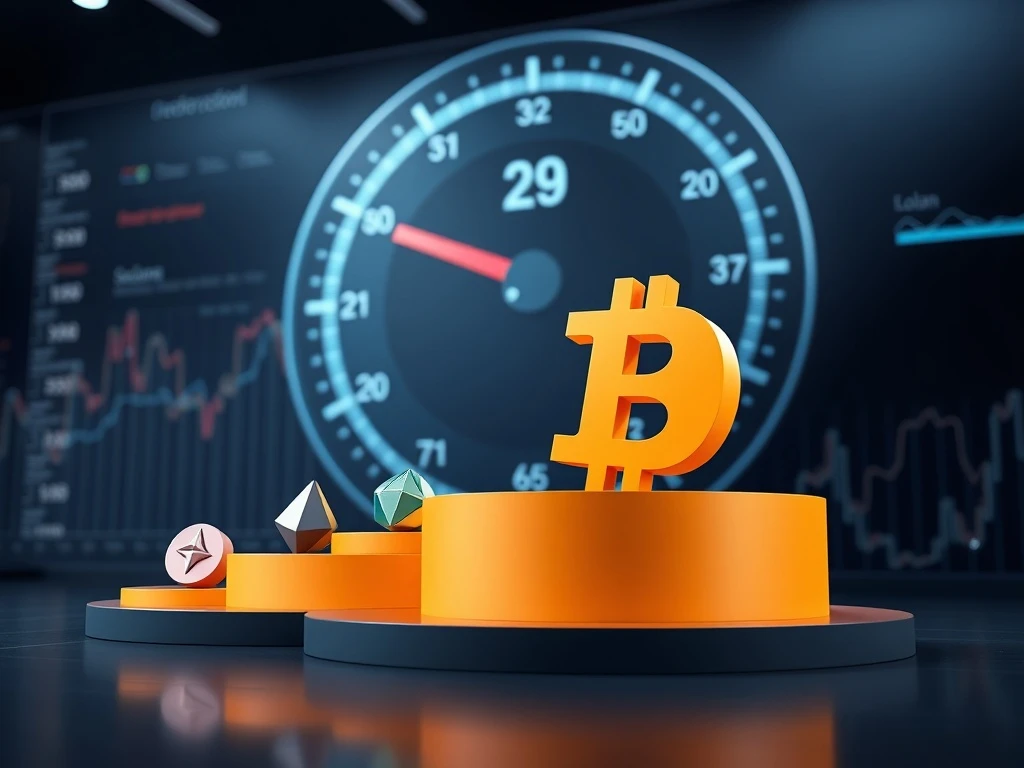
In a clear signal of shifting market dynamics, the widely watched Altcoin Season Index has fallen to a score of 29, marking a continued retreat from altcoin momentum and underscoring Bitcoin’s growing dominance in the cryptocurrency landscape as of early 2025. This key metric, published by leading data aggregator CoinMarketCap, serves as a critical barometer for investor sentiment and capital rotation between the flagship cryptocurrency and its numerous alternatives. Consequently, the one-point drop from the previous day’s reading of 30 reinforces a trend that has captured the attention of traders and analysts globally. This movement away from the ‘altcoin season’ threshold provides essential context for understanding current portfolio strategies and broader market cycles.
Decoding the Altcoin Season Index and Its 29-Point Reading
The Altcoin Season Index operates on a straightforward yet powerful premise. It systematically measures the performance of the top 100 cryptocurrencies, deliberately excluding stablecoins and wrapped assets, against Bitcoin over a rolling 90-day window. The index generates a score between 0 and 100. Market participants widely interpret a score above 75 as the official onset of an ‘altcoin season,’ indicating that at least 75% of these major altcoins have outperformed Bitcoin during the period. Conversely, a score like 29 sits firmly in ‘Bitcoin season’ territory, suggesting Bitcoin’s returns are surpassing the majority of the altcoin market. This quantitative approach removes emotional bias, offering a data-driven snapshot of relative strength.
Several critical factors typically influence movements in this index. First, Bitcoin’s own price action and market narratives, such as ETF inflows or macroeconomic hedge theories, directly impact its relative performance. Second, collective developments within the altcoin universe, including Ethereum network upgrades, Solana’s ecosystem growth, or regulatory news affecting specific tokens, play a significant role. Finally, broader market liquidity and risk appetite heavily dictate whether capital seeks the perceived safety of Bitcoin or the higher-beta potential of altcoins. The current index level of 29 strongly suggests a market environment favoring the former.
The Mechanics Behind the Market Sentiment Gauge
CoinMarketCap calculates this index daily using a transparent methodology. The process begins by filtering the top 100 cryptocurrencies by market capitalization, removing assets designed for price stability. Subsequently, the platform compares the 90-day price performance of each remaining asset directly against Bitcoin’s performance over the same timeframe. Each altcoin that outperforms Bitcoin contributes positively to the final score. Therefore, a score of 29 implies that only a small fraction of major altcoins are currently beating Bitcoin’s returns, highlighting a pronounced trend of capital consolidation into the market’s largest and most established asset.
Historical Context and Cyclical Implications of a Low Index Score
Placing the current 29 reading into historical context reveals meaningful patterns about cryptocurrency market cycles. Historically, prolonged periods of Bitcoin dominance, indicated by a low Altcoin Season Index, often precede major altcoin rallies. For instance, extended phases where the index remained below 30 have frequently set the stage for explosive ‘altcoin seasons’ once market sentiment and liquidity conditions shift. Analysts often view these Bitcoin-dominant phases as accumulation periods for altcoins, where prices consolidate before a potential surge. However, it is crucial to note that past performance does not guarantee future results, and each cycle possesses unique catalysts.
The transition between seasons is rarely abrupt. Typically, it follows a sequence where Bitcoin leads a market recovery, attracting initial institutional and macro-driven capital. As Bitcoin’s price stabilizes at higher levels, investor confidence grows, and capital begins to ‘trickle down’ or ‘rotate’ into altcoins in search of higher returns. This rotation gradually pushes the Altcoin Season Index higher until it crosses the 75 threshold. The current low score suggests the market is likely still in the earlier phase of this sequence, with Bitcoin capturing the majority of investor interest and inflows.
Expert Analysis on the Current Market Structure
Market analysts emphasize that a low Altcoin Season Index does not inherently signal weakness in the altcoin sector but rather indicates relative performance. Many altcoins could still be posting positive absolute returns while simultaneously underperforming a strongly advancing Bitcoin. This environment often creates selective opportunities rather than a broad-based altcoin decline. Seasoned traders monitor the index for divergences; for example, if the index begins to rise while Bitcoin’s price holds steady or increases slightly, it can be an early signal of capital beginning to rotate, potentially heralding a change in market leadership.
The Direct Impact on Trader and Investor Strategies
The practical implications of a 29-point Altcoin Season Index are significant for market participants. For portfolio managers, this data supports a strategy of overweighting Bitcoin or Bitcoin-related assets while maintaining a more selective, research-driven approach to altcoin allocations. Momentum traders might reduce exposure to broad altcoin baskets, focusing instead on individual projects with strong fundamental catalysts that could defy the broader trend of underperformance. Long-term investors, however, may view periods of low index scores as potential accumulation windows for high-conviction altcoin projects at relative valuations compared to Bitcoin.
Furthermore, this metric influences risk assessment. Generally, a ‘Bitcoin season’ correlates with lower overall volatility for a Bitcoin-heavy portfolio compared to an altcoin-heavy one, as Bitcoin often exhibits lower volatility than smaller-cap tokens. Investors using the index as one of several tools can adjust their risk parameters accordingly, potentially implementing tighter stop-losses on altcoin positions or increasing portfolio hedging activity during pronounced Bitcoin dominance phases.
Conclusion
The Altcoin Season Index’s decline to 29 provides a clear, quantifiable signal of the current market structure, firmly indicating a period of Bitcoin dominance in early 2025. This metric, rooted in comparative performance data, offers investors and analysts an objective framework to gauge sentiment and capital flows beyond mere price observation. Understanding the mechanics and historical context of this index is crucial for navigating the complex cryptocurrency cycles. While the low score highlights Bitcoin’s current strength, it also establishes a baseline from which future rotations into altcoins can be measured. As always, prudent market participation involves combining this broad sentiment indicator with rigorous fundamental research and disciplined risk management.
FAQs
Q1: What does an Altcoin Season Index of 29 mean?
An index score of 29 means that less than 30% of the top 100 altcoins (excluding stablecoins) have outperformed Bitcoin over the past 90 days. This strongly indicates a ‘Bitcoin season,’ where Bitcoin is delivering superior returns compared to the broader altcoin market.
Q2: How is the Altcoin Season Index calculated?
CoinMarketCap calculates it by comparing the 90-day price performance of each of the top 100 cryptocurrencies (excluding stablecoins and wrapped coins) against Bitcoin’s performance over the same period. The score reflects the percentage of those altcoins that have outperformed Bitcoin.
Q3: What is considered an ‘altcoin season’?
Market convention defines an ‘altcoin season’ as when the Altcoin Season Index sustains a score above 75. This threshold indicates that at least 75% of the major altcoins are outperforming Bitcoin, suggesting widespread capital rotation into alternative cryptocurrencies.
Q4: Does a low index score mean altcoins are losing value?
Not necessarily. A low score primarily indicates that altcoins are underperforming Bitcoin. Altcoins could still be increasing in absolute price terms but rising at a slower rate than Bitcoin, which results in a lower index score.
Q5: How should investors use the Altcoin Season Index?
Investors should use the index as a sentiment and cycle-tracking tool, not a standalone trading signal. It helps identify the dominant market trend (Bitcoin vs. altcoins) and can inform asset allocation and risk management decisions when combined with other fundamental and technical analyses.
Related News
- Binance Delisting Shakeup: 20 Spot Trading Pairs Including AAVE/FDUSD Face Removal in January 2025
- Sonic Labs Triumphantly Recovers 5.8 Million S Tokens from November Beets Exploit
- Ripple’s Strategic Triumph: Expands 75-License Footprint After Securing Preliminary EU Approval