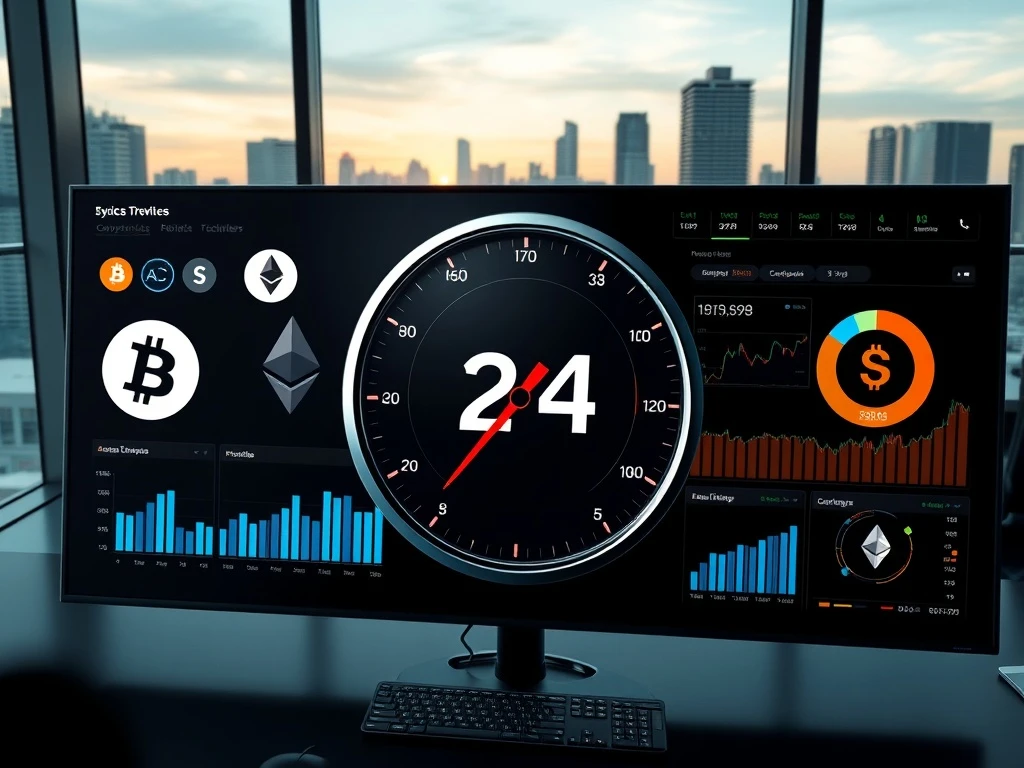
As of early 2025, a critical metric for cryptocurrency traders signals a cautious market phase. The Altcoin Season Index, a widely monitored benchmark from data platform CoinMarketCap, currently stands at 24. This score, far from the threshold of 100, indicates a market still firmly under Bitcoin’s influence. Consequently, this data point provides a crucial, evidence-based snapshot for investors navigating the complex digital asset landscape this year.
Understanding the Altcoin Season Index and Its Current Score
Crypto data platform CoinMarketCap calculates the Altcoin Season Index by analyzing the price performance of the top 100 cryptocurrencies by market capitalization. The methodology specifically excludes stablecoins and wrapped tokens to focus on volatile, speculative assets. Analysts then compare their 90-day performance against Bitcoin’s returns over the same period. A score of 100 would signify a full ‘altcoin season,’ where at least 75% of these top altcoins have outperformed Bitcoin. Conversely, a score of 24, as observed now, reveals a market where Bitcoin’s dominance persists. This quantitative approach removes sentiment and offers a clear, data-driven view of market structure.
The Mechanics Behind the Market Gauge
The index operates on a simple but powerful premise. It measures capital rotation between the market’s largest asset and the broader ecosystem. When the score trends upward, it suggests investors are seeking higher returns in alternative cryptocurrencies. When it remains low, capital concentration in Bitcoin is evident. The current reading of 24 is not an anomaly but part of a historical pattern. For instance, similar low readings often preceded major market shifts in previous cycles, providing context for today’s analysis. This historical perspective is essential for interpreting real-time data.
Bitcoin Dominance and Its Impact on the Broader Crypto Market
The low Altcoin Season Index score directly correlates with high Bitcoin dominance. This metric represents Bitcoin’s share of the total cryptocurrency market capitalization. A high dominance percentage, often above 50%, typically coincides with a low Altcoin Season Index. Market analysts observe this relationship because Bitcoin often acts as a market leader and a safe-haven asset during periods of uncertainty. Therefore, capital flows into Bitcoin first during bullish impulses or as a store of value during downturns. This dynamic leaves fewer funds available for altcoins to outperform, explaining the current index stagnation.
Several factors contribute to sustained Bitcoin dominance. Firstly, institutional adoption through spot Bitcoin ETFs, a landmark development from 2023-2024, continues to channel traditional finance capital primarily into Bitcoin. Secondly, macroeconomic conditions, such as interest rate decisions by central banks, disproportionately affect riskier altcoins. Finally, Bitcoin’s upcoming halving cycle, a scheduled reduction in mining rewards, historically creates a narrative that focuses investor attention on the original cryptocurrency. These combined forces create a headwind for the Altcoin Season Index to rise significantly.
Historical Context: Comparing Past Cycles to 2025’s Landscape
Examining previous crypto market cycles provides essential context for the index score of 24. Historically, prolonged ‘Bitcoin seasons’ have often given way to explosive ‘altcoin seasons.’ For example, after Bitcoin’s 2017 peak, the Altcoin Season Index eventually surged, leading to massive rallies in assets like Ethereum and Binance Coin. The pattern repeated, albeit differently, in the 2020-2021 cycle. However, each cycle possesses unique characteristics. The current market infrastructure, with regulated derivatives and institutional products, may alter the timing and intensity of these rotations. Past performance never guarantees future results, but it offers a framework for understanding probabilities.
The table below illustrates typical index ranges and their associated market phases:
| Index Range | Market Phase | Typical Investor Sentiment |
|---|---|---|
| 0-25 | Strong Bitcoin Season | Risk-Off, Cautious |
| 26-74 | Transition / Neutral | Watchful, Selective |
| 75-100 | Altcoin Season | Risk-On, Speculative |
Expert Analysis on Market Timing and Indicators
Seasoned market strategists emphasize that the Altcoin Season Index is a lagging indicator. It confirms a trend already in motion rather than predicting its start. Therefore, a score of 24 confirms that the past 90 days favored Bitcoin. Experts advise monitoring on-chain data and futures market funding rates for earlier signals of a potential shift. Furthermore, they highlight that ‘season’ does not imply all altcoins move together. Even in a Bitcoin-dominated market, select sectors, like decentralized physical infrastructure networks (DePIN) or real-world asset (RWA) tokenization, can see independent growth. This nuance is critical for sophisticated portfolio construction.
Strategic Implications for Crypto Investors in the Current Climate
For investors, the index reading provides a strategic framework rather than a direct buy or sell signal. A score of 24 suggests several actionable insights. Firstly, portfolio allocation might justifiably remain weighted toward Bitcoin or Bitcoin-correlated assets. Secondly, it underscores the importance of disciplined, fundamental research when selecting altcoins, as broad, market-wide tailwinds are absent. Thirdly, it may be a period for accumulating high-conviction altcoin positions during relative weakness, in anticipation of a future rotation. This phased approach balances risk management with growth potential.
Key considerations for a market with a low Altcoin Season Index include:
- Risk Management: Higher volatility in altcoins requires stricter position sizing.
- Sector Rotation: Identifying which blockchain sectors show resilience despite low index scores.
- Macro Awareness: Understanding how interest rates and liquidity affect capital availability for speculative assets.
- On-Chain Metrics: Tracking developer activity and network growth for individual projects, as these can diverge from price action.
Conclusion
The Altcoin Season Index at 24 offers a clear, quantitative snapshot of the cryptocurrency market in early 2025. It confirms a phase of Bitcoin dominance, shaped by institutional flows, macroeconomic factors, and Bitcoin’s own cyclical narrative. While historically such periods have preceded rotations into altcoins, the index itself is a confirmation tool, not a crystal ball. For investors, this data point reinforces the need for a strategy based on fundamentals, sector analysis, and patient capital allocation. Monitoring this Altcoin Season Index, alongside other on-chain and macroeconomic indicators, remains a vital practice for navigating the evolving digital asset landscape.
FAQs
Q1: What does an Altcoin Season Index score of 24 mean?
An index score of 24 means that very few of the top 100 altcoins have outperformed Bitcoin over the past 90 days. The market is in a pronounced ‘Bitcoin season,’ with capital and momentum concentrated in the leading cryptocurrency.
Q2: What index score triggers an official ‘altcoin season’?
Analysts declare an official ‘altcoin season’ when the index reaches 100. This occurs only if 75% or more of the top 100 cryptocurrencies (excluding stablecoins) outperform Bitcoin over a rolling 90-day window.
Q3: Is the Altcoin Season Index a good predictor of future prices?
No, the index is primarily a lagging indicator. It confirms a trend that has already occurred over the previous quarter. It is more useful for understanding the current market structure than for predicting short-term price movements.
Q4: Can some altcoins rally even when the index is low?
Absolutely. The index measures broad market performance. Individual altcoins or specific sectors like DeFi or gaming can experience significant rallies based on their own fundamentals, even during a period of overall Bitcoin dominance.
Q5: How often should an investor check the Altcoin Season Index?
For long-term investors, weekly or monthly monitoring is sufficient to gauge overall market structure shifts. Active traders may watch it more closely alongside other metrics like Bitcoin dominance and trading volume ratios.
Related News
- South Korea Crypto Disclosure: The Critical New Rule Forcing Foreigners to Reveal Digital Assets in Property Deals
- Crypto Scam Developer Faces Indictment in South Korea After Defrauding Victims of $615,000
- WLFI Token Attracts Massive $10M Investment as Cryptocurrency Whale Reveals Stunning Accumulation Strategy