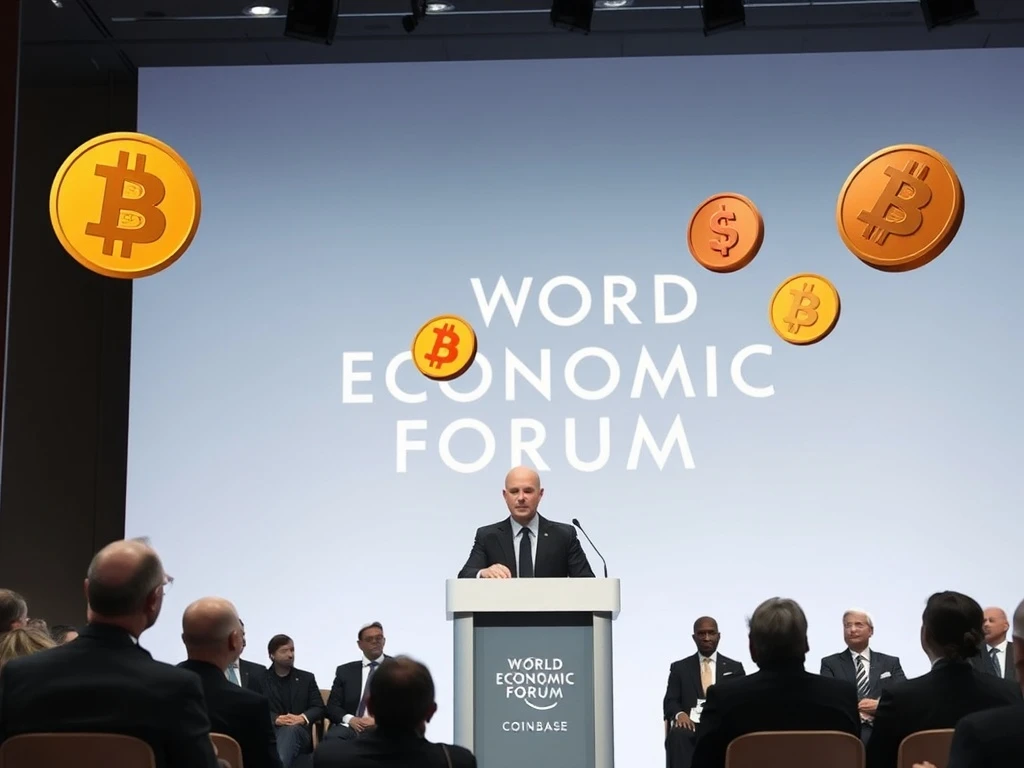
In a striking declaration that resonated through the halls of global finance, Coinbase CEO Brian Armstrong positioned Bitcoin not merely as an asset, but as a fundamentally more independent monetary system than traditional central banks. Speaking at the World Economic Forum in Davos, Switzerland, in January 2025, Armstrong’s comments ignited fresh debate about the future of money, sovereignty, and individual choice in the digital age. His argument hinges on a core, programmable feature of the pioneering cryptocurrency: its resistance to control by any single entity.
Bitcoin Independence: The Core of Armstrong’s Argument
Brian Armstrong’s central thesis at Davos was clear and technically grounded. He stated that Bitcoin’s independence stems from its decentralized architecture. Unlike a central bank, which operates under the direction of a government or a committee, no individual, corporation, or state can unilaterally alter Bitcoin’s core protocol. This includes its fixed supply cap of 21 million coins, its consensus mechanism, and its transaction history. Consequently, Armstrong framed this as a superior form of monetary independence because it is enforced by code and mathematics rather than institutional policy or political will.
Furthermore, Armstrong drew a direct comparison to gold, a traditional store of value. He noted that Bitcoin’s predictable, algorithmically enforced scarcity prevents the dilution of its monetary value through arbitrary issuance. This stands in stark contrast to fiat currencies, where central banks can, and historically have, engaged in quantitative easing or other policies that increase the money supply. For investors and citizens in economies experiencing high inflation, this feature represents a compelling alternative. The table below outlines the key structural differences Armstrong highlighted:
| Feature | Bitcoin | Traditional Central Bank Currency |
|---|---|---|
| Issuing Authority | Decentralized Network (No Single Entity) | Central Bank (A Government Institution) |
| Supply Control | Algorithmically Fixed, Transparent | Discretionary, Policy-Based |
| Primary Goal | Secure, Censorship-Resistant Transactions | Price Stability, Full Employment (Dual Mandate in many cases) |
| Value Basis | Network Consensus, Scarcity, Utility | Government Decree & Public Trust (Fiat) |
The Davos Context and Global Financial Dialogue
The World Economic Forum in Davos has long served as a nexus for discussions on global economic governance. Armstrong’s remarks there were particularly significant. They did not occur in a vacuum but within an ongoing, global conversation about the role of digital assets. In recent years, central banks worldwide have accelerated their exploration of Central Bank Digital Currencies (CBDCs). These are digital forms of sovereign currency, representing a technological evolution of the existing system, not a challenge to its centralized control.
Therefore, Armstrong’s comments can be seen as a direct counter-narrative. He positioned decentralized cryptocurrencies and state-backed digital currencies not as allies, but as philosophically distinct competitors. This framing elevates the discussion beyond mere technological efficiency to a debate about monetary philosophy and power structures. His presence at such a forum also signals the continued, albeit contentious, integration of cryptocurrency discourse into mainstream economic policy conversations.
Expert Perspectives on Monetary Independence
Financial historians and economists often define monetary independence as a central bank’s ability to set interest rates and control the money supply free from external political pressure or the need to maintain a fixed exchange rate. Armstrong’s speech redefined this term for a digital era, applying it to an asset class itself rather than its issuing authority. This conceptual shift is crucial.
Experts like Dr. Sarah Bloom, a financial technology historian, note that while Bitcoin offers independence from institutional manipulation, it also demands independence *from* institutional safeguards. “The trade-off is clear,” she explains. “Bitcoin provides a hedge against inflationary monetary policy but offers no lender of last resort, no deposit insurance, and limited consumer protection frameworks that are hallmarks of the traditional banking system.” This analysis adds necessary depth, showing that Armstrong’s proclaimed independence carries both a powerful promise and a set of inherent risks that users must accept.
Healthy Competition and Expanding Individual Choice
A key, often overlooked, element of Armstrong’s Davos commentary was his characterization of the relationship between crypto and fiat as “healthy competition.” This perspective moves away from a zero-sum, replacement narrative. Instead, it suggests a parallel evolution where different systems serve different needs. For instance:
- Cross-Border Transactions: Bitcoin can offer faster, cheaper settlements compared to legacy banking corridors.
- Inflation Hedging: Citizens in unstable economies may choose to allocate savings to Bitcoin as a store of value.
- Programmable Money: The Ethereum network and other smart contract platforms enable decentralized finance (DeFi) applications impossible in traditional finance.
This competition, Armstrong argued, ultimately benefits the end-user by expanding the toolkit for managing wealth and conducting transactions. It pressures traditional institutions to innovate—evidenced by faster payment rails and CBDC research—while providing alternatives where the traditional system fails or excludes. The dynamic creates a more resilient and diverse global financial ecosystem.
Conclusion
Brian Armstrong’s Davos statement on Bitcoin independence serves as a pivotal moment in the maturation of cryptocurrency discourse. By articulating Bitcoin’s value proposition in terms of systemic independence from centralized control, he framed it as a philosophical and technical alternative to central banking, not just a speculative asset. This argument gains potency in an era of expanding digital currency projects and geopolitical economic uncertainty. While the debate over security, volatility, and regulation continues, Armstrong successfully placed the core innovation of decentralized digital scarcity at the center of a global financial policy discussion. The healthy competition he envisions will likely define the next decade of monetary innovation, forcing both crypto-native and traditional institutions to evolve.
FAQs
Q1: What did Brian Armstrong mean by Bitcoin being “more independent” than central banks?
Armstrong referred to Bitcoin’s decentralized nature. No single government, company, or individual can control its monetary policy (like changing its supply cap) or censor transactions, whereas a central bank is a centralized institution that makes discretionary policy decisions.
Q2: How does Bitcoin’s fixed supply make it like gold?
Both Bitcoin (capped at 21 million) and gold have a finite, scarce supply that cannot be easily increased. This scarcity is a key reason both are considered potential stores of value, as they are theoretically resistant to devaluation through inflation caused by oversupply.
Q3: Are Central Bank Digital Currencies (CBDCs) the same as Bitcoin?
No, they are fundamentally different. A CBDC is a digital form of a country’s existing fiat currency (like a digital dollar), issued and controlled by its central bank. Bitcoin is a decentralized asset with no issuing authority, operating on a public blockchain independent of any state.
Q4: What are the risks of a “more independent” system like Bitcoin?
Independence from central control also means independence from central bank protections. There is no entity to reverse fraudulent transactions, insure deposits, or act as a lender of last resort during market crises. Users bear full responsibility for security and asset custody.
Q5: How is the competition between crypto and fiat currencies “healthy”?
Competition drives innovation. Cryptocurrencies push traditional finance to develop faster payment systems and new products. Conversely, the growth of crypto forces it to develop better governance, security, and regulatory compliance. This gives consumers and businesses more choices tailored to different needs.
Related News
- CZ’s Shocking Prediction: Most Memecoins Will Vanish While Dogecoin Survives Banking Revolution
- Mike Novogratz Reveals Bullish Crypto Outlook Despite Macroeconomic Headwinds
- Ondo Finance’s Strategic Leap: Revolutionizing Access with Hundreds of Tokenized Stocks and ETFs on Solana