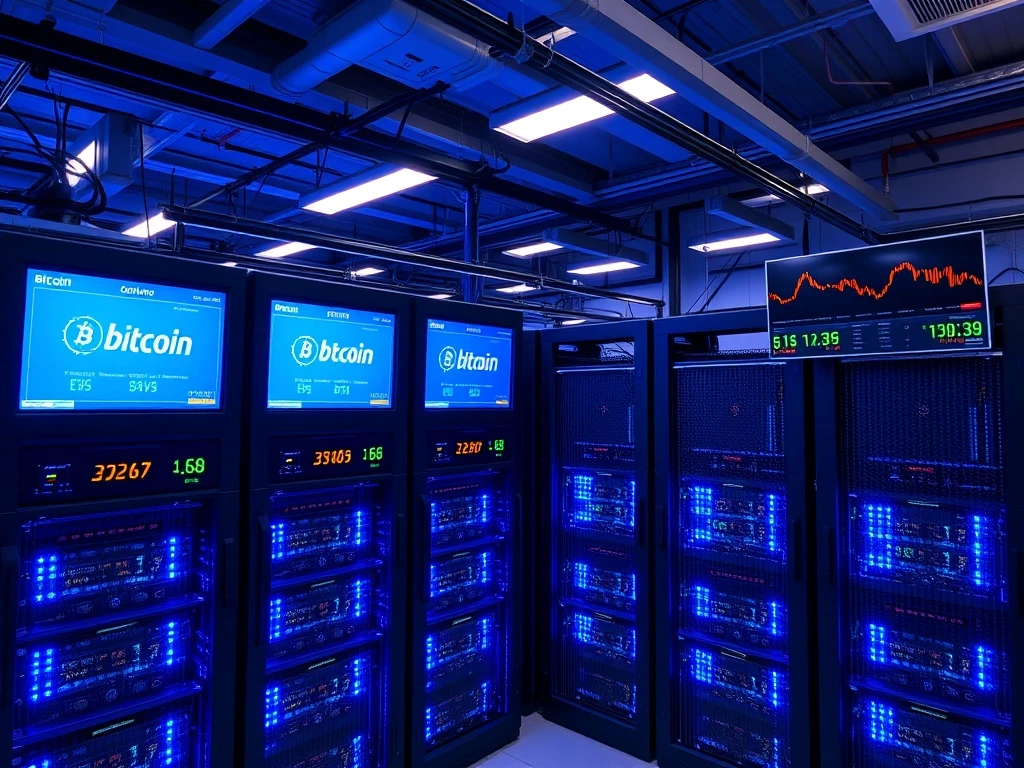
NEW YORK, March 2025 – While Bitcoin’s price exhibits characteristic volatility, publicly traded mining companies demonstrate unexpected stability, creating a fascinating divergence that challenges conventional market wisdom. This resilience emerges despite broader cryptocurrency uncertainty, suggesting structural shifts within the digital asset ecosystem. Mining operations continue expanding their infrastructure while optimizing energy consumption strategies.
Bitcoin Miners Show Market Resilience
Major publicly traded mining firms including Marathon Digital, Riot Platforms, and CleanSpark report consistent operational metrics throughout recent market fluctuations. Their stock performance notably diverges from Bitcoin’s price movements during the same period. This separation indicates evolving investor perspectives regarding mining company fundamentals. Market analysts observe increased institutional interest in mining equities as alternative cryptocurrency exposure.
Several factors contribute to this resilience. First, mining companies implemented sophisticated hedging strategies against Bitcoin price volatility. Second, operational efficiency improvements reduced production costs significantly. Third, geographic diversification minimized regulatory risks. Fourth, vertical integration created additional revenue streams beyond block rewards. These developments transformed mining from pure cryptocurrency speculation to industrial-scale technology operations.
Operational Metrics Defy Price Volatility
n
Recent quarterly reports reveal consistent hash rate growth across major mining operations. Marathon Digital increased its operational capacity by 23% despite Bitcoin’s 18% price decline during the same quarter. Similarly, Riot Platforms achieved record energy efficiency metrics while expanding its Texas facilities. These operational improvements demonstrate mining companies’ focus on long-term fundamentals rather than short-term price movements.
Mining Economics During Price Volatility
Bitcoin mining economics involve complex calculations beyond simple price appreciation. The network difficulty adjustment mechanism automatically responds to changing mining participation. When prices decline, less efficient miners typically exit the network, reducing competition for remaining operators. This natural adjustment benefits publicly traded miners with superior operational scale and capital reserves.
Key economic factors include:
- Hash price efficiency: Revenue per unit of computational power
- Energy cost management: Fixed-price contracts and renewable integration
- Equipment lifecycle optimization: Extended hardware utilization through cooling innovations
- Regulatory compliance advantages: Public companies navigate regulations more effectively
| Company | Hash Rate Growth | Bitcoin Mined | Stock Performance | Energy Cost/kWh |
|---|---|---|---|---|
| Marathon Digital | +23% | 2,195 BTC | +8% | $0.042 |
| Riot Platforms | +18% | 1,875 BTC | +6% | $0.038 |
| CleanSpark | +31% | 1,642 BTC | +12% | $0.035 |
| Bitfarms | +15% | 1,420 BTC | +4% | $0.045 |
Institutional Perspective on Mining Stocks
Financial institutions increasingly view mining equities as infrastructure investments rather than cryptocurrency proxies. This perspective shift explains the decoupling from Bitcoin’s price movements. Analysts at Goldman Sachs note mining companies’ improved balance sheets and predictable cash flows. Meanwhile, JPMorgan highlights mining operations’ strategic positioning within the broader energy transition narrative.
Several institutional advantages emerge from this framework. First, mining stocks offer regulated exposure to cryptocurrency themes. Second, they provide traditional financial metrics absent from direct cryptocurrency investments. Third, mining operations demonstrate tangible asset backing through physical infrastructure. Fourth, public reporting requirements increase transparency compared to private mining operations.
Regulatory Developments Supporting Public Miners
Recent regulatory clarity benefits publicly traded mining operations disproportionately. The SEC’s updated guidance distinguishes between mining operations and cryptocurrency securities. This distinction allows mining companies to operate within established corporate frameworks. Additionally, energy regulations increasingly recognize mining’s grid stabilization potential during renewable energy intermittency.
State-level initiatives further support mining development. Texas offers attractive energy credits for flexible load operations. Wyoming provides corporate structures specifically designed for blockchain businesses. Georgia implements tax incentives for data center investments. These regulatory tailwinds enhance publicly traded miners’ competitive positioning against private operations.
Technological Innovations Driving Efficiency
Public mining companies lead technological adoption within the industry. Immersion cooling systems improve energy efficiency by 30-40% compared to traditional air cooling. Advanced ASIC designs specifically optimize for post-halving economics. Artificial intelligence applications dynamically allocate computational resources between mining and other high-performance computing tasks.
These innovations create multiple competitive advantages. First, they extend hardware lifespan despite increasing network difficulty. Second, they enable participation in emerging computational markets beyond cryptocurrency mining. Third, they improve environmental metrics crucial for ESG-focused investors. Fourth, they create intellectual property assets with standalone value.
Recent patent filings reveal mining companies’ technological ambitions. Marathon Digital filed patents for waste heat recovery systems. Riot Platforms developed proprietary software for real-time energy market arbitrage. CleanSpark patented modular data center designs optimized for renewable integration. These developments position mining as a technology sector rather than commodity production.
Energy Market Integration Strategies
Public mining operations increasingly function as flexible energy assets. Their interruptible load characteristics provide grid stability services. During peak demand periods, miners voluntarily reduce consumption, receiving compensation from grid operators. This capability transforms energy cost from pure expense to potential revenue stream.
Strategic energy partnerships demonstrate this evolution. Several mining companies collaborate with renewable developers to monetize curtailed energy. Others participate in demand response programs with traditional utilities. These arrangements create predictable revenue streams independent of Bitcoin prices. Consequently, mining profitability depends less on cryptocurrency appreciation than previously assumed.
Geographic Diversification Reducing Risk
Leading mining companies expanded operations across multiple jurisdictions. This geographic diversification mitigates regulatory and energy risks. North American operations dominate, but strategic presence continues growing in Scandinavia, Central Asia, and South America. Each region offers distinct advantages including renewable energy access, favorable climate conditions, or regulatory frameworks.
Diversification provides operational resilience during localized disruptions. When Texas experienced grid instability during winter storms, miners with operations in multiple regions maintained production. Similarly, regulatory changes in one jurisdiction minimally impact globally diversified operations. This risk management approach appeals particularly to institutional investors accustomed to multinational corporations.
Future Outlook for Mining Equities
Industry analysts project continued divergence between mining stocks and cryptocurrency prices. The upcoming Bitcoin halving event will test mining efficiency further. Companies with superior operational metrics will likely consolidate market share. Meanwhile, institutional adoption may accelerate as traditional finance recognizes mining’s infrastructure characteristics.
Several trends will shape mining’s evolution. First, increasing computational demands may expand beyond proof-of-work validation. Second, energy market integration will deepen through advanced grid services. Third, regulatory frameworks will mature, reducing uncertainty. Fourth, technological innovations will continue improving efficiency metrics. These developments suggest mining’s transformation from niche activity to established industrial sector.
Conclusion
Publicly traded Bitcoin miners demonstrate remarkable resilience despite cryptocurrency price volatility. Their performance divergence reflects fundamental transformation within the mining sector. Operational efficiency, technological innovation, and strategic positioning create sustainable business models less dependent on Bitcoin appreciation. This evolution attracts institutional investment while stabilizing previously volatile industry segments. As mining matures into infrastructure technology, its relationship with underlying cryptocurrency prices will likely continue evolving in unexpected directions.
FAQs
Q1: Why are mining stocks performing differently than Bitcoin recently?
Mining companies improved operational efficiency and developed additional revenue streams beyond block rewards. Their business models now depend less on Bitcoin price appreciation than previously.
Q2: How do mining companies hedge against Bitcoin price volatility?
They use futures contracts, options strategies, and treasury management policies. Some companies also maintain significant cash reserves and diversify into other computational services.
Q3: What advantages do publicly traded miners have over private operations?
Public companies access capital markets more easily, benefit from regulatory clarity, achieve operational transparency, and often secure better energy contracts through scale advantages.
Q4: How does the Bitcoin halving affect mining companies differently now?
Efficient miners prepared through equipment upgrades and energy optimization. The halving may actually benefit them by eliminating less efficient competitors from the network.
Q5: Can mining profitability continue if Bitcoin prices decline further?
Yes, for the most efficient operations. Network difficulty adjusts downward when miners exit, increasing rewards for remaining participants. Companies with lowest production costs maintain profitability across various price scenarios.
Related News
- Bitcoin ETF Outflow Shock: U.S. Spot Funds See $269.9 Million Net Exodus
- Crypto Futures Liquidations Reveal Staggering $576 Million Market Shakeout as Long Positions Dominate Losses
- Bitcoin Whale’s Stunning $118M Loss: Analyzing the Massive 5,076 BTC Sell-Off