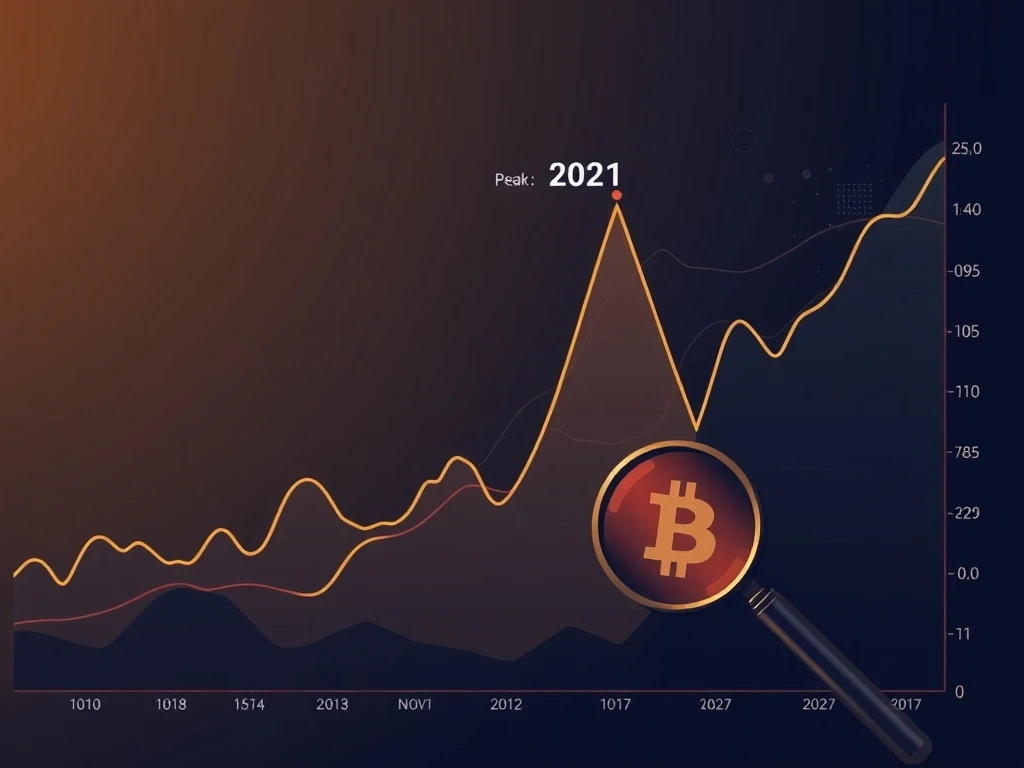
The cryptocurrency world constantly seeks patterns and insights into market movements. Four years ago yesterday, on November 10, 2021, Bitcoin reached a significant milestone. This date marked the previous BTC cycle high, a pivotal moment in the asset’s history. Understanding this peak provides crucial context for future market predictions. Therefore, analysts meticulously study such historical data.
Understanding the BTC Cycle High of 2021
Julio Moreno, Head of Research at CryptoQuant, recently highlighted this significant anniversary on X. He noted that November 10, 2021, recorded the previous BTC cycle high. This observation underscores the cyclical nature of Bitcoin’s price action. Moreover, it reminds investors about the importance of historical context. CryptoQuant, a leading on-chain analytics firm, provides invaluable data for market participants.
A ‘cycle high’ represents the highest price point an asset reaches within a defined market cycle. For Bitcoin, these cycles often correlate with its halving events. These halvings reduce the supply of new Bitcoin, frequently preceding bull runs. The 2021 peak was a culmination of several factors. It reflected widespread institutional adoption and growing retail interest. Indeed, many new investors entered the market during that period.
Decoding Bitcoin Peak Dynamics
Examining past market tops helps investors anticipate future movements. The 2021 Bitcoin peak was not an isolated event. Historically, Bitcoin has experienced several distinct bull and bear cycles. Each cycle presents unique characteristics, yet common patterns emerge. For example, previous peaks occurred in 2013 and 2017. The 2021 peak, however, reached unprecedented levels. This suggested a maturing market. Furthermore, it demonstrated increased global recognition.
Several factors fueled the 2021 ascent to the Bitcoin peak. Firstly, macroeconomic conditions, including low-interest rates, encouraged risk-on assets. Secondly, major companies and payment processors began integrating Bitcoin. Thirdly, the emergence of NFTs and DeFi applications brought new capital into the broader crypto ecosystem. These elements combined to create a powerful upward momentum. Consequently, Bitcoin’s price soared to its all-time high.
The significance of the 2021 peak extends beyond its numerical value. It signaled a shift in perception. Bitcoin moved from a niche digital asset to a recognized store of value. Many traditional financial institutions started offering crypto products. This mainstream acceptance bolstered investor confidence. Thus, the market expanded significantly.
Insights from CryptoQuant Research
CryptoQuant stands as a prominent name in on-chain analytics. Their CryptoQuant research offers deep insights into market behavior. They analyze data directly from the blockchain. This includes transaction volumes, miner activity, and exchange flows. Such data provides a transparent view of market participants’ actions. It often reveals underlying trends before they become evident in price action.
Julio Moreno’s insights stem from this robust analytical framework. CryptoQuant uses various metrics to identify market tops and bottoms. For instance, the MVRV Z-Score helps assess whether Bitcoin is over or undervalued. The Puell Multiple indicates miner profitability, signaling potential market shifts. By monitoring these indicators, CryptoQuant research provides early warnings. Their models help investors make informed decisions. Furthermore, their analysis contributes to a more transparent market understanding. This approach minimizes reliance on speculative news alone.
Key metrics frequently utilized in CryptoQuant research include:
- Exchange Netflow: Tracks Bitcoin moving in and out of exchanges, indicating selling pressure or accumulation.
- Whale Activity: Monitors large transactions by institutional or high-net-worth investors.
- SOPR (Spent Output Profit Ratio): Measures the profit or loss of all coins moved on-chain.
These tools offer a unique perspective. They allow analysts to gauge market sentiment and identify potential turning points. Therefore, CryptoQuant’s contributions are vital for serious crypto investors.
Navigating Crypto Market Cycles
Understanding crypto market cycles is fundamental for any investor. These cycles are generally characterized by distinct phases: accumulation, bull run, distribution, and bear market. Bitcoin’s halvings often act as catalysts for these cycles. Each halving event reduces the block reward for miners by half. This scarcity mechanism typically triggers increased demand over time.
The 2021 BTC cycle high occurred approximately a year and a half after the May 2020 halving. This timing aligns with historical patterns. Previous bull runs also followed similar post-halving trajectories. However, each cycle also introduces new variables. Regulatory changes, technological advancements, and global economic conditions all play a role. Investors must adapt their strategies accordingly. Consequently, continuous learning is essential in this dynamic market.
Many analysts debate whether future crypto market cycles will mimic past ones. Some suggest cycles might lengthen due to market maturity. Others predict diminishing returns for each subsequent peak. Nevertheless, the underlying principles of supply and demand remain constant. Observing historical data provides a valuable framework. It helps investors prepare for volatility. Ultimately, patience and strategic planning are key.
Advanced BTC Price Analysis Techniques
Effective BTC price analysis combines various methodologies. Technical analysis (TA) involves studying price charts and indicators. This helps identify trends, support, and resistance levels. Common TA tools include moving averages, RSI, and MACD. Fundamental analysis (FA), conversely, focuses on intrinsic value. It examines factors like network hash rate, development activity, and adoption rates. Both approaches offer unique perspectives for evaluating Bitcoin’s potential.
Integrating on-chain data with traditional BTC price analysis offers a more comprehensive view. On-chain metrics reveal the true state of the network. They show investor behavior directly. For example, a rising number of long-term holders suggests accumulation and conviction. Conversely, large inflows to exchanges might signal impending sell-offs. Combining these data points creates a robust analytical framework. It enhances predictive capabilities. Therefore, a multi-faceted approach is often most effective.
Key indicators for advanced BTC price analysis often include:
- Realized Cap: Measures the value of all Bitcoin at the price they last moved.
- Reserve Risk: Assesses the confidence of long-term holders relative to the current price.
- Net Unrealized Profit/Loss (NUPL): Indicates the overall market’s profit or loss status.
These advanced tools help identify market sentiment and potential shifts. They offer a deeper understanding beyond simple price movements. Thus, informed decisions become more probable.
Future Implications and Market Outlook
The 2021 BTC cycle high serves as a benchmark for future expectations. As the market looks towards the next halving, comparisons to 2021 are inevitable. Will Bitcoin surpass its previous peak? Many analysts believe it will, citing continued adoption and growing institutional interest. However, market conditions are ever-changing. Geopolitical events, regulatory shifts, and technological advancements all influence the trajectory. Investors must remain vigilant.
The crypto market has matured significantly since 2021. New financial products, such as spot Bitcoin ETFs, have broadened access for traditional investors. This increased liquidity and accessibility could impact future cycles. While past performance does not guarantee future results, historical data offers valuable insights. It helps set realistic expectations. Consequently, informed strategies are paramount for navigating the complex crypto landscape.
The journey from one Bitcoin peak to the next is rarely linear. Volatility remains a defining characteristic of the asset. However, the long-term trend has consistently been upward. Data from sources like CryptoQuant provides a crucial foundation. It helps investors understand underlying dynamics. By leveraging such insights, market participants can better position themselves for potential future gains. The ongoing evolution of Bitcoin continues to captivate global attention.
[Image: Chart showing Bitcoin’s price history, highlighting the BTC cycle high of November 2021, with an overlay of CryptoQuant research insights.]
In conclusion, the anniversary of the 2021 BTC cycle high offers a moment for reflection and forward planning. Julio Moreno’s observation from CryptoQuant reminds us of the importance of historical data. Understanding past Bitcoin peak events, coupled with robust CryptoQuant research and thorough BTC price analysis, is essential. These elements collectively help investors navigate the complex world of crypto market cycles. The future of Bitcoin remains a subject of intense interest and ongoing analysis.
Frequently Asked Questions (FAQs)
What is a BTC cycle high?
A BTC cycle high refers to the highest price Bitcoin reaches within a specific market cycle. These cycles are often influenced by Bitcoin’s halving events, which reduce the supply of new coins. The 2021 peak on November 10, 2021, is a notable example of a previous BTC cycle high.
Who is Julio Moreno, and what is CryptoQuant?
Julio Moreno is the Head of Research at CryptoQuant. CryptoQuant is a prominent on-chain analytics platform that provides data-driven insights into the cryptocurrency markets. They analyze blockchain data to help investors understand market trends, sentiment, and potential turning points, often referenced in BTC price analysis.
Why is the November 10, 2021, Bitcoin peak significant?
The November 10, 2021, Bitcoin peak is significant because it marked the previous all-time high for Bitcoin within that market cycle. It represents a key historical data point for analysts to study market behavior, investor psychology, and the impact of various factors on the asset’s price, crucial for understanding crypto market cycles.
How do analysts use on-chain data for BTC price analysis?
Analysts use on-chain data by examining transactions, wallet movements, and exchange flows directly on the blockchain. This data provides transparency into real-time market activity. Metrics like exchange netflow, whale activity, and SOPR help identify accumulation, distribution, and overall market sentiment, informing comprehensive BTC price analysis.
What are the implications of the 2021 BTC cycle high for future market movements?
The 2021 BTC cycle high provides a benchmark for future price expectations. It helps analysts understand the potential trajectory of upcoming bull runs, especially after halving events. While past performance does not guarantee future results, studying previous peaks offers valuable context for predicting future crypto market cycles and investor behavior.
Are crypto market cycles predictable?
While crypto market cycles exhibit recurring patterns, especially around halving events, they are not entirely predictable. External factors like global economic conditions, regulatory changes, and technological advancements can introduce variability. Analysts use historical data and on-chain metrics to forecast potential trends, but volatility remains a key characteristic of the market.
Related News
- Revolut Secures Crucial Banking License in Peru, Accelerating Its Ambitious Latin America Expansion
- Sell America Trade Surges as Dollar Plummets: Markets Face Unprecedented Turbulence
- Kamino USD1 Integration: Strategic Move Adds Trump-Linked Stablecoin to Solana DeFi