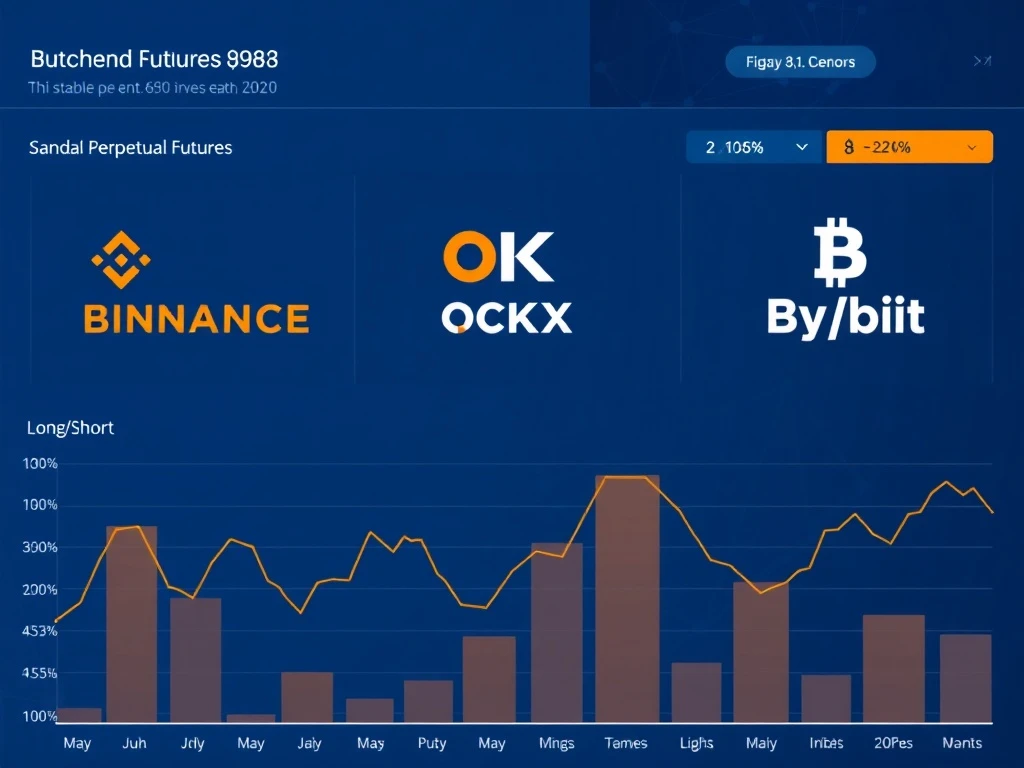
Global cryptocurrency markets observed a subtle yet significant tilt in trader positioning on March 21, 2025, as aggregate data from the world’s three largest derivatives exchanges by open interest showed BTC perpetual futures long positions maintaining a narrow majority. This persistent, albeit slight, bullish lean offers a critical snapshot of institutional and retail sentiment amidst ongoing market consolidation, providing a data-driven pulse on the forces shaping Bitcoin’s price trajectory.
Analyzing the BTC Perpetual Futures Long/Short Landscape
Over the preceding 24-hour period, the collective long/short ratio for Bitcoin perpetual futures contracts settled at 51.04% long versus 48.96% short. Consequently, this marginal bias toward long positions indicates a cautiously optimistic market stance. Perpetual futures, unlike traditional dated contracts, lack an expiry date and use a funding rate mechanism to tether their price to the underlying spot asset. Therefore, their long/short ratios serve as a high-frequency sentiment gauge, often preceding noticeable price movements. Market analysts consistently monitor these metrics because they reflect the immediate, leveraged bets of a vast pool of capital.
Furthermore, the distribution of this sentiment varied slightly across the leading platforms. Binance, the global volume leader, reported a ratio of 51.18% long to 48.82% short. Similarly, OKX showed a nearly identical skew at 51.27% long against 48.73% short. In contrast, Bybit presented the most balanced picture, with longs at 50.17% and shorts at 49.83%. This granular exchange-level data is vital; it helps identify if sentiment is broad-based or concentrated on a single venue, which can influence overall market stability.
The Mechanics and Importance of Long/Short Ratios
Understanding these percentages requires context about derivatives market structure. A long/short ratio above 50% does not simply mean more traders are bullish. Instead, it signifies that the aggregate value of open long positions exceeds that of short positions. This distinction is crucial because a few large institutional longs can outweigh numerous small retail shorts. The ratio is a direct measure of capital commitment, not participant headcount. Traders utilize these contracts for speculation, hedging, or arbitrage, making the ratio a composite signal of diverse strategies.
Historical Context and Market Impact
Historically, extreme readings in long/short ratios often act as contrarian indicators. For instance, a ratio soaring above 70% long can signal excessive bullish leverage, creating a crowded trade vulnerable to a rapid unwinding or “long squeeze.” Conversely, a deeply negative ratio may foreshadow a short squeeze if the price begins to rise. The current reading near equilibrium suggests a balanced, less euphoric market. This environment typically reduces the immediate risk of violent liquidations that occur when highly leveraged positions are forced to close. Data from 2024’s volatility cycles show that sustained periods with ratios between 48% and 52% often correlate with consolidation phases before a decisive trend emerges.
Moreover, the funding rate mechanism integral to perpetual futures provides additional context. When long positions dominate, longs typically pay a periodic funding fee to shorts to maintain the price peg. A positive but modest funding rate accompanying a slight long majority, as seen currently, indicates a healthy, non-speculative bullish bias. If the funding rate becomes excessively high, it becomes costly to hold longs, which can naturally cool overheated sentiment. Current rates across these exchanges remain within a neutral band, supporting the stability narrative.
Exchange-Specific Dynamics and Trader Behavior
Breaking down the data by venue reveals nuanced trader preferences. Binance and OKX, with their nearly identical ratios just above 51% long, cater to a massive global user base encompassing both retail and institutional clients. Their similarity suggests a consensus view among a diverse cohort. Bybit’s razor-thin margin, however, indicates a trader base that is almost perfectly split. This could reflect Bybit’s popularity among sophisticated high-frequency and algorithmic traders who employ more market-neutral strategies. Monitoring these divergences is essential; a sudden convergence or divergence can signal a shift in which trader cohort is gaining influence.
The open interest (OI)—the total value of outstanding contracts—on these exchanges provides the weight for these ratios. High OI during a balanced ratio period, as observed, signifies significant capital waiting on the sidelines for a catalyst. It represents latent energy in the market. A subsequent price move, especially if it breaks a key technical level, can trigger a cascade as this committed capital moves to either add to winning positions or cut losses, thus amplifying the initial price movement.
Integration with Broader Market Indicators
Professional analysts never view long/short ratios in isolation. They are cross-referenced with other on-chain and technical metrics. For example, the current ratio aligns with Bitcoin’s holding pattern near established support levels. Additionally, stablecoin exchange reserves and miner outflow data provide complementary views. When derivatives sentiment is neutral-to-bullish and on-chain data shows accumulation (e.g., coins moving off exchanges), it builds a stronger case for underlying strength. This multi-faceted analysis forms the backbone of modern crypto market evaluation, moving beyond simple price charts to understand the capital flows and psychological positioning driving them.
Conclusion
The latest BTC perpetual futures long/short ratios from Binance, OKX, and Bybit paint a picture of a market in careful equilibrium with a slight bullish inclination. The aggregate 51.04% long ratio reflects measured optimism without the hallmarks of leverage-induced euphoria. This data point, crucial for both short-term traders and long-term investors, underscores a period of consolidation where sentiment is balanced. Ultimately, monitoring these derivatives metrics remains an indispensable practice for gauging market temperature and anticipating potential volatility, as capital positioning on these major exchanges frequently leads spot price discovery in the digital asset ecosystem.
FAQs
Q1: What is a BTC perpetual futures long/short ratio?
The ratio compares the total value of open long (buy) positions to open short (sell) positions for Bitcoin perpetual futures contracts on a given exchange. A ratio above 50% indicates more capital is betting on price increases.
Q2: Why are Binance, OKX, and Bybit specifically highlighted?
These three platforms consistently rank as the top global cryptocurrency exchanges by open interest (total value of outstanding contracts) for BTC derivatives. Their data represents the majority of market activity and sentiment.
Q3: Does a 51% long ratio mean the price will go up?
Not necessarily. While it shows a bullish bias, it is a sentiment indicator, not a direct price predictor. Extreme ratios can be contrarian signals. The current near-neutral ratio suggests a balanced, less predictable market.
Q4: How does the funding rate relate to the long/short ratio?
In perpetual futures, when longs outnumber shorts, long traders typically pay a periodic funding fee to short traders. A slightly positive ratio usually corresponds with a small, positive funding rate, as seen currently, which helps keep the contract price anchored to the spot price.
Q5: How often do these long/short ratios change?
Ratios are highly dynamic and can shift significantly intraday based on price action, news, and liquidations. The 24-hour aggregate provides a smoothed snapshot, but traders monitor real-time data for immediate shifts in positioning.
Related News
- M-Pesa Blockchain Partnership: Revolutionary Alliance with ADI Foundation to Transform Finance for 60 Million African Users
- Binance FRAX Perpetual Futures: Strategic Expansion into Algorithmic Stablecoin Derivatives
- Saudi Arabia Gold Discovery: Monumental 7-Million-Ounce Vein Accelerates Historic Shift From Oil