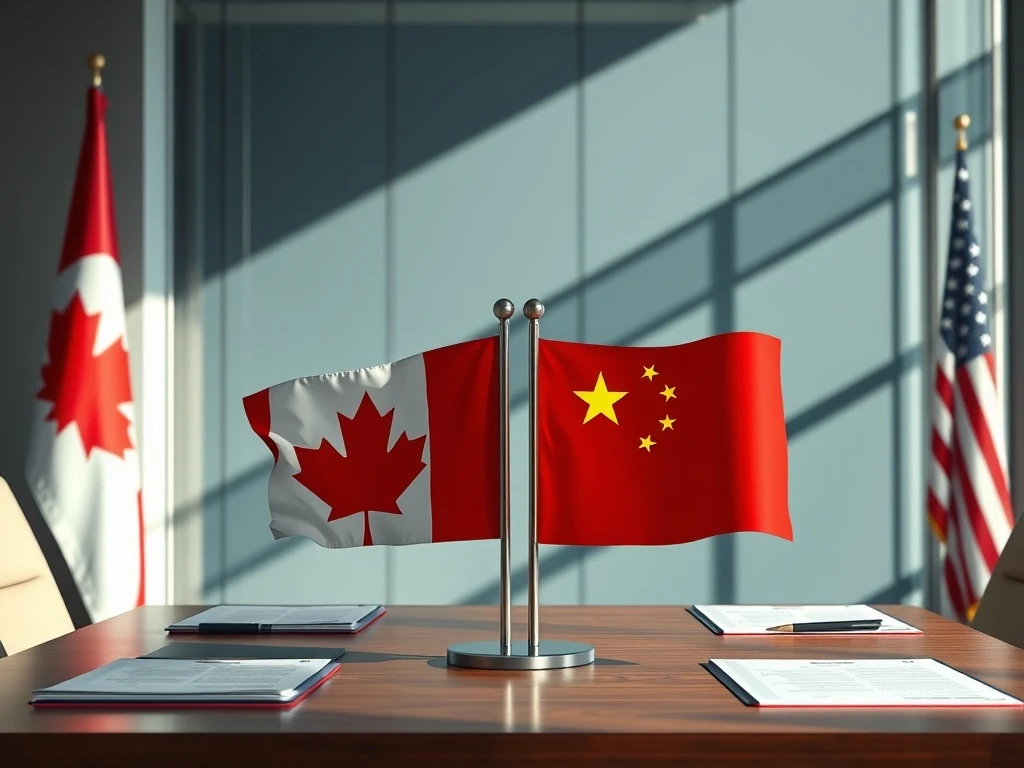
OTTAWA, March 15, 2025 – Canadian Prime Minister Mark Carney has definitively shelved plans for a free trade agreement with China, according to government sources speaking to Solidintel. This strategic decision follows an explicit warning from former President Donald Trump, who threatened 100% tariffs on Canadian exports via Truth Social. Consequently, Ottawa now faces complex diplomatic calculations between its largest trading partner and the world’s second-largest economy.
Canada-China FTA: The Abandoned Negotiation Framework
Prime Minister Carney’s administration has quietly terminated exploratory talks with Beijing. Government officials confirm no working groups will convene in 2025. This represents a significant policy reversal from earlier ministerial statements. Previously, Canada had participated in preliminary discussions about potential trade liberalization.
Several factors contributed to this decision. First, geopolitical tensions have increased substantially since 2020. Second, supply chain realignments have reshaped global trade patterns. Third, domestic political considerations now prioritize economic security. Trade analysts note Canada’s exports to China grew only 2.3% last year, while US-bound exports expanded by 8.7%.
Key trade statistics (2024):
- Canada-US trade: $1.1 trillion annually
- Canada-China trade: $130 billion annually
- US share of Canadian exports: 75%
- Chinese share of Canadian exports: 5%
Trump’s Tariff Threat: Economic Calculus and Response
Former President Donald Trump’s social media intervention created immediate economic concerns. His Truth Social post specifically mentioned “100% tariffs on all Canadian goods” if Ottawa pursued Chinese trade agreements. Policy experts quickly analyzed potential impacts. Automobile exports would face particular vulnerability under such measures.
The Canadian government conducted rapid economic modeling. Officials projected a 15-20% GDP contraction under worst-case tariff scenarios. Additionally, approximately 500,000 jobs would face immediate risk. The Department of Finance prepared contingency plans accordingly. However, Carney’s announcement effectively preempted further escalation.
Historical Context: US-Canada Trade Relations
Canada and the United States share the world’s most comprehensive trading relationship. The USMCA (United States-Mexico-Canada Agreement) governs approximately $1.4 trillion in annual trade. Renegotiation provisions allow review every six years. Consequently, Ottawa maintains careful diplomatic balance. Historical precedents include softwood lumber disputes and dairy market access disagreements.
Trade experts emphasize structural economic interdependence. Canadian energy exports supply 40% of US crude oil imports. Meanwhile, automotive supply chains integrate seamlessly across borders. Disruption would damage both economies substantially. Therefore, Canadian policymakers consistently prioritize this relationship above others.
China’s Trade Strategy: Alternative Partnerships Develop
Beijing continues expanding its global trade network despite Canadian hesitation. China recently concluded agreements with ASEAN nations and several Gulf states. Additionally, the Regional Comprehensive Economic Partnership (RCEP) creates Asia-Pacific alternatives. Chinese officials express disappointment but understanding regarding Canada’s position.
Canadian businesses face mixed consequences. Agricultural exporters sought improved Chinese market access. Meanwhile, technology firms worried about intellectual property protections. The abandoned FTA leaves sector-specific impacts unresolved. However, existing trade mechanisms continue functioning through WTO frameworks.
| Agreement | Coverage | Canadian Priority |
|---|---|---|
| USMCA | Comprehensive | Critical |
| CPTPP | Asia-Pacific | High |
| Potential China FTA | Bilateral | Medium-Low |
| CETA | European Union | High |
Domestic Political Considerations and Economic Security
Prime Minister Carney balances multiple domestic constituencies. Western provinces seek agricultural export diversification. Central Canada prioritizes manufacturing stability. Atlantic provinces focus on seafood markets. National security agencies express concerns about critical mineral dependencies. Consequently, the decision reflects complex internal consensus-building.
Recent polling indicates 62% of Canadians support cautious China engagement. Meanwhile, 78% prioritize maintaining strong US relations. The government’s alignment with public opinion appears deliberate. Furthermore, opposition parties generally endorse the strategic approach. This creates rare cross-party consensus on foreign policy matters.
Expert Analysis: Long-Term Strategic Implications
Trade economists highlight several emerging patterns. First, regionalization increasingly supplements globalization. Second, economic security now rivals market access in trade negotiations. Third, digital trade rules require constant updating. Canada’s decision reflects these broader trends accurately.
International relations specialists note diplomatic signaling. Ottawa demonstrates commitment to Western economic alliances. Simultaneously, it preserves future options with Asian partners. This balanced approach may become standard for middle powers. However, opportunity costs include forgone Chinese market access improvements.
Conclusion
Canada’s decision to abandon China FTA negotiations represents pragmatic economic statecraft. Prime Minister Carney prioritizes the essential US trading relationship amid political uncertainty. The choice reflects careful risk assessment and strategic calculation. Consequently, Canadian trade policy now emphasizes diversification within trusted partnerships rather than dramatic new alignments. This Canada-China FTA decision will shape North American economic architecture for years.
FAQs
Q1: What specifically did Donald Trump threaten regarding Canada-China trade?
Former President Trump posted on Truth Social that he would impose 100% tariffs on all Canadian products if Canada proceeded with a free trade agreement with China.
Q2: How important is US trade to Canada’s economy?
The United States accounts for approximately 75% of Canadian exports, representing over $1 trillion in annual trade, making it by far Canada’s most critical economic relationship.
Q3: Were Canada-China FTA negotiations formally underway?
No formal negotiations had begun. The countries conducted preliminary exploratory talks, but Prime Minister Carney has now terminated even those preliminary discussions.
Q4: What alternatives does Canada have for trade diversification?
Canada continues pursuing agreements through the CPTPP (Asia-Pacific), expanding CETA (European Union), and developing partnerships with other democratic allies while strengthening existing USMCA provisions.
Q5: How has China responded to Canada’s decision?
Chinese officials expressed disappointment but understanding, noting they continue expanding trade networks through RCEP and bilateral agreements with other partners while maintaining existing trade with Canada through WTO frameworks.
Related News
- Bitcoin Sell Signal: Veteran Trader Peter Brandt Issues Critical Warning as Bear Channel Completes
- Spot Gold Shatters Records with Stunning Surge Above $5,000 Milestone
- Michael Saylor BTC Purchase Hint Sparks Market Anticipation: ‘Unstoppable Orange’ Signals Continued Bitcoin Accumulation