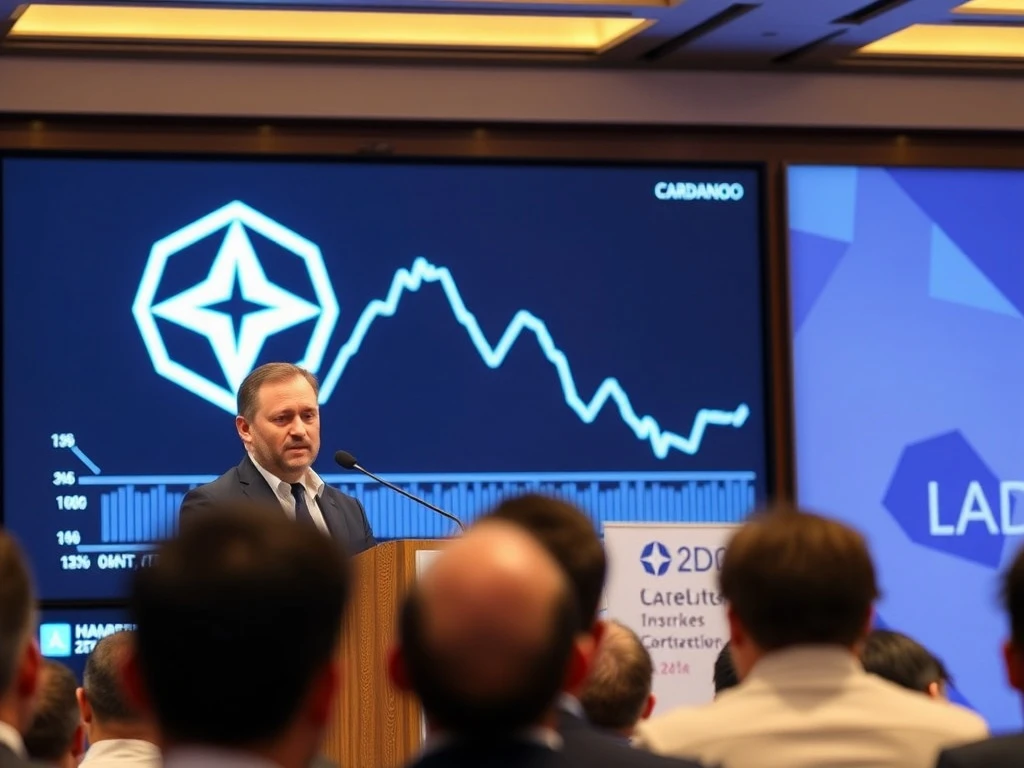
In a striking display of long-term conviction, Cardano founder Charles Hoskinson has publicly declared he will not sell his cryptocurrency holdings, even while facing paper losses exceeding $3 billion. Hoskinson made this defiant statement during a live broadcast event in Tokyo, Japan, on April 10, 2025, directly addressing the severe market downturn that has impacted the entire digital asset sector. This revelation provides a rare, personal glimpse into the mindset of a foundational blockchain figure during periods of extreme financial pressure.
Cardano Founder’s Unwavering Commitment Amid Market Turmoil
Charles Hoskinson’s announcement arrives during a significant correction phase for the broader cryptocurrency market. According to data from The Block, which first reported the remarks, the value of Cardano’s native token, ADA, has declined substantially from its all-time highs. Consequently, Hoskinson’s personal portfolio, heavily weighted in ADA, reflects these steep unrealized losses. During his address, he candidly noted to the audience that he has “likely lost more money than anyone” present, framing the situation not as a catastrophe but as an inherent part of the volatile blockchain innovation journey. Furthermore, industry analysts often compare such founder-led commitment to historical figures in tech who endured similar paper losses before their projects succeeded.
Understanding Unrealized Losses in Cryptocurrency Portfolios
The term “unrealized loss” refers to a decrease in the value of an asset that an investor continues to hold. It represents a paper loss, not an actualized financial event. For long-term investors like Hoskinson, this distinction is crucial. Selling the asset would crystallize the loss, while holding maintains exposure to potential future recovery. This strategy aligns with a core philosophy in venture capital and technology investing, where patience through multiple market cycles is often rewarded. Major investment firms like Grayscale and Fidelity have published research highlighting the historical pattern of steep drawdowns followed by new all-time highs in crypto asset classes, a pattern that informs many long-term holding strategies.
The Psychological and Strategic Landscape for Founders
Hoskinson’s commentary extended beyond mere numbers. He emphasized the importance of enjoying the building process and finding ways to have fun, even if market conditions deteriorate further. This perspective touches on a critical aspect of founder psychology: resilience. Academic studies on entrepreneurial stamina, such as those from the Stanford Graduate School of Business, suggest that a founder’s public commitment can significantly influence community and investor sentiment. By openly accepting paper losses and focusing on development, Hoskinson signals that Cardano’s roadmap and technological milestones remain the primary focus, not short-term price action.
Cardano’s Development Context and Market Position
To fully grasp the significance of Hoskinson’s stance, one must consider Cardano’s position within the blockchain ecosystem. As a proof-of-stake network launched in 2017, Cardano has methodically pursued a research-driven development approach. Its recent technological upgrades, including the implementation of smart contracts through Plutus and scaling solutions like Hydra, aim to increase its utility and adoption. Market data from CoinGecko shows ADA consistently ranks among the top ten cryptocurrencies by market capitalization, indicating substantial ongoing interest and a large, decentralized holder base. The network’s treasury, funded by a portion of transaction fees, also provides a development war chest independent of token price, insulating its engineering progress from market sentiment.
Comparative Founder Stances During Downturns:
- Vitalik Buterin (Ethereum): Historically has focused on ecosystem grants and technical development during bear markets, rarely commenting on personal portfolio status.
- Changpeng Zhao (Binance): Has emphasized exchange resilience and industry recovery funds during periods of low liquidity.
- Hoskinson’s Approach: Distinctly personal, combining acknowledgment of paper losses with public reaffirmation of holding strategy and project fun.
The Broader Impact on the Cardano Community and Ecosystem
Public statements from project founders can have a tangible impact on their communities. Hoskinson’s vow to hold may bolster confidence among long-term ADA supporters, known as the “Cardano community.” This community actively participates in network governance through Project Catalyst and stakes ADA to secure the network. A founder’s demonstrated skin-in-the-game reinforces the principle of alignment. However, financial analysts caution that individual strategies, even from founders, should not substitute for personal risk assessment. Every investor’s financial situation and risk tolerance are unique. Data from on-chain analytics firm IntoTheBlock reveals that a significant percentage of ADA addresses remain in a loss position, mirroring the broader market trend and highlighting the widespread nature of the current drawdown.
Regulatory and Macroeconomic Backdrop in 2025
The current market environment does not exist in a vacuum. Regulatory clarity in major jurisdictions like the United States, the European Union with its MiCA framework, and Japan—where Hoskinson spoke—continues to evolve. Additionally, global macroeconomic factors such as interest rate policies and institutional adoption rates heavily influence cryptocurrency valuations. Hoskinson’s comments implicitly reflect a belief that these headwinds are temporary and that the fundamental value proposition of decentralized proof-of-stake networks will prevail over the long term. This outlook is shared by several asset managers who are gradually increasing their digital asset allocations despite near-term volatility.
Conclusion
Charles Hoskinson’s declaration that he will not sell his Cardano (ADA) holdings despite over $3 billion in unrealized losses is a powerful narrative of conviction in the face of market adversity. It underscores a long-term, builder-centric philosophy that prioritizes technological progress and ecosystem health over short-term portfolio management. While the statement offers a personal insight into a leading founder’s mindset, it also serves as a focal point for discussing investment strategy, founder-community alignment, and the inherent volatility of the cryptocurrency market. As the Cardano network continues its development roadmap, the commitment of its founder provides a steadfast, though not risk-free, signal to the ecosystem he helped create.
FAQs
Q1: What are unrealized losses?
A1: Unrealized losses are decreases in the current market value of an asset that an investor still owns. The loss is “on paper” only and is not locked in until the asset is actually sold for a lower price than its purchase price.
Q2: Why would Charles Hoskinson not sell to avoid further losses?
A2: As a founder with a long-term vision, his strategy likely assumes that the fundamental value of the Cardano network will increase over time, potentially recovering the paper losses. Selling would realize the loss and eliminate future upside from that portion of his holdings.
Q3: How does this impact the average ADA investor?
A3: While a founder’s actions can influence sentiment, they do not guarantee market performance. Every investor should make decisions based on their own financial goals, risk tolerance, and independent research, not solely on the actions of others.
Q4: What is the current state of Cardano’s development?
A4: As of 2025, the Cardano network continues to implement its development roadmap, focusing on scaling solutions, smart contract optimization, and governance enhancements through its on-chain treasury and community voting system.
Q5: How common are such large unrealized losses among crypto founders?
A5: It is relatively common for founders whose wealth is heavily tied to their project’s native token to experience massive paper gains and losses due to extreme market volatility. Most maintain a long-term outlook, but few publicly disclose the specific scale of their paper losses during downturns.
Related News
- USDT Minted: Tether Treasury’s Monumental 1,000 Million Issuance Shakes Crypto Liquidity
- BlackRock Bitcoin Deposit: Monumental $270M Move to Coinbase Prime Signals Institutional Confidence
- Strategy Q4 Loss: Staggering $17.4 Billion Hit Reveals Bitcoin’s Brutal Correction