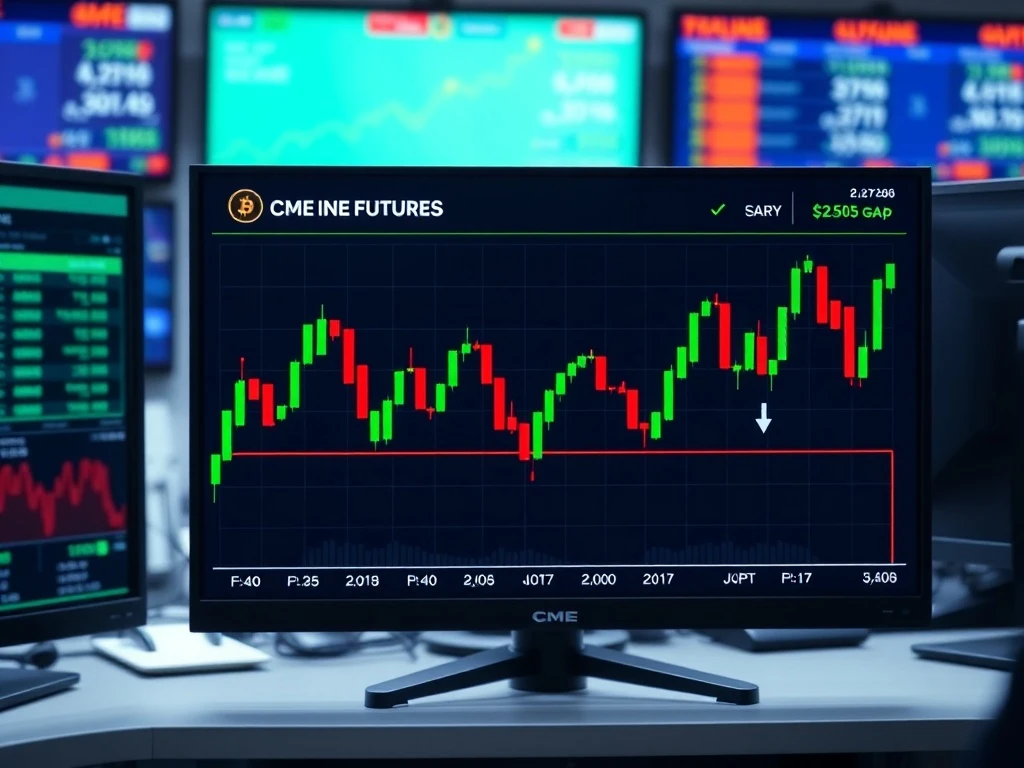
The financial world observed a significant event recently. **CME Bitcoin futures** opened with a notable $1,230 gap. This specific occurrence often captures the attention of traders. It prompts immediate questions about potential market movements. Understanding these gaps is crucial for anyone involved in **cryptocurrency trading**.
Understanding the CME Bitcoin Futures Gap
On a recent Monday, **CME Bitcoin futures** began trading at $115,750. This followed a Friday close of $114,520. The difference created an approximate $1,230 gap. This gap represents a space on the price chart. It forms between the closing price of one trading session and the opening price of the next. Specifically, for CME Bitcoin futures, this gap appears between the Friday close and the Monday open. The CME Group, a major derivatives marketplace, observes traditional weekend closures. Conversely, the Bitcoin spot market operates continuously, 24 hours a day, seven days a week. This fundamental difference in operating hours directly causes these gaps. Weekend price volatility in the spot Bitcoin market largely determines the size of the gap. Greater weekend price swings result in larger gaps. Consequently, many traders closely monitor these formations. They often anticipate a subsequent move in the futures price. This move typically aims to ‘fill’ or ‘close’ the existing gap. This phenomenon is a key aspect of futures market dynamics.
Why CME Gaps Form: The Mechanics Explained
The creation of a **Bitcoin futures gap** is a direct consequence of differing market schedules. The Chicago Mercantile Exchange (CME) facilitates the trading of Bitcoin futures contracts. Like traditional stock exchanges, it operates during standard business hours. It closes for the weekend. However, the underlying asset, Bitcoin, trades globally without interruption. Its spot market never sleeps. Therefore, significant price movements can occur over the weekend. These movements happen when the CME futures market is closed. When the CME reopens on Monday morning, its opening price reflects these weekend shifts. If Bitcoin’s price rises substantially over the weekend, the futures market will open higher. This creates an upward gap. Conversely, a sharp weekend decline leads to a downward gap. The size of this gap directly correlates with the volatility of the spot market during the non-trading hours of the CME. Understanding this core mechanism is fundamental. It helps traders interpret the immediate market sentiment. It also informs their strategies for the upcoming trading week. This distinct feature makes CME Bitcoin futures unique in the crypto derivatives landscape.
Analyzing the Recent $1.2K Bitcoin Futures Gap
The recent $1,230 gap in **CME Bitcoin futures** warrants careful **market analysis**. This particular gap suggests significant upward price action occurred over the weekend. Traders often interpret such gaps in various ways. Some view them as potential areas of support or resistance. Others see them as price inefficiencies that the market will eventually correct. A gap of this magnitude is not uncommon. However, its specific context within the broader market trend matters. Was Bitcoin experiencing a strong bullish run? Did any major news events impact its price over the weekend? These questions help provide context. Moreover, the gap’s position on the chart is important. Is it an exhaustion gap, a runaway gap, or a breakaway gap? Each type carries different implications for future price action. Therefore, a comprehensive analysis considers multiple factors. It goes beyond just the gap’s size. It incorporates overall market sentiment and technical indicators. This layered approach helps traders make more informed decisions.
Historical Trends of CME Gap Closure
Historically, a high percentage of **CME gap** formations tend to ‘fill.’ This means the price eventually revisits the gap area. It often moves to cover the empty space on the chart. This tendency is a well-documented phenomenon in futures markets. It is not unique to Bitcoin. Traders often refer to this as the ‘gap fill’ theory. While not guaranteed, the likelihood of a gap closing is a powerful psychological factor. It influences trading strategies. Data suggests that a significant majority of CME Bitcoin futures gaps do close over time. However, the timeframe for closure can vary greatly. Some gaps close within hours or days. Others might take weeks or even months. Furthermore, not all gaps close completely. Sometimes, the price will only partially fill the gap. Therefore, relying solely on gap closure for trading decisions carries risks. Traders must combine this observation with other technical and fundamental analysis tools. This helps them build a more robust trading plan. Understanding these historical tendencies provides a valuable edge in **cryptocurrency trading**.
Trading Strategies Focused on Bitcoin Futures Gaps
Many **cryptocurrency trading** strategies incorporate the concept of **Bitcoin futures gap** closure. One common approach is the ‘mean reversion’ strategy. This strategy assumes that prices tend to return to their average. In the context of gaps, it suggests the price will revert to fill the open gap. Traders might enter positions anticipating this movement. For an upward gap, some traders might open short positions. They expect the price to fall and fill the gap. Conversely, for a downward gap, long positions might be opened. These traders expect the price to rise and cover the gap. However, these strategies are not without risk. Gaps can sometimes act as strong support or resistance levels. This means the price might bounce off them without filling. Furthermore, strong market momentum can push prices further away from the gap. This delays or even prevents closure. Therefore, traders often use stop-loss orders. These limit potential losses if the market moves against their prediction. They also employ profit targets. These secure gains once the gap is filled or partially filled. Effective risk management remains paramount when trading based on gap theories.
The Psychological Impact of CME Gaps on Traders
The appearance of a **CME gap** significantly influences trader psychology. It creates a focal point for market participants. Many traders become fixated on the gap’s potential closure. This collective focus can sometimes become a self-fulfilling prophecy. As more traders anticipate a gap fill, their actions contribute to that outcome. The psychological aspect also involves fear of missing out (FOMO) or fear of being on the wrong side of a move. When a large gap forms, it often signals strong directional momentum. Traders must decide quickly whether to follow that momentum or bet against it. This decision-making process is fraught with emotional considerations. Moreover, the existence of a visible gap provides a clear target. This target can simplify trading decisions for some. However, it can also lead to overconfidence or tunnel vision. Experienced traders understand these psychological dynamics. They strive to remain objective. They integrate gap analysis with broader **market analysis**. This helps them avoid emotional pitfalls. This balanced approach is vital for consistent success.
Broader Market Implications of CME Bitcoin Futures Gaps
The existence and behavior of **CME Bitcoin futures** gaps extend beyond individual trading strategies. They offer insights into the broader health and maturity of the Bitcoin market. As institutional interest in Bitcoin grows, CME futures become increasingly relevant. These futures provide regulated exposure to Bitcoin. They attract traditional financial players. Consequently, the dynamics of CME futures, including gap formations, reflect institutional sentiment. A consistently high rate of gap closure might suggest a more mature and efficient market. Conversely, persistent, unfilled gaps could indicate strong, sustained directional biases. These biases might be driven by significant institutional flows. Furthermore, these gaps can sometimes act as leading indicators. They may signal shifts in momentum for the underlying spot Bitcoin market. Therefore, monitoring CME gaps contributes to a more holistic **market analysis**. It helps traders understand the interplay between traditional finance and the evolving digital asset space. This interconnectedness is a defining feature of modern **cryptocurrency trading**.
Advanced Market Analysis: Combining Gaps with Other Indicators
Effective **market analysis** of **Bitcoin futures gap** formations rarely relies on gaps alone. Traders often combine gap observations with other technical indicators. This creates a more robust and reliable trading strategy. For example, a trader might look for a gap to form. Then, they would wait for confirmation from other signals. These signals could include volume spikes. They might also look at moving average crossovers. Relative Strength Index (RSI) divergences are another common confirmation tool. If a gap forms, and the RSI shows an overbought or oversold condition, it strengthens the case for a potential gap fill. Furthermore, considering the overall market trend is essential. Is the market in a strong uptrend or downtrend? Gaps that form against the prevailing trend might be more likely to close. Gaps that form in the direction of a strong trend might take longer or act as continuation signals. Therefore, a multi-faceted approach provides greater confidence. It reduces the reliance on a single, isolated market phenomenon. This comprehensive strategy is crucial for navigating complex markets effectively.
Navigating Volatility and Risk in Cryptocurrency Trading
The inherent volatility of **cryptocurrency trading** makes risk management paramount. This is especially true when considering strategies around **CME gap** formations. While the historical tendency for gaps to fill is compelling, it is never a guarantee. Unexpected news events, regulatory changes, or macroeconomic shifts can dramatically alter market dynamics. These factors can cause gaps to remain open for extended periods. They might even lead to further price divergence. Therefore, traders must implement strict risk management protocols. These include setting appropriate stop-loss levels. They also involve position sizing. Never risk more capital than you can afford to lose on any single trade. Diversifying portfolios also helps mitigate risk. Avoid placing all capital on a single gap-fill prediction. Furthermore, continuous learning and adaptation are essential. Market conditions evolve rapidly in the crypto space. What works today might not work tomorrow. Staying informed about market news and technical developments is crucial. This proactive approach helps traders navigate the inherent risks. It allows them to capitalize on opportunities presented by CME Bitcoin futures gaps responsibly.
In conclusion, the $1,230 gap in **CME Bitcoin futures** serves as a potent reminder of market dynamics. It highlights the interplay between traditional finance and the 24/7 crypto world. While these gaps present interesting trading opportunities, they demand careful **market analysis** and disciplined risk management. Traders must integrate gap theory with broader strategies. This ensures they make informed decisions. The continued evolution of **cryptocurrency trading** ensures that phenomena like CME gaps will remain a significant point of discussion and analysis.
Frequently Asked Questions (FAQs)
What is a CME Bitcoin futures gap?
A CME Bitcoin futures gap occurs when the opening price of CME Bitcoin futures on Monday differs significantly from its closing price on the preceding Friday. This happens because the CME market closes for weekends, while the spot Bitcoin market trades 24/7, allowing price movements to occur when futures trading is paused.
Why do CME Bitcoin futures gaps tend to close?
The tendency for CME Bitcoin futures gaps to close is a widely observed phenomenon. Traders often view these gaps as market inefficiencies or price vacuums that the market eventually seeks to fill. This behavior is often attributed to mean reversion principles and collective trader psychology, where many traders anticipate and act on the expectation of a gap fill.
How do traders use CME Bitcoin futures gaps in their strategies?
Traders often use CME Bitcoin futures gaps as potential entry or exit points. For an upward gap, some might open short positions, expecting the price to fall and fill the gap. For a downward gap, long positions might be opened. These strategies are typically combined with other technical indicators and strict risk management to enhance their effectiveness.
Are CME Bitcoin futures gaps guaranteed to close?
No, CME Bitcoin futures gaps are not guaranteed to close. While historical data suggests a high probability of closure over time, some gaps may remain open for extended periods, or only partially fill. Strong market trends or unforeseen events can override the tendency for gap closure, emphasizing the need for robust risk management.
What does a large CME Bitcoin futures gap indicate?
A large CME Bitcoin futures gap typically indicates significant price volatility in the spot Bitcoin market over the weekend. A large upward gap suggests strong bullish momentum, while a large downward gap points to strong bearish pressure during the CME’s non-trading hours. It reflects a substantial shift in market sentiment or price action that occurred when the futures market was closed.
How does institutional involvement affect CME Bitcoin futures gaps?
Increased institutional involvement in CME Bitcoin futures can amplify the significance of these gaps. Institutions often trade large volumes, and their collective actions can contribute to larger weekend price movements in the spot market, leading to more pronounced gaps. Their strategies around these gaps can also influence the speed and likelihood of gap closure, as they often have substantial capital to act on their market views.