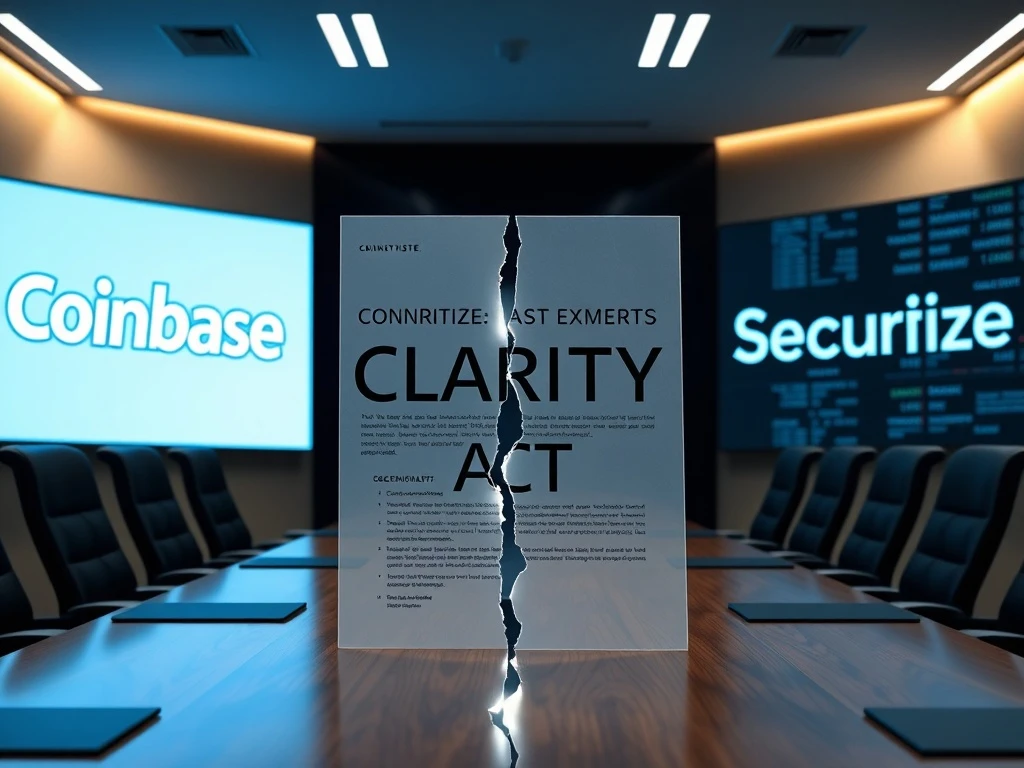
In a significant development for U.S. cryptocurrency regulation, Coinbase’s recent withdrawal of support for the pivotal CLARITY Act has ignited a fierce debate about competitive dynamics within the digital asset industry. Market research firm Citron Research has levied a serious allegation, contending that the exchange’s stance is a strategic maneuver designed to stifle the growth of security token platform Securitize. This controversy, emerging in early 2025, underscores the complex interplay between regulatory advocacy and market competition as the industry seeks legislative clarity.
Coinbase CLARITY Act Reversal and Citron’s Core Allegation
The Clarity for Lending Arrangements and Regulatory Oversight of Integrated Tokens (CLARITY) Act represents a congressional effort to create a comprehensive federal framework for digital asset markets. Initially, Coinbase voiced support for the bill’s goals. However, the company’s subsequent opposition has drawn intense scrutiny. Citron Research, a firm known for its equity analysis, directly linked this reversal to competitive concerns.
Specifically, Citron pointed to a recent CNBC interview where Coinbase CEO Brian Armstrong expressed reservations about regulations concerning tokenized traditional assets like stocks. Simultaneously, Armstrong emphasized the importance of protecting revenue streams from services like stablecoins. Citron’s analysis frames these positions as contradictory. The firm argues Coinbase desires regulatory certainty but opposes a bill that might create a more level playing field for competitors specializing in tokenized securities.
- Regulatory Shield vs. Competitive Weapon: Citron suggests the opposition acts as a shield for Coinbase’s core business models against new regulatory paradigms that could benefit rivals.
- Securitize’s Strategic Position: As a registered broker-dealer and transfer agent with the SEC, Securitize is uniquely positioned to thrive under clear rules for security tokens, a niche distinct from Coinbase’s retail-centric exchange model.
- The Stakes of Market Structure: The CLARITY Act would define which digital assets are securities versus commodities, a classification with monumental implications for which companies dominate which market segments.
Decoding the Regulatory Battlefield and Market Impacts
This dispute transcends a simple corporate rivalry. It sits at the heart of a decade-long struggle for regulatory definition in the United States. The Securities and Exchange Commission (SEC) has historically applied a broad interpretation of securities laws to many digital assets, leading to ongoing litigation and market uncertainty. The CLARITY Act seeks to resolve this by providing statutory clarity, but its specific provisions inevitably create winners and losers.
For context, the journey toward this bill includes several key milestones. The Securities Act of 1933 and the Howey Test have long been the basis for SEC enforcement. More recently, proposed bills like the Digital Commodities Consumer Protection Act (DCCPA) and the Responsible Financial Innovation Act have attempted, but failed, to create a dual regulatory regime. The CLARITY Act is the latest and most prominent effort in this legislative saga.
| Entity | Primary Business Focus | Stated Position on CLARITY Act | Potential Impact from Bill |
|---|---|---|---|
| Coinbase | Retail crypto exchange, stablecoin services | Opposed (after initial support) | Could face new rules for certain listed assets; stablecoin model protected. |
| Securitize | Security token issuance and trading | Supportive (inferred from business alignment) | Would benefit from clear security token rules and legitimized market structure. |
| Citron Research | Equity and market analysis | Critical of Coinbase’s motives | Analytical viewpoint shaping public and investor perception. |
Consequently, the market impact of this controversy is tangible. Regulatory uncertainty has long been cited as a barrier to institutional adoption. A clear, fair framework could unlock significant capital. Conversely, a framework perceived as tilting the field could consolidate market power and limit innovation. Investors and projects are closely watching this debate, as its outcome will dictate capital allocation and business strategy for years.
Expert Analysis on Motive and Market Fairness
Financial legal experts often note that corporate lobbying on regulation frequently involves a balance between seeking general clarity and protecting specific commercial interests. This is not unique to crypto. However, the nascent state of digital asset law amplifies the consequences of each legislative detail. An expert in securities law might argue that any comprehensive bill will inevitably be gamed by incumbents to fortify their moats.
Furthermore, the timing is critical. The security token market, while smaller than the general crypto market, is poised for growth with the advent of tokenized real-world assets (RWAs). A platform like Securitize, built for compliance, could capture this wave more efficiently if the rules are well-defined. Coinbase’s move could therefore be interpreted as an attempt to control the pace and terms of this evolution, ensuring its own platform can adapt on its own timeline. This perspective aligns with classic competitive strategy but raises questions about the industry’s collective advancement toward mainstream legitimacy.
Conclusion
The allegation by Citron Research that Coinbase opposes the CLARITY Act to stifle competitor Securitize highlights a pivotal moment in cryptocurrency’s maturation. This episode demonstrates how the quest for regulatory clarity is deeply entangled with competitive strategy. The outcome of this debate will not only shape the fortunes of individual companies like Coinbase and Securitize but will also define the very structure of the digital asset market in the United States. As the legislative process continues, the industry must navigate the fine line between advocating for sensible rules and engaging in competition that could ultimately hinder the broad, innovative potential of blockchain technology.
FAQs
Q1: What is the CLARITY Act?
The Clarity for Lending Arrangements and Regulatory Oversight of Integrated Tokens (CLARITY) Act is a proposed U.S. bill aimed at creating a federal regulatory framework to classify digital assets and establish rules for crypto markets, exchanges, and service providers.
Q2: Why does Citron Research allege Coinbase is opposing the bill?
Citron alleges Coinbase’s opposition is strategically motivated to prevent regulatory clarity that would specifically benefit security token platforms like Securitize, thereby stifling a potential competitor in a growing market segment.
Q3: What is Securitize and how is it different from Coinbase?
Securitize is a platform focused primarily on the issuance, management, and trading of digital security tokens, which are blockchain representations of regulated financial assets. Coinbase is primarily a retail-focused exchange for a broader range of digital assets, many of which it argues are commodities.
Q4: How does this controversy affect the average crypto investor?
The controversy prolongs regulatory uncertainty, which can impact market stability, the types of products available, and the long-term legitimacy of the industry. Clear rules generally reduce risk for all participants.
Q5: Has Coinbase publicly responded to Citron’s allegations?
As of this reporting, Coinbase has not issued a formal, direct response to Citron Research’s specific allegation about stifling Securitize. The company’s public statements focus on concerns that the bill in its current form may not provide the optimal regulatory framework for innovation.
Q6: What are tokenized stocks or securities?
Tokenized securities are digital tokens on a blockchain that represent ownership in a traditional financial asset, such as a share of stock, a bond, or a fund. They aim to make buying, selling, and settling these assets more efficient.
Related News
- Bitcoin Investment Milestone: Digital Wealth Partners’ $250M Strategic Move with Two Prime
- KBC Crypto Trading Revolution: Belgian Bank’s Bold Move to Offer BTC and ETH Services Under MiCA
- Sela Network’s Revolutionary Solution to X API Restrictions: Eliminating Platform Dependency Risks